Christmas decorating inspiration in 2026 runs from $15 stockings to $1,100 faux trees, and the right choice depends on whether you are starting from a packed ornament box or from nothing. The Balsam Hill Norwegian Grand Fir costs that premium because its branch tips are cast from actual Norwegian Grand Fir branches and hinged to hold heavy glass ornaments without sagging.
1. Color Palette Ideas
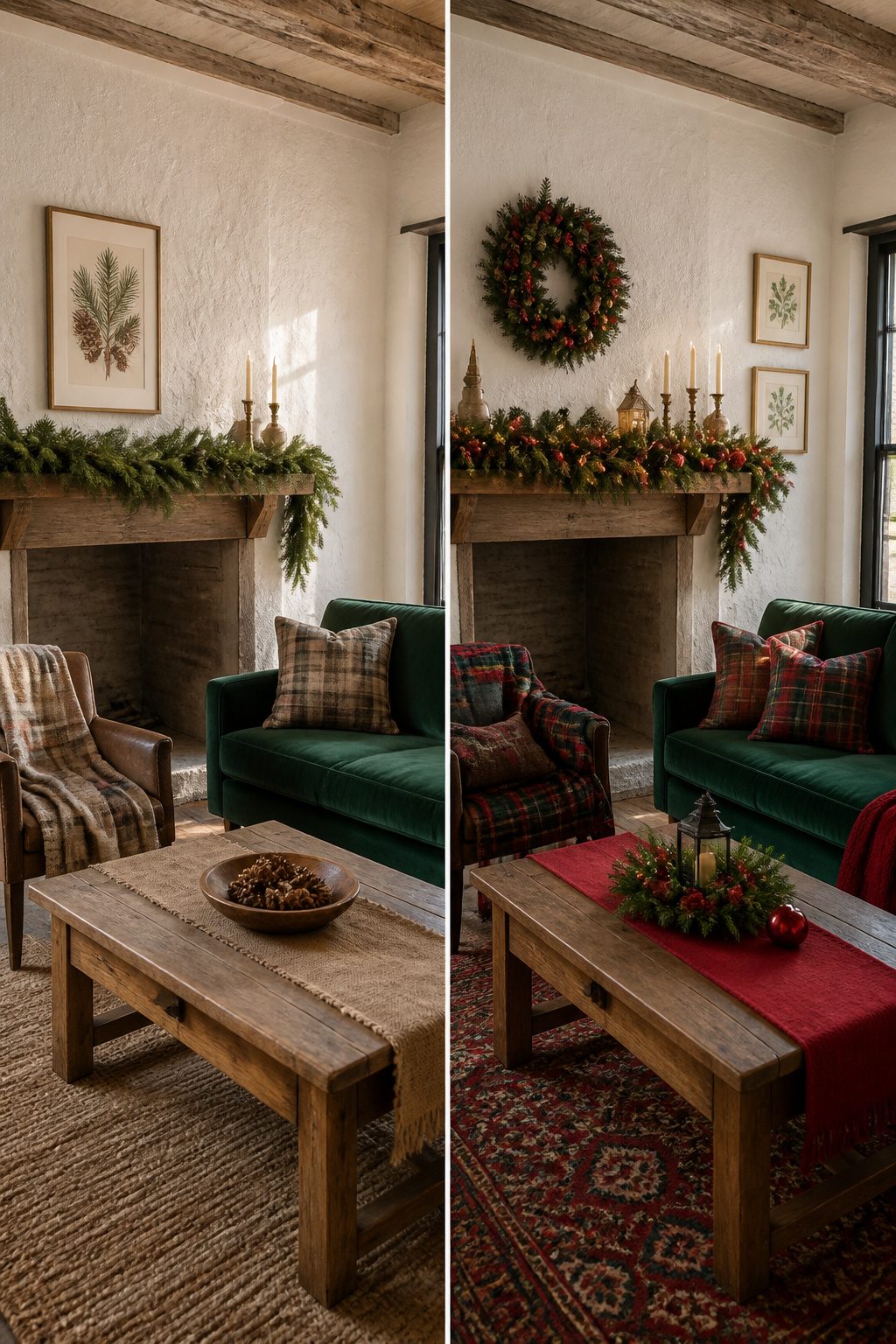
A unified palette is what separates holiday decorating from holiday clutter. Three years back I spread red and green across every room without thinking it through, and the result felt like walking through a discount store in December. Now I pick two or three colors and thread them everywhere, the tree to the mantel to the wrapping paper stacked by the door.
Red and green still earns its place, especially with the vintage comeback happening now. Tartan and plaid patterns, gold accents, and raw wooden tones are showing up everywhere this season, giving that classic pairing a worn-in, inherited feel rather than the plastic brightness I used to default to. If your home already leans traditional, this is the easiest path to cohesion.
Jewel tones run the other direction entirely. Deep plum, emerald, sapphire, those colors carry enough weight to feel festive without reading Christmas-by-the-numbers. Paint color Tyrian Plum works with metallics and candlelight in a way that red simply does not, and the ochre-and-cream checks I have seen lately function almost as neutrals within that scheme.
For smaller spaces or renters who cannot repaint, neutral palettes do the heavy lifting. Cream, ivory, and natural greenery let you go maximal on texture, garlands, wreaths, swags, without the visual noise of competing colors. The restraint becomes the statement.
"If there is only one tip I can share that helps turn Christmas chaos into holiday magic, it’s this: pick a color palette and stick to it."
That advice scales to any budget. Start with what you own, spot the common threads, whether gold rims on your everyday dishes or the raspberry pink already in your sofa, and build outward.
2. Types of Christmas Trees
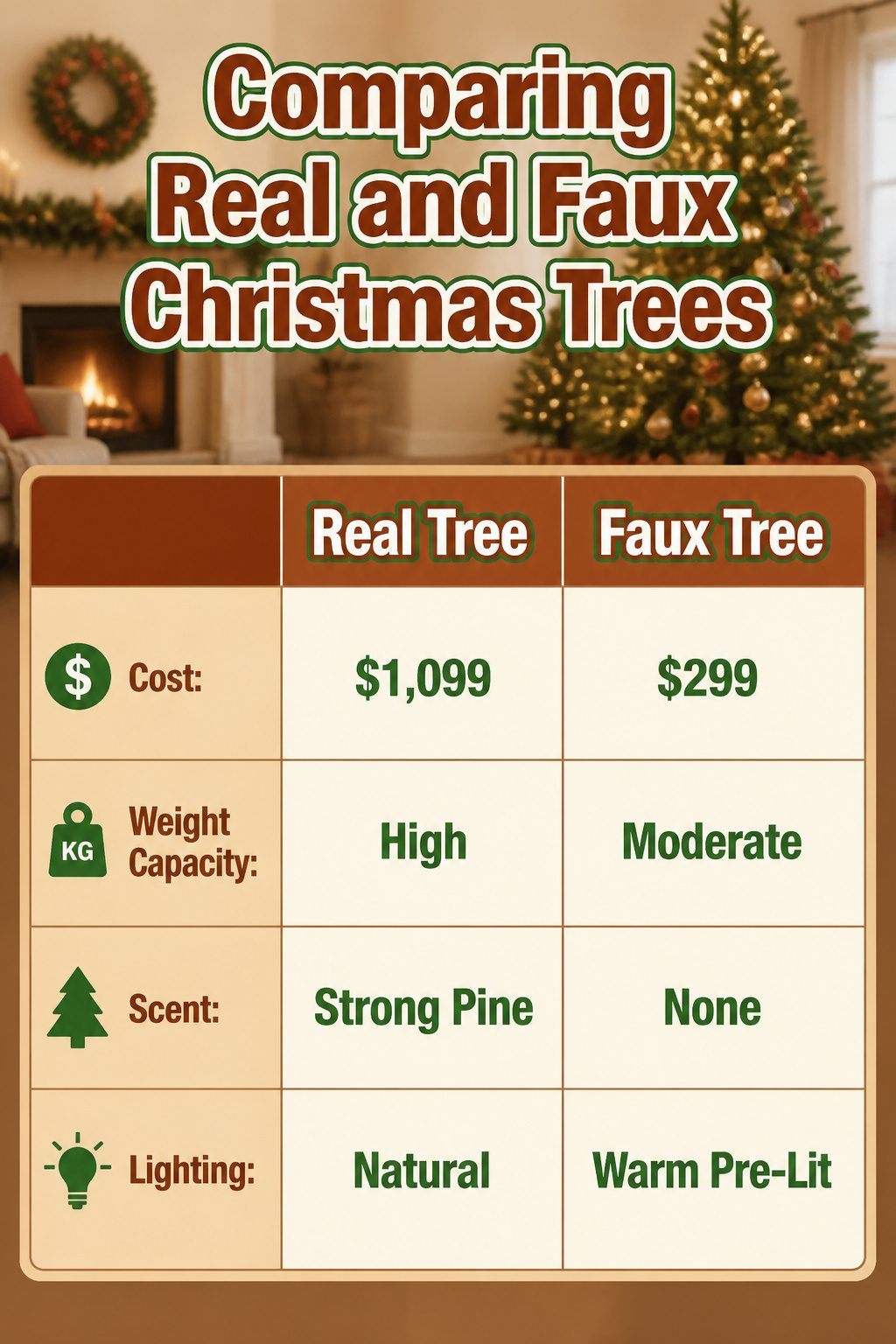
Real trees still carry that pine scent through the living room, but a good faux tree has gotten hard to dismiss. The needles are molded from actual branch casts now, the color variation is built in, and warm pre-lit wiring means you are not wrestling with a tangle every November.
The Balsam Hill Norwegian Grand Fir runs $1,099 and sits at the high end of what most of us would spend, which is exactly why it is worth understanding. Its branch tips are hinged and shaped to hold weight, so heavy glass balls and collected ornaments from your kids do not pull the needles down. Emily Henderson, who collects ornaments the way some people collect records, keeps a Nordic-style faux tree specifically for that load-bearing advantage.
Layering ornaments works best with the big shapes first. A large reflective ball catches light and gives the eye a place to rest between smaller, busier pieces. Wire hooks on delicate ornaments keep them from shifting every time someone walks past. Ribbon is the move that fills gaps without buying more ornaments; cut lengths and tuck them deep into the branches, letting the ends emerge at different depths rather than wrapping the outside like a maypole.
Themed decorations hold together better when the tree itself is simple. A Nordic-style faux tree with warm lights needs less ornament competition than a heavily flocked or colored version. Two ways to play this: collect in one palette and vary the textures, or gather everything sentimental and let the size variation create the order. The palette wins if you want the room to feel calm; the collected approach wins if the stories matter more than the photograph.
3. Wreaths and Garlands
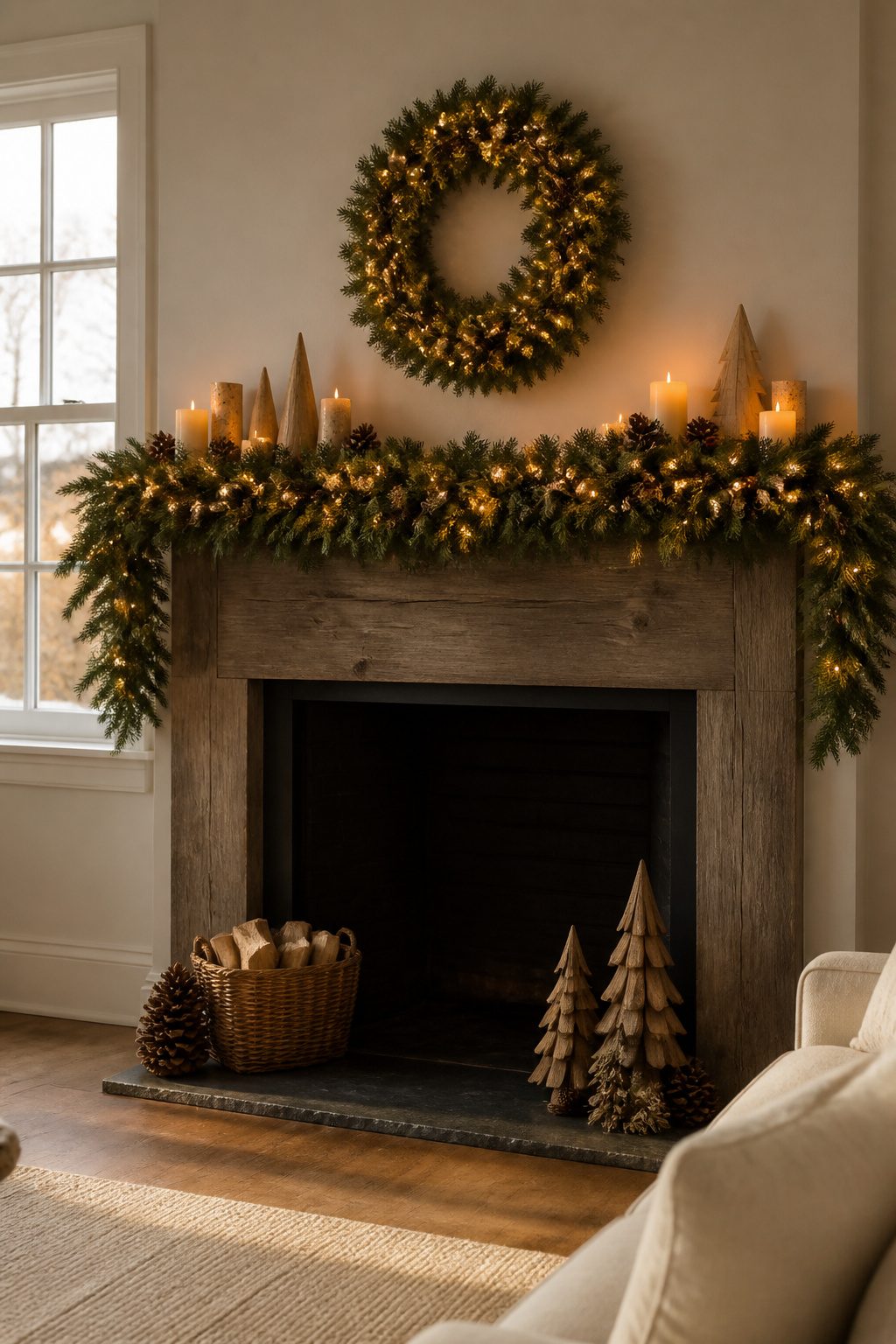
The 9′ Pre-Lit Garland changed how I handle mantels and wide windows. Three strands connect end-to-end, one plug, warm LED light for the full month. The scale is thick enough that it does not disappear on a large opening, which is where cheaper garlands always failed me. I hang them in a loose drape rather than pulling tight; the drape shows off the volume and hides any sag in the middle.
For something unlit and less expected, the $39.00 Decorative Woodland Cedar Garland fills a table runner or lays across a bookshelf without fighting other lights. At that price it is a filler, not a statement piece, and that is exactly when I reach for it: background texture that reads "winter" without demanding its own outlet.
Wreaths are harder to judge online. The 3′ Pre-Lit Wreath is the only dimension I have seen specified, and it is the right size for a standard front door; anything smaller reads skimpy from the street. I still wire mine to the door rather than trusting an over-the-door hook once the weather turns. The pre-lit wreath saves the annual fight with battery boxes, but the plug means you need a plan for the cord. I run mine through the mail slot and call it done.
4. Table Settings
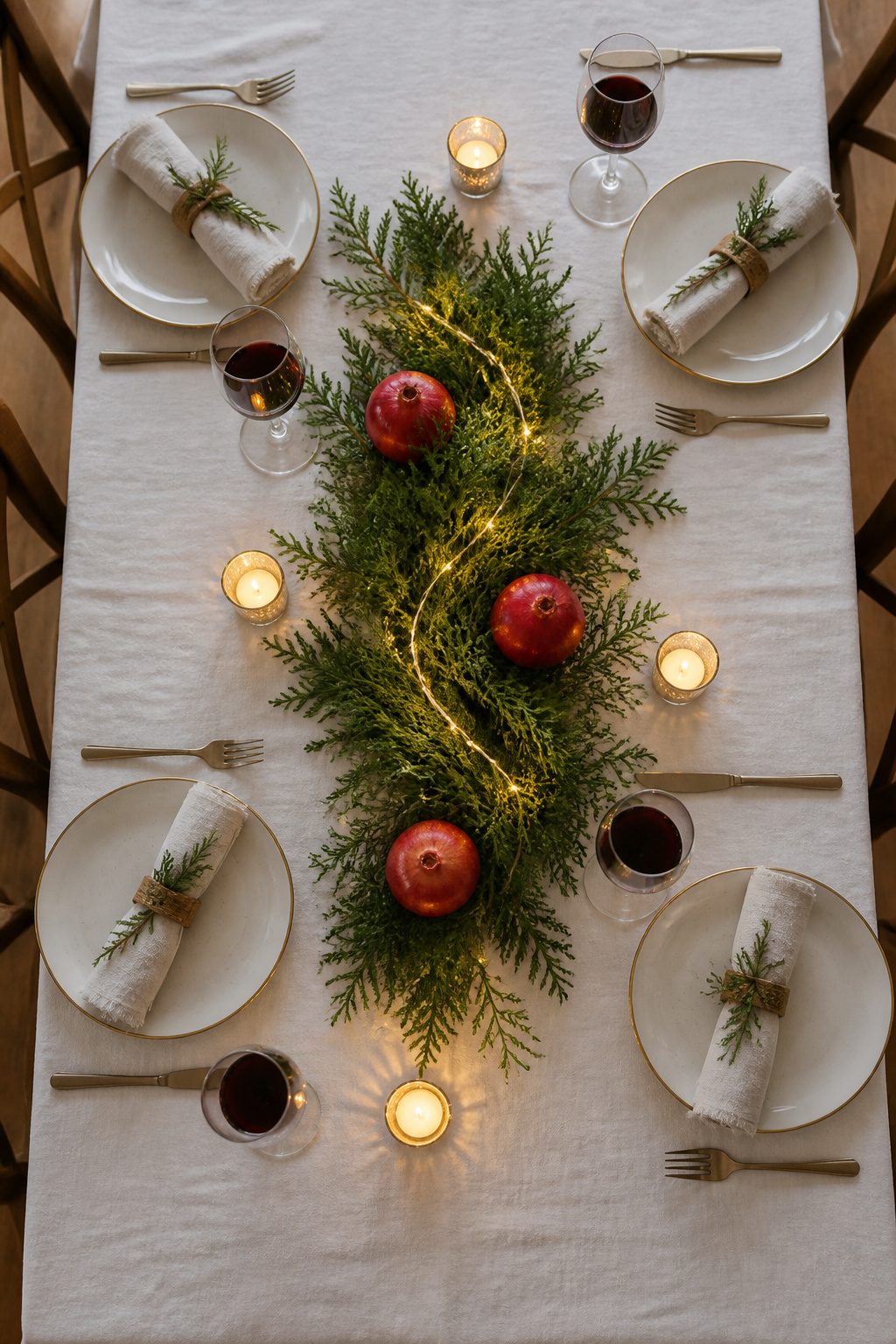
Last December I set our table with the wedding china we usually keep boxed up, and the difference was immediate. A white linen cloth, a runner of snipped evergreen and three pomegranates down the middle: that was the whole centerpiece, low enough that nobody had to peer around it to talk. Votive candles after dark turned it into something that felt considered rather than bought.
The china did the heavy lifting. Pull out what you already own and let the greenery and candlelight do the holiday translation. No matching set? A yard of linen and a string of battery twinkle lights across a plain table reads the same for under $20.
I skip the tall arrangements. Flowers at eye level divide the table into separate conversations; keep the line under twelve inches and the room holds together. One bottle of decent red, a few stems in a short jar if you have them, and the fire or a cluster of votives for the glow. The Scandinavian restraint wins here: white, green, candleflame, done.
5. Stocking Ideas
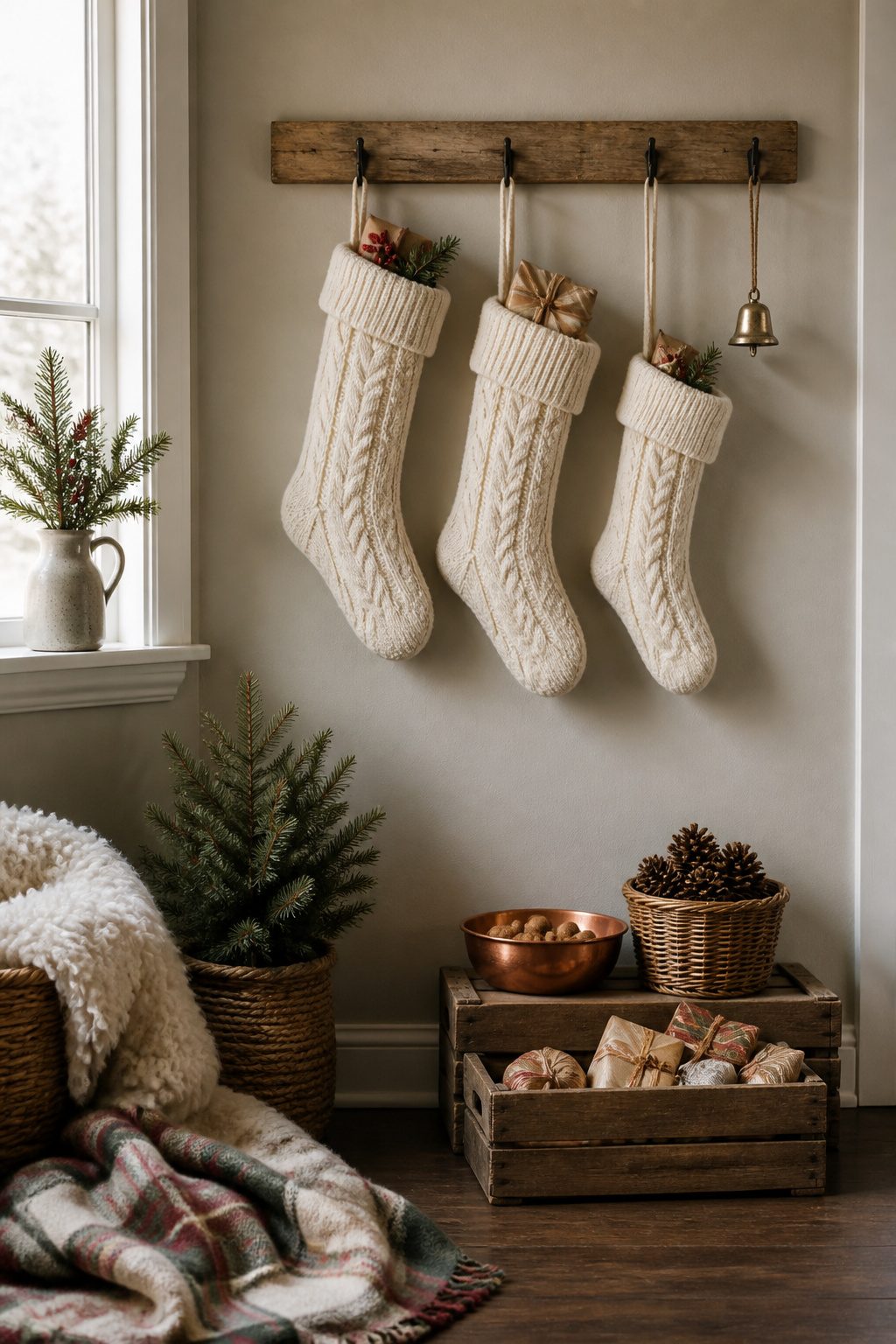
A mantel is not the only place for stockings, and in many rentals it is not even an option. The year I lived in a studio with a wall heater and no fireplace, I learned that a simple hook rail mounted at chair-rail height turns any blank wall into a stocking station. Three stockings across about three feet of wall looked intentional, not like a workaround.
Weight matters more than you would think. A knit stocking empty looks flat and sad, but stuff it too full and the hook tears out. I use crumpled tissue paper inside to give shape, then add small gifts last so the bulk stays in the toe. The $15 Wondershop Cable Knit Christmas Stocking at Target has the density to hold that shape without collapsing, and the cable pattern reads as traditional without trying too hard.
For a row of matching stockings, I stagger the heights slightly, about two inches between each hook, so the tops do not form a rigid line. That small unevenness is what makes the arrangement look gathered over time rather than installed all at once. If you are mixing textures, keep the palette tight. Two knits and one velvet in the same cream family works; two knits and one metallic sequin fights for attention and loses.
6. DIY Decorations
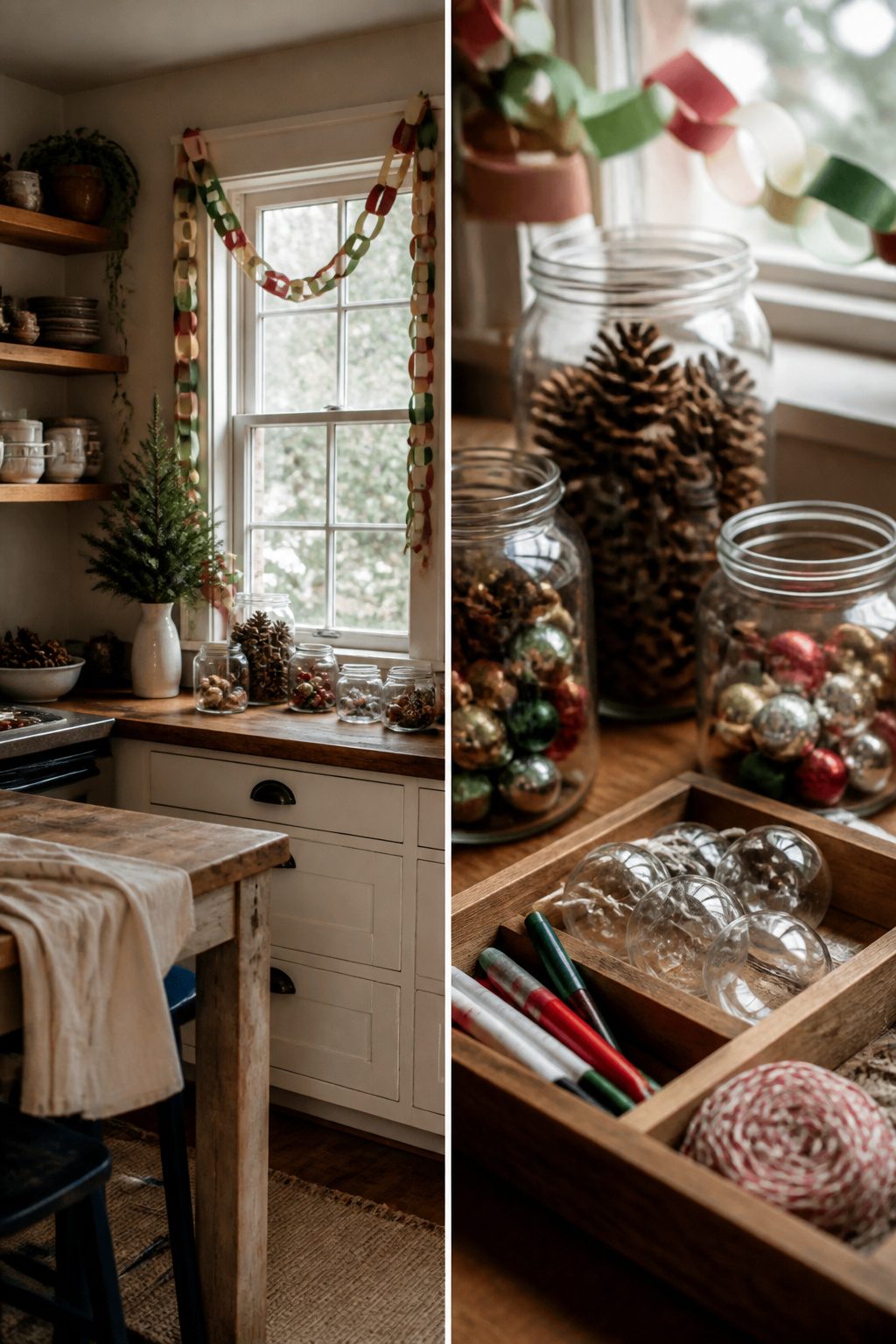
A handmade paper chain garland still carries the same old-school warmth it did on grade-school bulletin boards, and the material costs almost nothing. Strips of construction paper or leftover wrapping paper, a glue stick, and twenty minutes of television time will string across a doorway or frame a window with the kind of irregular, human charm no store version replicates. The loops twist and sag in ways that read as cozy, not sloppy.
Glass jars work on the same principle of low effort, high presence. A few pinecones, tiny ornaments, or even dreidels and gold coins layered in a clear cylinder catch light on a mantel or kitchen shelf without the commitment of a full arrangement. The jar does the heavy lifting; the contents just have to be small enough to rattle slightly when someone walks past.
Personalized ornaments land somewhere between the two. A plain ball, a paint pen, and a date or name turn a generic filler into something that actually comes back out of the box each year. The trick is stopping at one detail; too many colors or messages and the thing looks like a craft fair stall. One year I tried hand-lettering lyrics inside a clear globe. The ink pooled. Now I stick to last names and years, and the failures stay buried in the ornament box as a quiet reminder.
7. Lighting Options
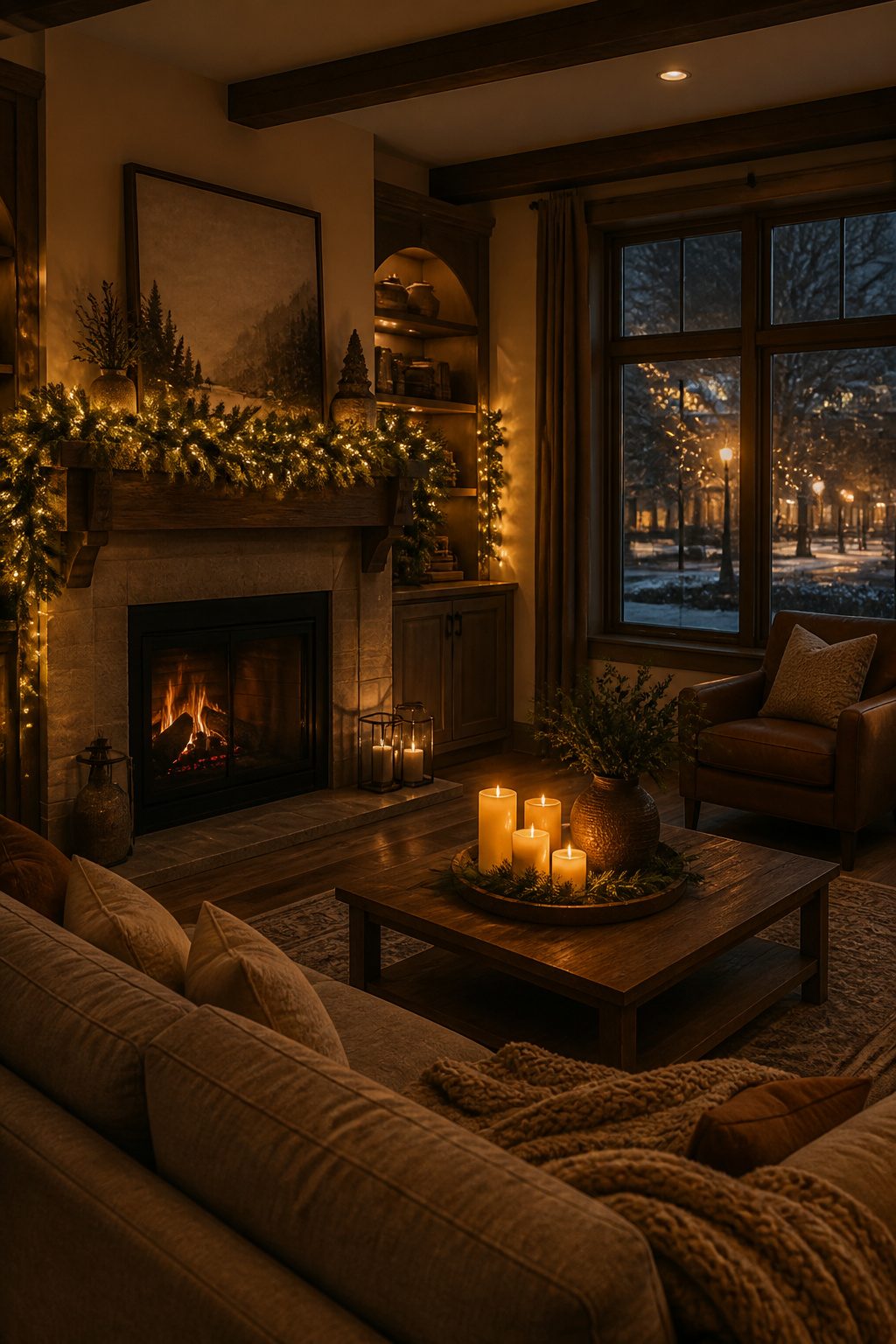
LED lights run cooler than the old incandescent strings, which matters more than I used to think when you’re wrapping a garland around a dried pine mantel or tucking strands into a tree that’s been inside for three weeks. The reduced heat is the reason I switched, not the energy savings.
Before you plug anything in, run your fingers along every wire and check for fraying. Frayed wires are the kind of thing you notice once you start looking, and the damage usually sits right at the plug or where the strand took a sharp bend last year. Surge protectors are non-negotiable for anything you’re running overnight.
Fairy lights, the tiny LED strands, handle the close-up work that bigger bulbs can’t manage: woven through a centerpiece, tucked behind glass in a cabinet, coiled in a jar on the bathroom counter. The scale reads as magic rather than decoration, especially after dark.
Candles still do something electric light cannot. I keep real ones on the coffee table and the fire going when I’m home, but LED candles are the practical choice for the hours you’re asleep or out. The glow is close enough, and the house still feels lit from within.
Natural Elements
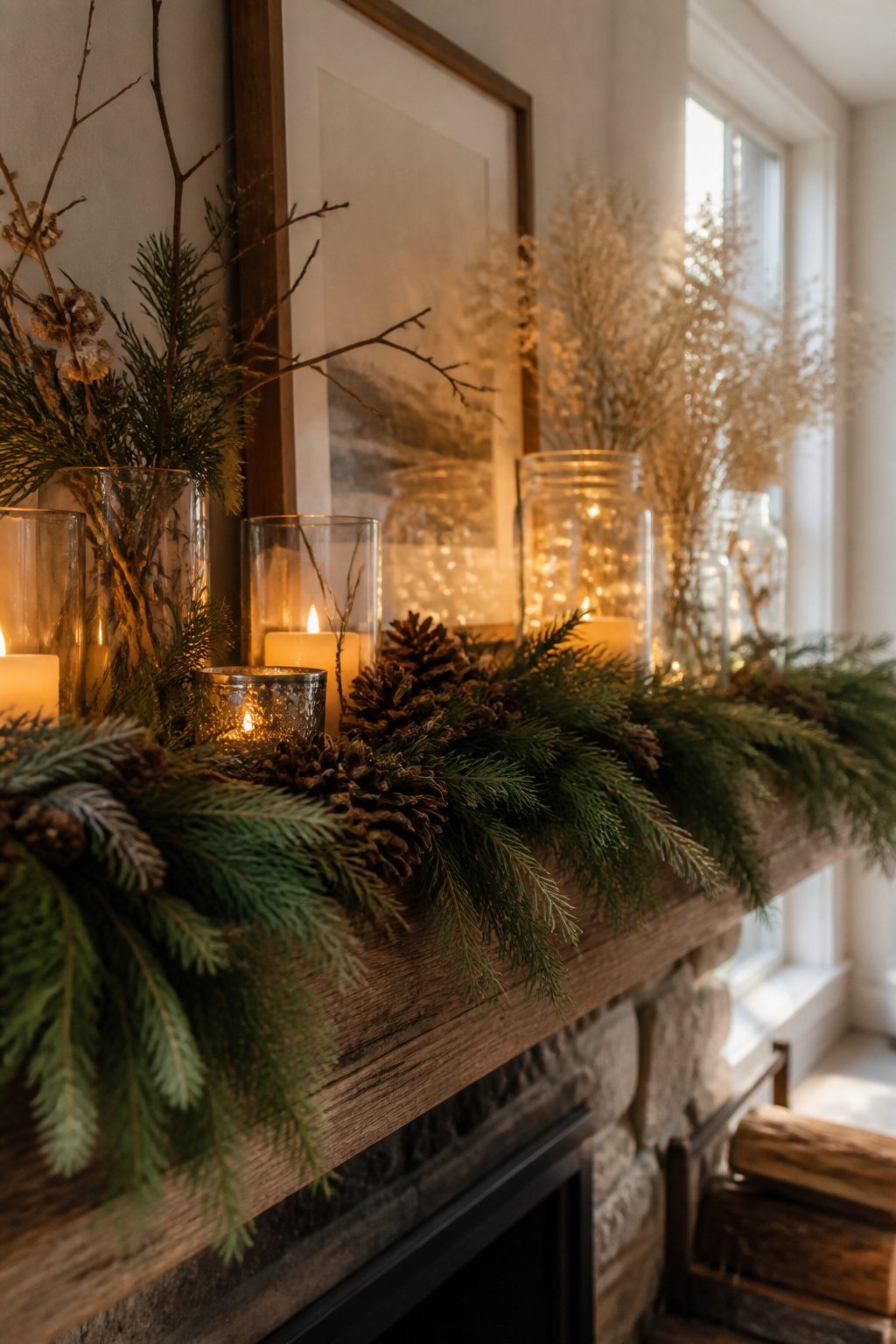
Greenery and found materials do more for a space than most store-bought trim ever will. Last December I layered evergreen garland with a few dried stems I already had, scattered pinecones across the mantel, and added the soft glow of faux candles. The whole arrangement took maybe twenty minutes and cost nothing beyond the garland, which I reused from the year before.
Pinecones, branches, and clippings from outside warm up a room without the polished stiffness of retail decor. Glass jars filled with pinecones or tiny ornaments sit nicely on a shelf or coffee table and read as intentional rather than leftover. The earthy palette keeps things calm, which matters when the season itself is hectic. One route is the very neutral, very natural look: woven textures, natural green garland, nothing loud. Another is to layer in a few floral elements for softness. Both work; the neutral path is easier to build from what you already own, and the layered version needs only a handful of stems to feel complete.
Personal and Vintage Touches
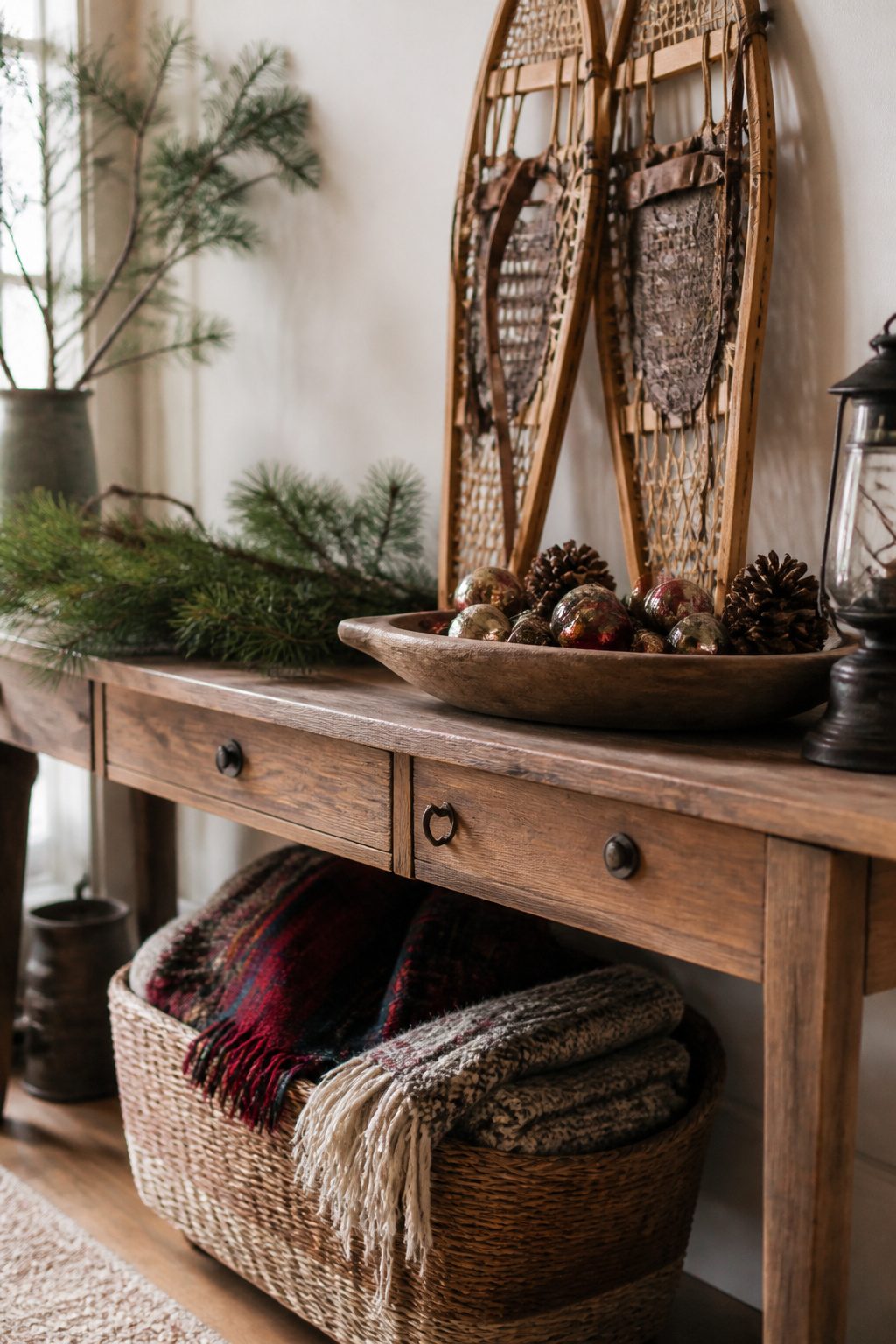
Vintage snowshoes leaned against my console table last December, and three guests asked where I bought them. The answer was my uncle’s garage. That scuffed paint and frayed leather strap carried more winter atmosphere than anything I could have ordered new, and the price was an afternoon of helping him sort through boxes.
The hunt itself is half the point. Thrift stores and parents’ attics yield ornaments with the soft color loss that only forty years of storage achieves, tree toppers that don’t match anything in the current catalog, and textiles worn enough to repurpose into stockings without guilt. These pieces add what manufactured nostalgia cannot: the irregularity of real age.
The mix matters more than the era. Metallic glass Christmas trees on a traditional mantel with fresh greenery reads as intentional, not inherited. Too much vintage and the room becomes a set piece; too little and the new stuff looks flat against it. I aim for about one older piece per surface, enough that the eye keeps moving between textures.
New decorations designed to look vintage fail this test under direct light. The patina is uniform, the wear patterns predictable. Real vintage carries the chaos of actual use: a dent from a child’s hand in 1987, varnish yellowed by someone else’s cigarettes. Those marks are the individuality renters and first-home owners can actually afford.
What Fifty Dollars Buys

Fifty dollars does not sound like much until you stop trying to buy everything at once. Last year I spent $47 on three strands of warm-white LED lights, a spool of jute twine, and two yards of plain muslin from the remnant bin. The lights went around the kitchen window frame, the twine tied cinnamon sticks into bundles I hung from cabinet pulls, and the muslin became a dozen no-sew napkins with pinked edges. That $47 covered two rooms and looked intentional, not spare.
Where the money actually goes depends on what you already own. Someone with a box of glass ornaments from past years needs greenery and filler, maybe $30 at a grocery store floral section plus $15 for wire and floral tape. Starting from nothing, $50 buys impact in exactly one spot: a mantel, a console table, a single window. Spread it thinner and every surface looks like you gave up halfway.
If you have $200 to $300, the math changes. I would put $80 toward a real wreath or a quality faux one I can reuse, $60 on enough lights for one tree or two windows, and the rest on fresh greenery from a nursery or a wholesale lot. The remaining $40 to $100 stays flexible for the thing you forgot: extension cords, replacement bulbs, the hook that does not fit the door. Budgets fail at the edges, not the center.
Making It All Match
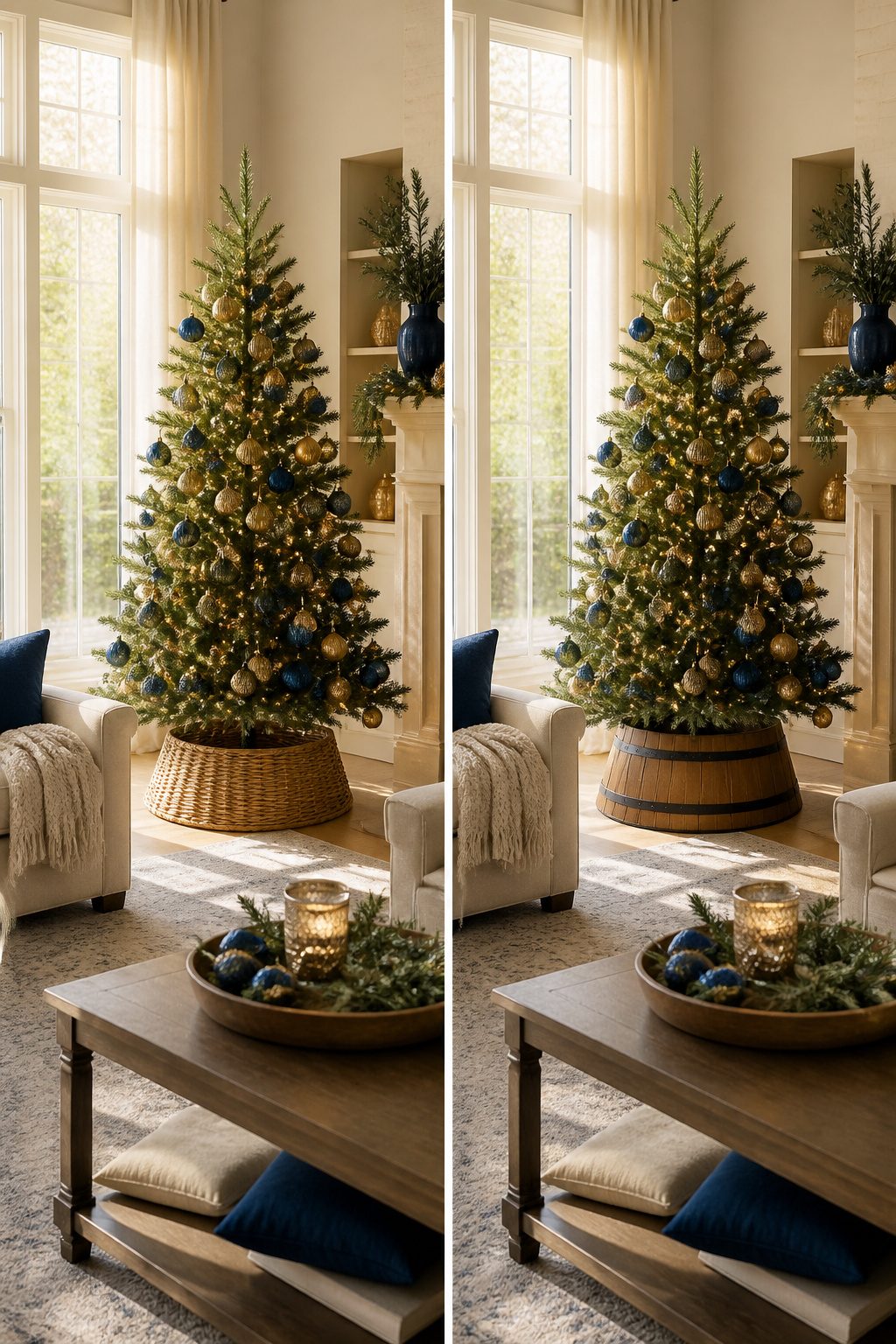
The fastest way to pull a room together is to match new holiday pieces to what already lives there. A tree collar in natural or dark walnut hides the plastic stand and echoes existing wood tones instead of fighting them. Leftover upholstery fabric, the kind already on your sofa or chairs, stitches into stockings that look intentional rather than bought from a bin.
I used to think cohesive Christmas decorating meant a full reset every November. The smarter move is pulling one or two colors from your everyday rooms and repeating them in ribbons, wrapping paper, or ornament clusters. In my own place, that meant stepping away from the expected red-green pairing and letting blues and golds talk to the deeper tones already on the walls.
A few new accents freshen the look without discarding what you own. The collected feel comes from restraint, not volume; narrow to the decorations that actually share a thread, and let the rest stay in storage.
What I Skip and Why
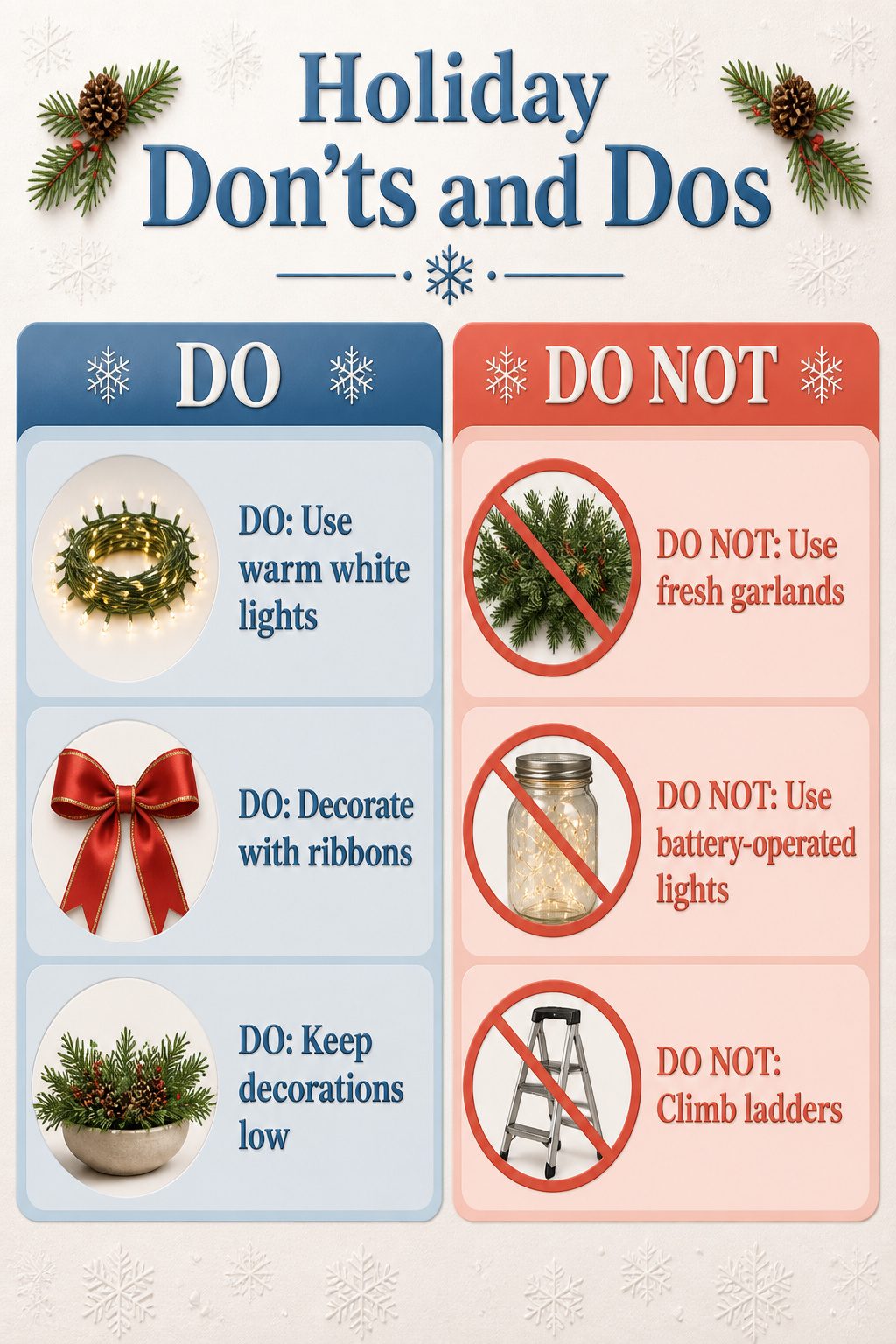
Fresh garlands look like the obvious upgrade from artificial ones, until you spend a Saturday afternoon vacuuming needles from every crevice of your hallway. The scent is real for about two days, then you are left with dry branches and a lingering reminder that live greenery demands daily attention a weekend project cannot sustain.
I have tried the Pinterest trick of spraying them with anti-desiccant. The branches still browned, and the chemical smell mingled badly with anything pine-scented nearby.
Battery-operated fairy lights in glass jars were another impulse I regret. The warm glow photographs beautifully, but replacing twenty coin-cell batteries every season costs more than a single plug-in strand and twice the patience. For renters especially, the math does not hold up.
What I do skip now is anything requiring a ladder beyond a single step stool. The high-window candles, the mantel garlands draped to the ceiling: the thirty minutes of setup is not worth the season-long worry about a rental deposit. Low and stable beats impressive and precarious.
Frequently Asked Questions
What are popular Christmas decorating trends?
Vintage Christmas décor is back this season, with tartan and plaid patterns, gold accents, and raw wooden tones giving the classic red-and-green pairing a worn-in, inherited feel. Jewel tones like deep plum, emerald, and sapphire offer a fresher alternative that still reads festive without looking like default holiday colors.
What are some budget-friendly Christmas decorating ideas?
Fifty dollars covers two rooms if you spend it on versatile basics like warm-white LED lights, jute twine, and plain muslin for no-sew napkins with pinked edges. Pull out wedding china or everyday dishes you already own and let greenery and candlelight do the holiday translation for practically nothing.
How can I make my Christmas decorations look cohesive?
Pick two or three colors and thread them from the tree to the mantel to the wrapping paper by the door. Match new holiday pieces to what already lives in your rooms, a tree collar in walnut to echo wood tones, or stockings sewn from leftover upholstery fabric that talks to your sofa.
What are some must-have Christmas decorations for a festive home?
Start with vintage-inspired glass ornaments and stained wood lanterns if you are building a collection, or lean on what you already own and add fresh greenery and votive candles. A quality faux wreath you can reuse, enough lights for one tree or two windows, and flexible cash for the forgotten extension cord or hook rounds out a $200 to $300 spend.
How do I safely decorate with lights?
Switch to LED lights for the cooler running temperature, especially when wrapping dried pine mantels or trees that have been indoors for weeks. Run your fingers along every wire before plugging anything in to catch fraying, usually right at the plug or where the strand took a sharp bend last year, and always use a surge protector for overnight runs.