A traditional Christmas living room centers on tartan plaid ribbon, blue and white chinoiserie, and layered greenery that looks gathered rather than bought. The trick is letting one pattern dominate while the other accents, never splitting them fifty-fifty.
A single roll of wide tartan ribbon cut in 8-inch loops and tucked deep toward the tree trunk reads as structure, not clutter, and the same roll can move from dining room to tree across seasons until the cost per use drops to pennies.
Red and Green Tartan Plaid

Tartan plaid ribbon does the heavy lifting in a traditional Christmas living room, and the sources back this up across four separate rooms where it served as the core element.
The pattern carries red and green together in one strip, which saves you from having to balance the two colors separately.
I have seen the same roll of ribbon move from a dining room one year to a Christmas tree the next, and the cost per use drops fast when you plan it that way.
On the tree, wide tartan ribbon cut in 8-inch loops and tucked deep toward the trunk reads as structure, not clutter.
Garland accents get the same treatment: a narrow strip woven through plain greenery ties the mantel to the tree without matching everything exactly.
Pillow trims are where I would spend the least, since a 2-yard cut folded and pinned over existing covers changes the room for about the price of a poinsettia.
Ornaments in matching plaid fill the mid-zone of the tree, the spot where solid red balls go flat and metallics turn gaudy.
The pairing that sources keep returning to is tartan with blue and white chinoiserie. It sounds wrong until you see it: the plaid warms up porcelain that can otherwise feel summer-cold in December.
One room used blue velvet stockings against a tartan tree skirt, another hung blue and white ginger jars as ornaments. The rule seems to be let one pattern dominate and the other accent, never split them fifty-fifty.
Blue and White Chinoiserie Accents
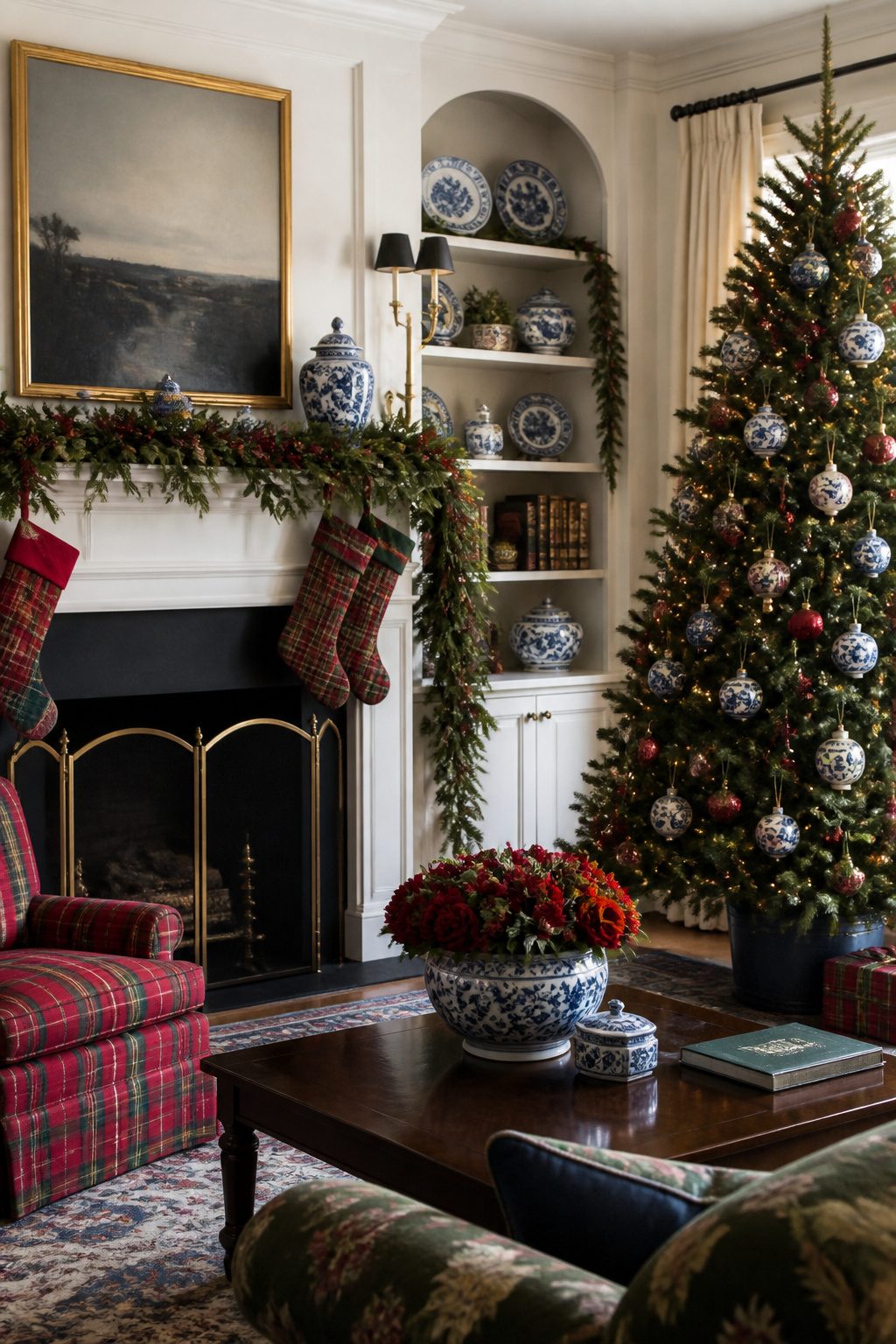
Blue and white chinoiserie pieces thread through traditional Christmas palettes without fighting the red and green.
A ginger jar on the mantel, a plate propped on a shelf, or a small ornament hung on the tree reads as inherited rather than bought for the season.
The contrast cools down tartan warmth and keeps the room from feeling like a single-note holiday display.
What works is the collected quality.
One ginger jar lamp, a set of blue and white footbath planters by the hearth, a few ginger jar ornaments mixed into greenery; each piece looks as if it lived in the room year-round and the Christmas decor simply grew around it.
The sources that pull this off best limit the blue and white to three or four spots so the eye travels rather than settles.
Plates layered into a mantel display or hung with ribbon on cabinet fronts add that layered, grandmother’s-parlor feeling that traditional style aims for.
The chinoiserie pattern itself, with its scrolling vines and pagodas, nods to centuries-old trade rather than this year’s catalog. That historical weight is what separates the look from a trend passing through.
A blue velvet stocking or tree skirt can echo the accent without repeating the pattern so literally that it becomes a theme rather than a texture.
The risk is overdoing it. Two ginger jars flanking a mantel read as intentional; six scattered through one room reads as a collection that swallowed the space.
The same sources that praise the mix also keep the blue and white to under twenty percent of the visible holiday decor.
That proportion lets the red and green remain dominant while the chinoiserie does the quiet work of making the whole display feel considered.
Generous Greenery Swags
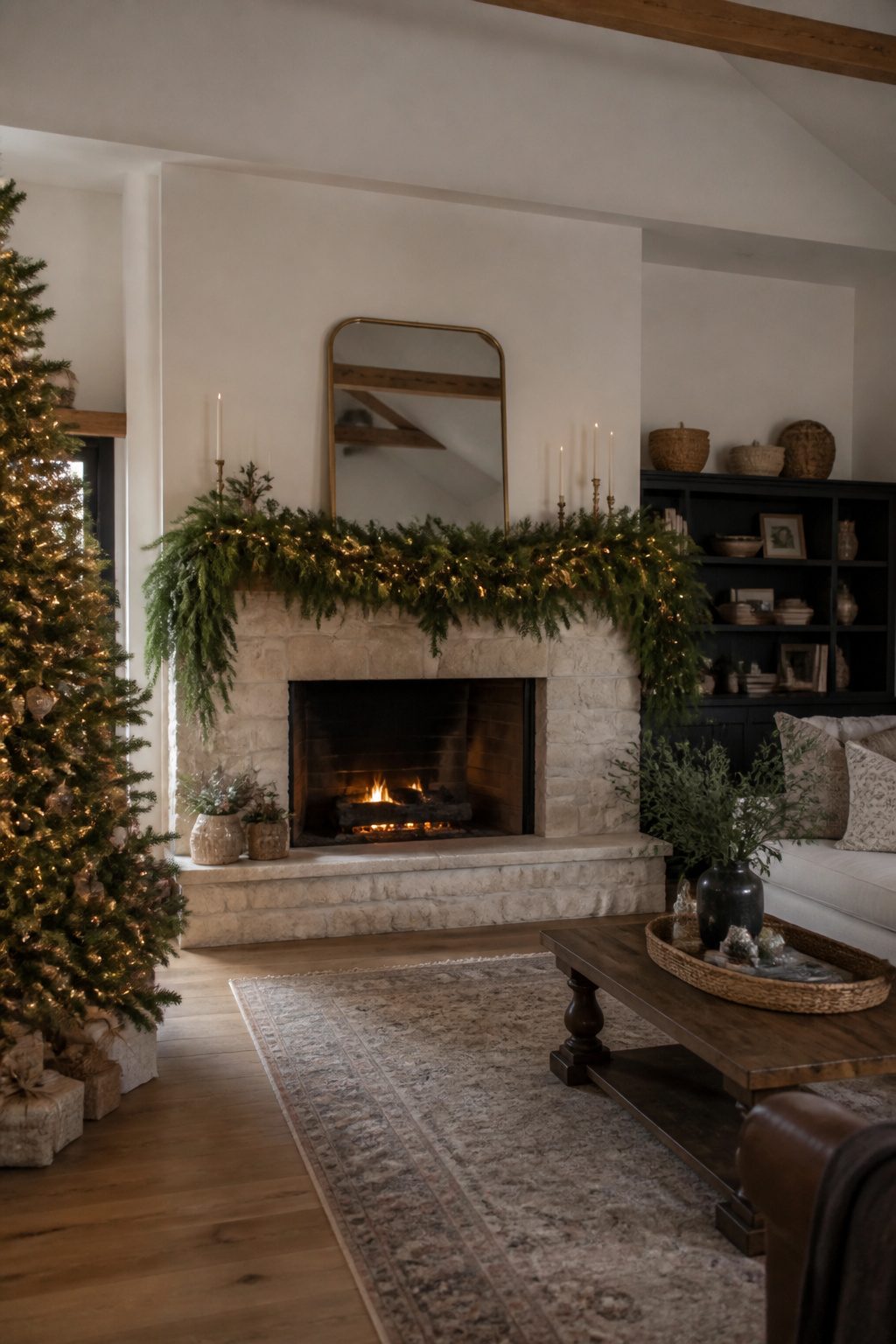
Norfolk pine and fraser fir together build the backbone of greenery that reads as traditional rather than trendy.
Layering the two, as sources describe, gives a fuller mix than either achieves alone: the Norfolk pine brings soft, draping length while fraser fir adds the stiff, upright branches people picture when they think of Christmas trees.
Fresh garlands win on scent and immediate presence, but they shed and dry, and the pollen and resin can trigger reactions for anyone with allergies in the household.
Faux versions, especially the real-touch or real-feel stems now available, solve that tradeoff and store flat for reuse.
A generous scale matters more than perfect arrangement; a thin, tidy swag looks apologetic, while one that spills six inches past the mantel edge or drapes deep below the stair rail reads lush and intentional.
Mantels are the obvious placement, though doorways and stair rails carry the same weight of greenery with less competition from stockings and candles.
The source that wrapped a foraged branch in faux Norfolk pine, grapevine, and light-up star garland found the result felt woodland and storied rather than decorated, which is the mood traditional styling aims for.
Wherever you hang it, let the greenery be the event, not the frame around one.
Vintage Ornaments and Decorations
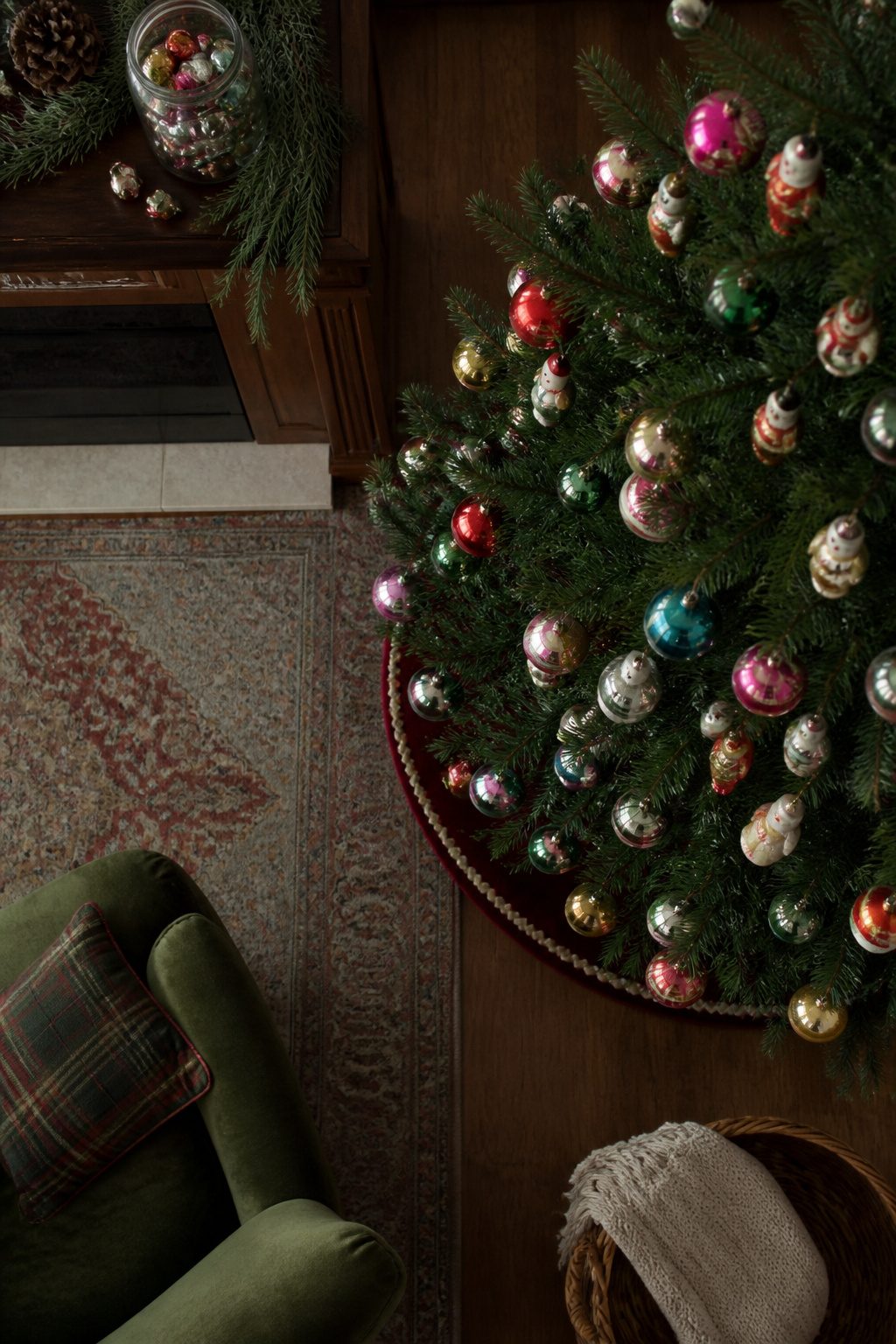
Vintage ornaments carry a warmth that new glass rarely matches, and they are easier to find than most people assume.
Estate sales in older neighborhoods, the back corners of thrift stores, and Etsy shops run by retirees clearing out attic boxes all turn up Shiny Brite baubles, spun-cotton figures, and hand-painted glass from the 1940s through the 1960s.
The ones with slightly faded paint or a thin crack in the cap read as character, not damage, on a tree that is already about nostalgia.
I mix mine by color family rather than by era. A box of red Shiny Brites I found at a church rummage sale for eight dollars sits next to a strand of newer matte balls in the same tone.
From five feet away they read as one collection. The older pieces go deeper in the branches where the light catches the worn silvering; newer ornaments fill the outer edges where they take the knock if someone brushes past.
Condition matters less than you would think. An ornament with a chipped top still hangs fine if you slip a bit of floral wire through the remaining cap.
The ones that truly fail are the shattered hollows, and even those can be tucked into a glass jar on the mantel with a strand of lights behind them.
Joanna Gaines has used this same trick of layering vintage pieces into greenery, and it works because the eye reads age as authenticity, not as clutter.
Spend under ten dollars per piece and you will not wince when one breaks. The limit keeps the hunt fun and the risk low.
Layered Mantels
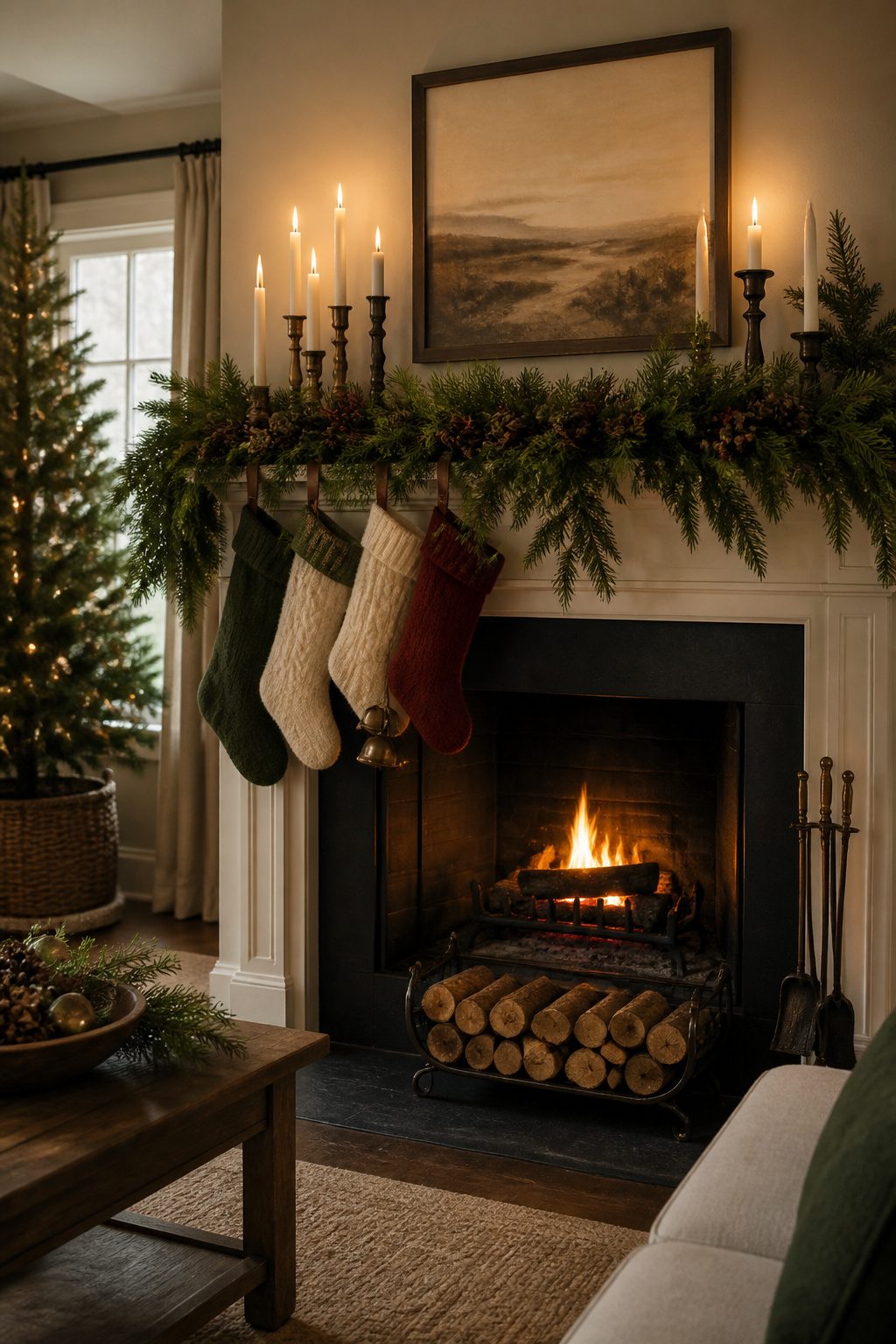
The mantel is where a traditional Christmas living room actually comes together, and the layering order matters more than any single piece.
Start with greenery draped across the full span, either a Norfolk pine garland mixed with Fraser fir or a single lush garland with berries and pinecones worked in.
This base should feel slightly overfull; the stockings and accents will compress it visually once they go up.
Hang stockings in the center or offset to one side, depending on what sits above the mantel.
A large vintage mirror or framed artwork needs breathing room, so three stockings clustered to the left keeps the weight balanced without crowding the focal point.
The stockings themselves set the color story: cream knit with a nostalgic feel, blue velvet with white piping for something richer, or a plaid that picks up the ribbon woven through the greenery.
Height comes last. Candlesticks at varying levels, a bell swag, or a light-up Moravian star garland add the vertical dimension that flat garland alone cannot give.
Battery-operated candles inside the fireplace itself extend the glow downward for evening.
The proportion to watch is the mantel depth against the tallest piece; a shallow mantel with oversized candleholders reads cluttered, while deep ledges can handle a sugar pinecone cluster or small decorative houses without feeling crowded.
For standard eight-foot ceilings, keep the tallest element roughly one-third the mantel height so the wall above still reads as intentional negative space.
Cozy Textiles

Wool, velvet, and cable knit each read Christmas instantly without any pattern at all.
I reach for tartan when I want the room to feel intentional rather than accidental, but a solid forest green velvet pillow against a wheat-colored sofa does the same work more quietly.
The mistake I kept making was piling every texture onto one chair until sitting down required excavation.
Layer two textiles per seating piece, three only on the largest sofa. That rule kept my living room usable through last December.
A folded wool throw across the back, two pillows in front, and the seat itself stays clear for actual humans.
Fabric weight matters more than print. Heavy wool and velvet hold their shape through January; thin knits pill and sag by Boxing Day.
For storage, I skip the vacuum bags that flatten loft out of wool and use labeled bins with cedar blocks instead. The velvet goes in first, knits on top so nothing crushes the pile.
Come January, tartan pillows rotate to the guest room where they read cabin rather than holiday. Solid reds and greens stay out through February paired with cream rather than gold.
The wool throw lives on the sofa year-round; it is just a blanket in March.
Christmas Tree Ornament Mix
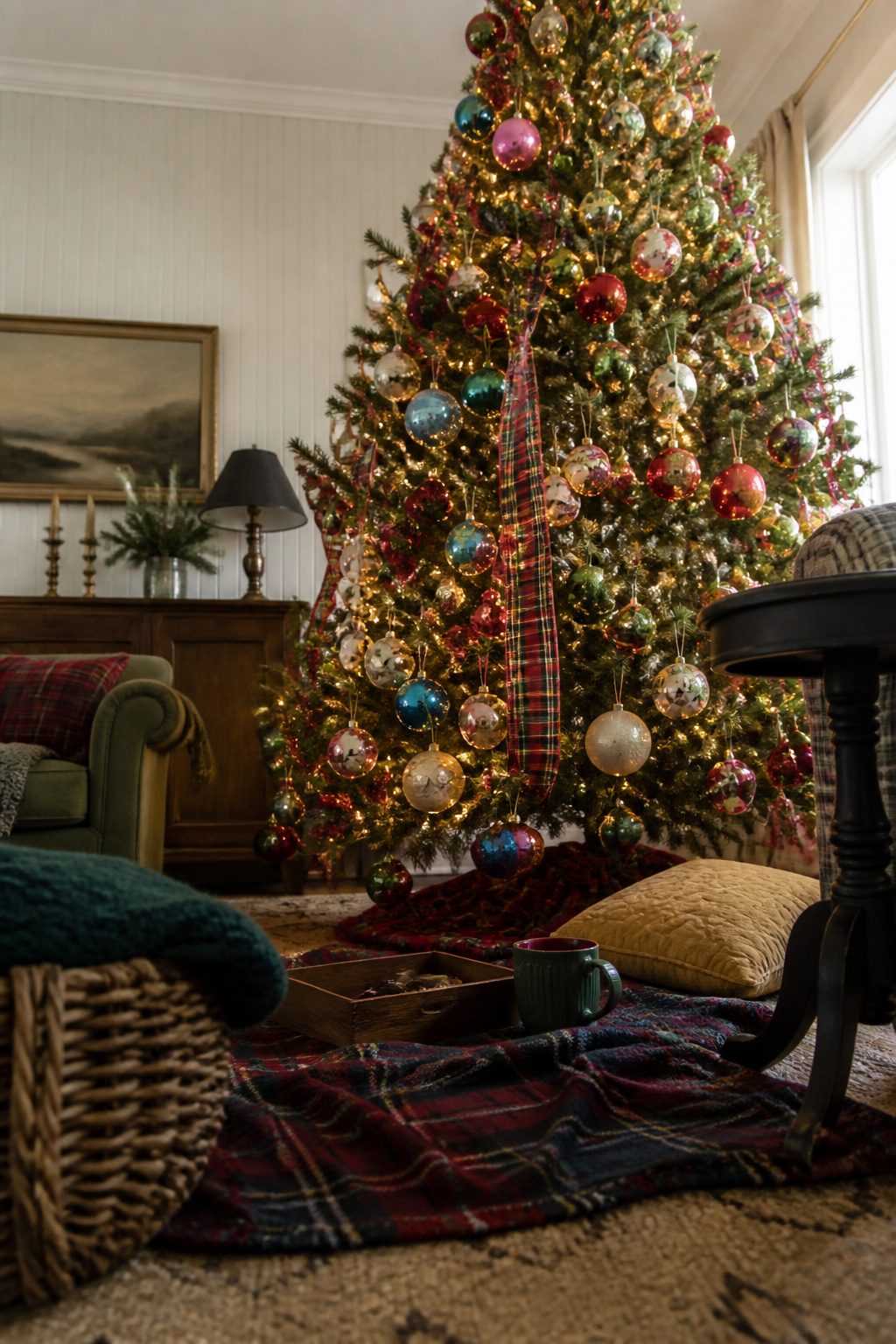
A traditional Christmas living room builds outward from the tree, and the ornament mix matters more than the theme. Six years of switching palettes taught me that collected beats coordinated every time.
Red, green, and gold ornaments carried across three seasons of my own tree, swapped in and out with farmhouse pieces one year, woodsy accents the next.
The constant was the mix itself: vintage Shiny Brites hung alongside felt ornaments from a craft fair, paper stars made one December afternoon, and newer glass balls filling gaps where old ones broke. Sizes need to vary too.
Large ornaments read from across the room; tiny ones pull people in close.
Ribbon runs through it vertically now, not just curled on branches. I thread wide tartan plaid from the top down, tucking it deep into the interior so the tree has depth, not just surface.
Lights are warm white, and more of them than feels safe at first. LED strands reduce heat, which matters when you’re wrapping a tree this densely.
The base is where the tree claims its territory as anchor. A plaid blanket wrapped around the stand, with everyday decor stacked nearby, ties the whole corner together without buying a single skirt.
What reads as traditional is really just time layered on time, ornament by ornament.
Natural Elements
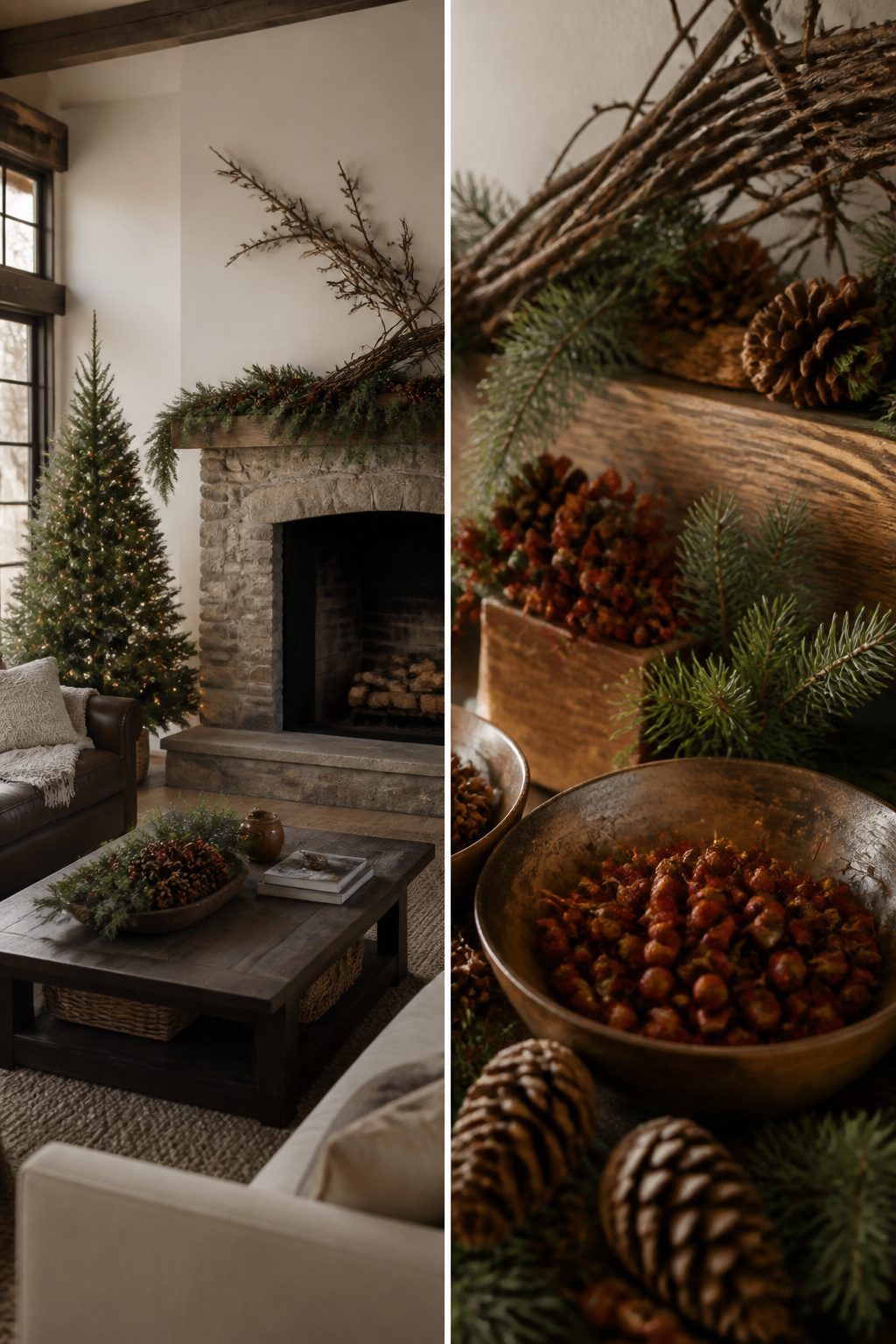
Pinecones, berries, and fallen branches do the work of making a traditional Christmas living room feel gathered rather than bought.
Louise Roe pulls ivy, holly, and berries straight from her garden to drape around pictures and fill pots, while Molly Mahon brings in armfuls of evergreen foliage against her Parsonage Pink walls.
Both approaches depend on having access to a garden, which is not every renter’s situation.
Faux greenery solves the maintenance problem without losing the look. One writer switched to faux cedar garland after real cedar triggered allergies, and now mixes in berries and pinecones with the fake stems.
The faux Norfolk pine and grapevine wrapped around a foraged branch above a mantel reads as organic because the natural form underneath is real, even if the greenery is not.
For storage, fabric bows and paper garlands wind neatly around a kitchen roll tube. Pinecones keep indefinitely in a dry closet.
Berries are the weak link, real or fake; the red ones dusted across garlands tend to shed or fade first, so the ones that look best in January are usually the replacements you tucked in at New Year’s.
Color Schemes That Hold Together
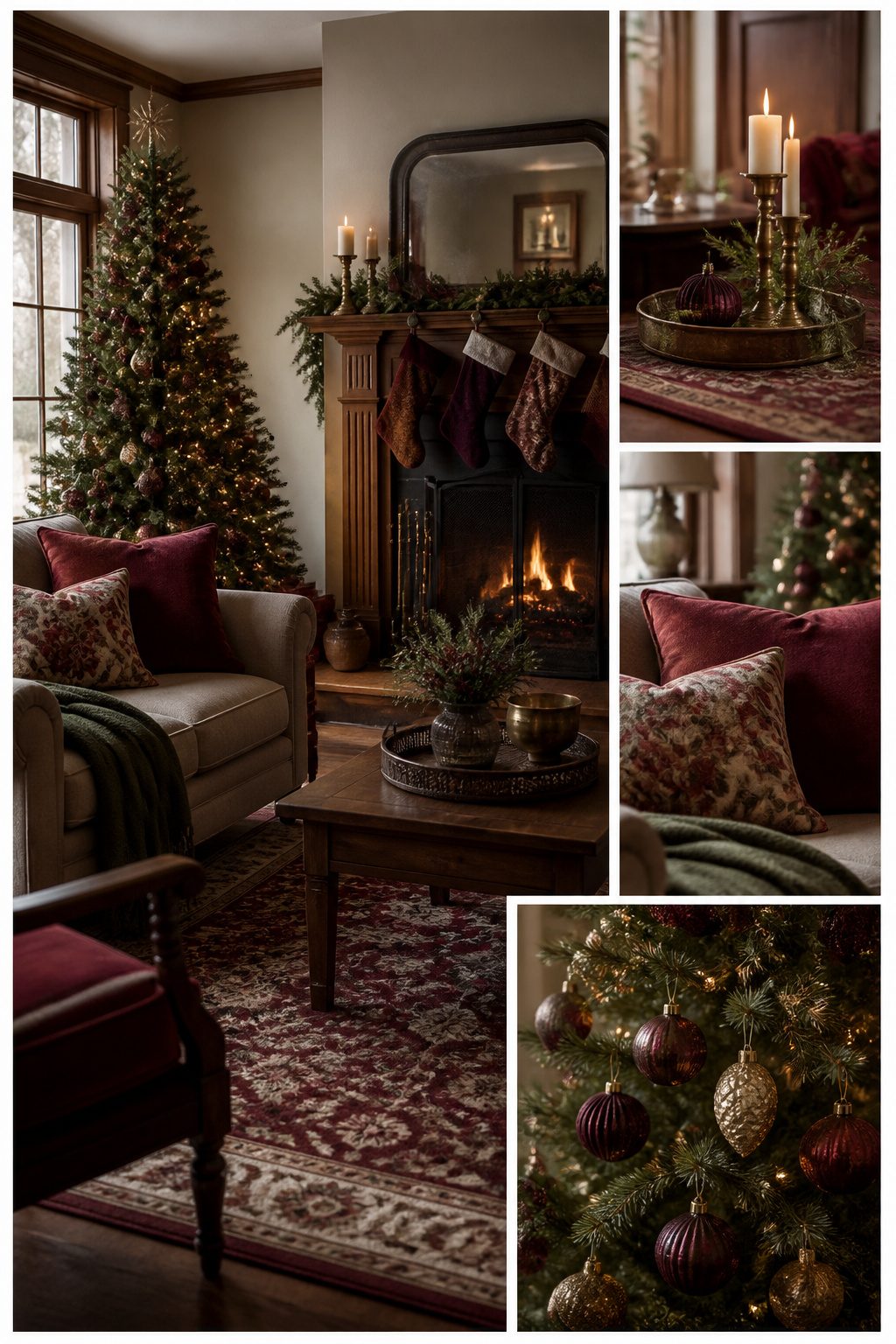
A traditional Christmas living room starts with what is already on your walls and floors.
My own living room is painted a warm greige with honey-toned oak trim, so the classic red-and-green pairing reads garish against it; instead, burgundy and forest green work because they pick up the deeper undertones already in the wood.
Match your greens to your existing wood tones, not the other way around. Cool blue-greens suit gray or white trim, while olive and moss tones settle in beside warmer woods without fighting them.
The trick is treating your room’s permanent colors as the first swatch in the palette.
I pull out the two most prominent non-neutrals, usually from a rug or a sofa, then choose decorations one step deeper or more muted than those.
A navy sofa gets midnight blue ornaments rather than primary; a cream room gets ivory candles and aged gold rather than bright yellow metallics. This keeps the holiday layer from floating on top like a costume.
If your space is mostly neutral, add one rich color through greenery and a second through textiles, but keep both in the same temperature family.
Two warm tones or two cool tones will always look more expensive than one of each. The cohesion comes from restraint: three colors total, including your walls, is enough for any traditional scheme.
Working With What You Own
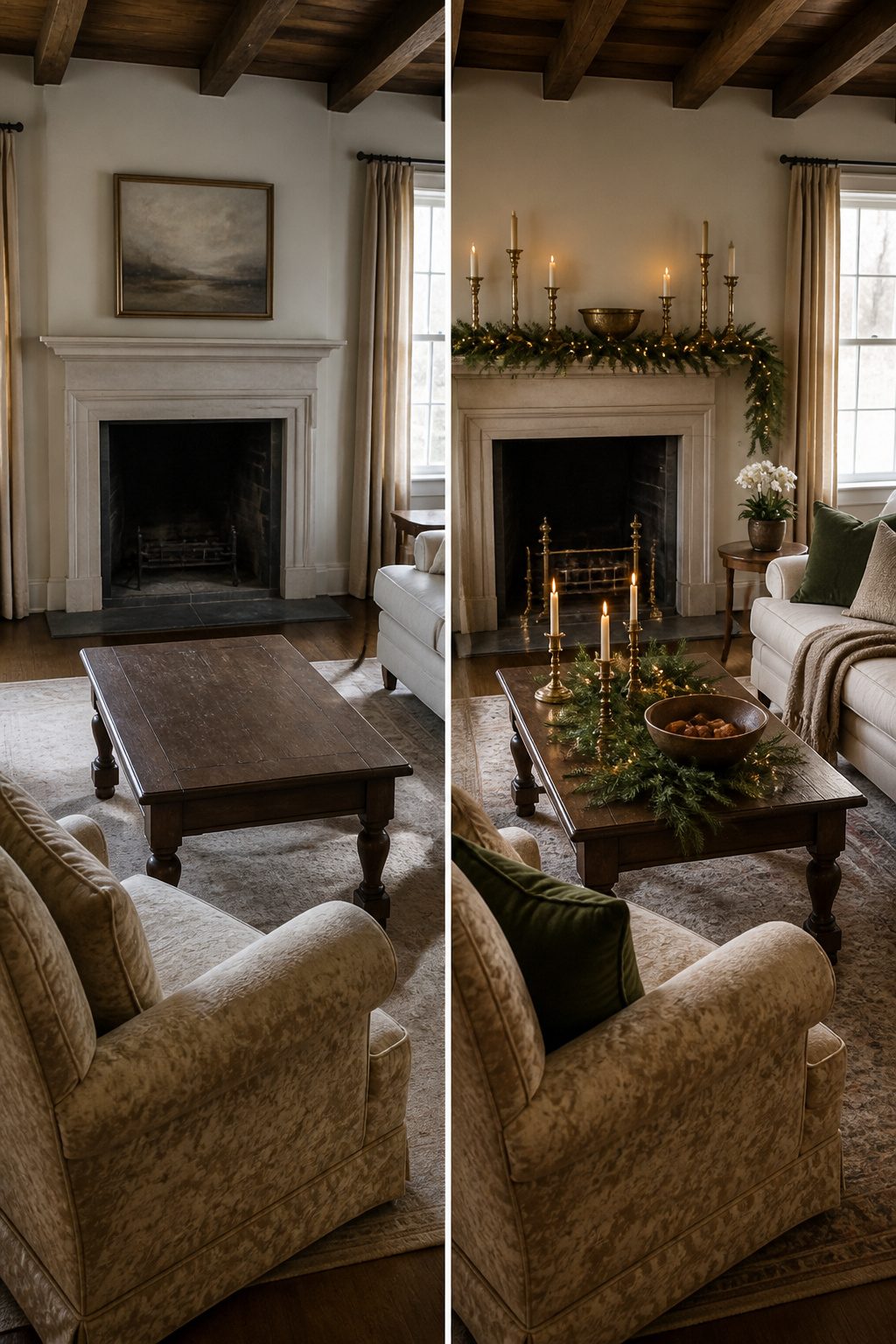
The question that always crosses my mind by mid-November is how to make the living room feel festive without another trip to the store.
Rearranging what you already own is the fastest way to a traditional Christmas look on a real budget.
I start by walking through the house with a basket, pulling anything that reads warm, metallic, or old: brass candlesticks from the bedroom, the heavy ceramic bowl I use for keys, a stack of cloth-bound books.
These audition next to the mantel or clustered under a table lamp. The trick is proximity to greenery or a strand of lights, which shifts the context from everyday to seasonal without changing the object itself.
Furniture moves matter too.
The sofa angled toward the fireplace in January gets pulled square to the window in December, opening the path from the entry to the tree so guests circulate through the room instead of bottlenecking at the door.
A side table from the guest room fills the gap, holding a pot of forced paperwhites.
What stops me from buying new is the realization that most traditional Christmas rooms are built on texture and patina, not on items labeled "Christmas."
The worn wood, the tarnish, the faded spines: those read as heritage precisely because they have history in this house, not because they came from a holiday collection.
DIY Touches Without a Workshop
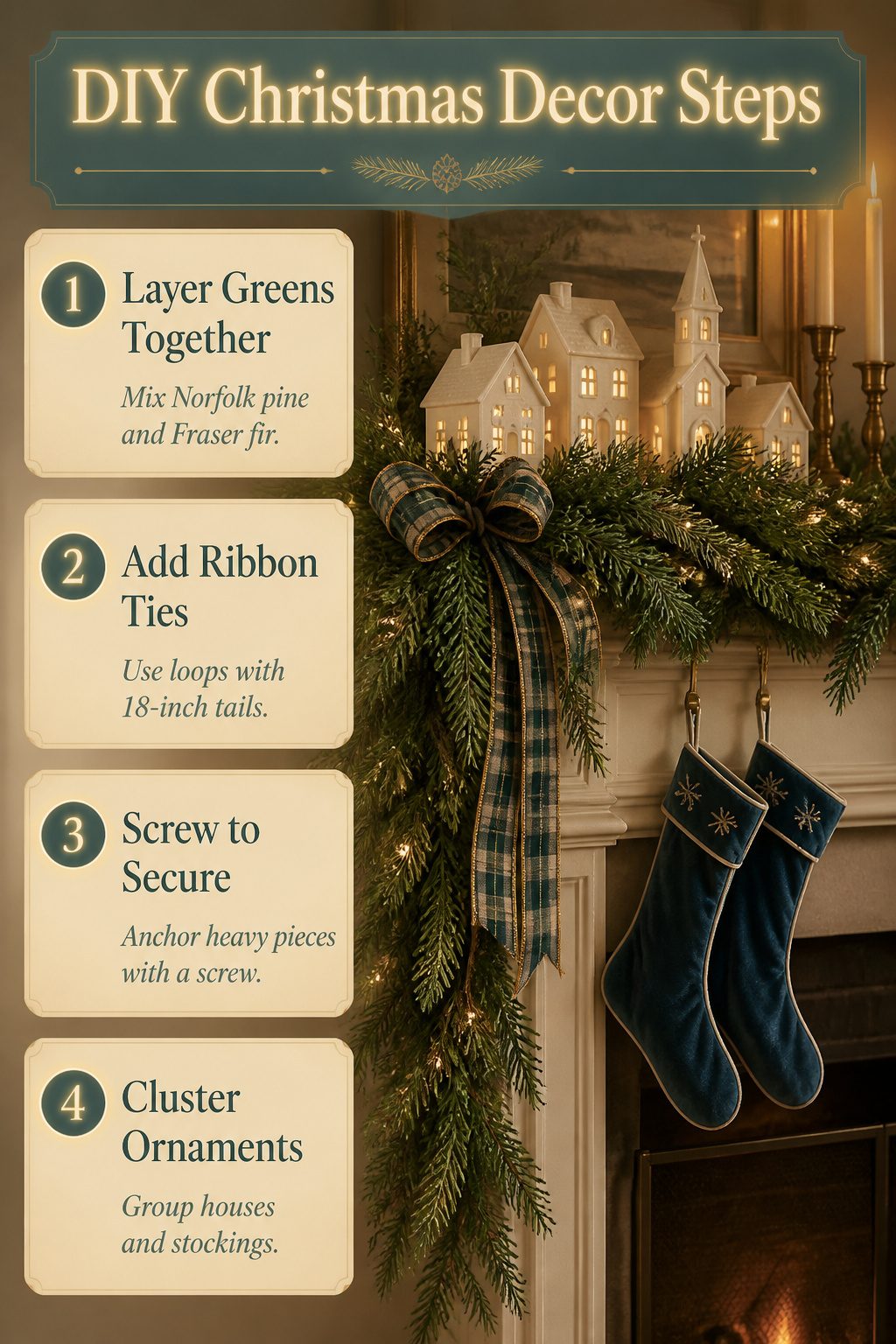
A pre-made garland can look thin once it is hung, so layering two greens changes the whole result.
Norfolk pine and Fraser fir twist together into something that reads as one lush piece, and the mix of needle shapes catches light differently from every angle.
Ribbon is where hand skill shows without needing tools. Plaid layered into greenery, tied off in loops rather than tight bows, gives the dressed-up look the pros use.
The trick is leaving enough tail, about eighteen inches, so the ends drape rather than stick out stiff.
For anchoring, a small screw set into the top back edge of a mantel becomes invisible once greenery is in place. Wire or cord wraps around it and holds weight that adhesive strips cannot manage.
Command strips work fine for lighter swags along a shelf front, but anything with glass or ceramic needs that mechanical anchor.
Ornament clustering takes the same layering idea. Creamy white houses and churches, the small ceramic kind, group tighter against a dark background so they read as one mass of light.
Blue velvet stockings with white piping hang better bunched in pairs than spaced evenly; the slight overlap looks collected over years rather than arranged in one afternoon.
Faux Greenery and Fresh Tradeoffs
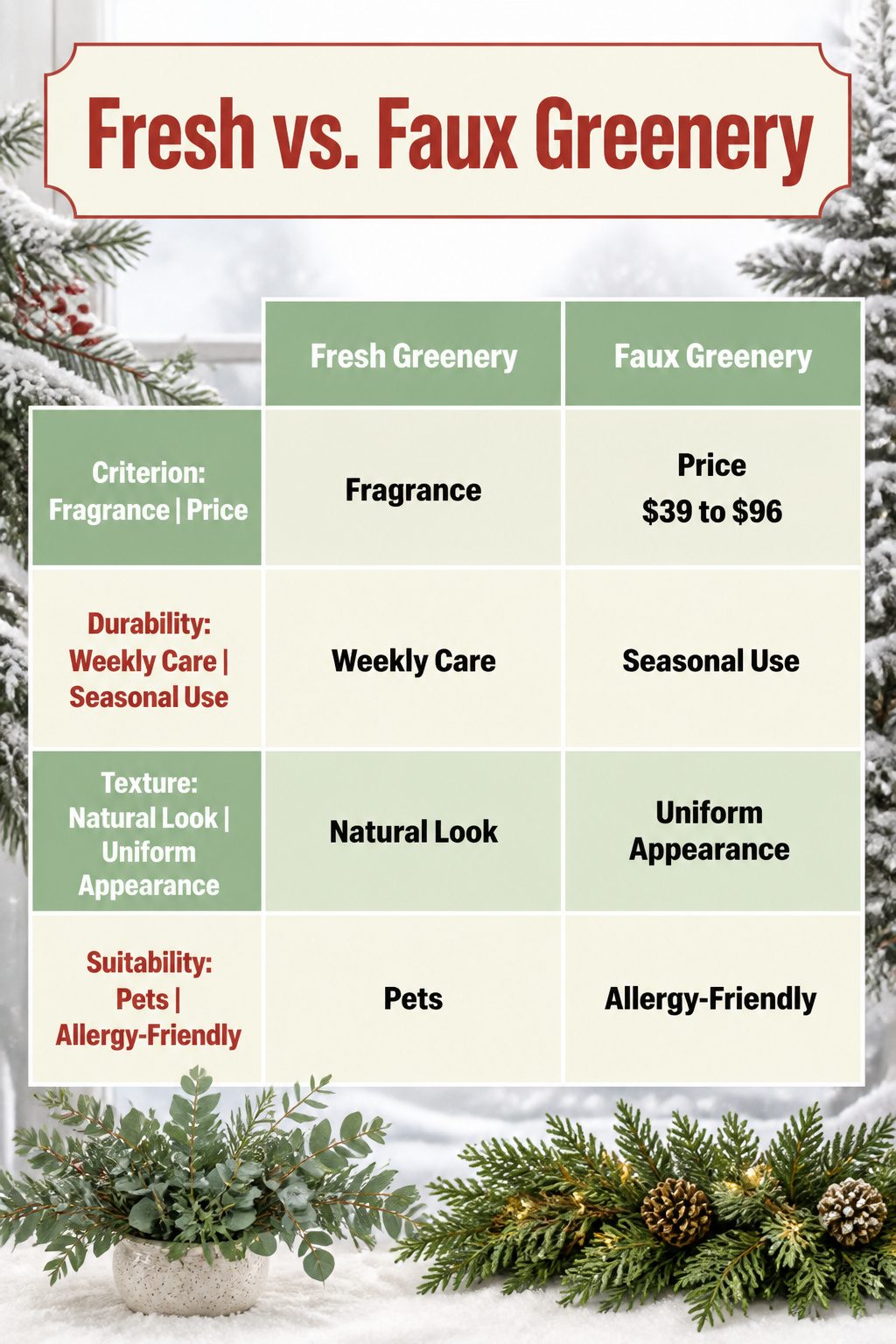
Fresh greenery carries fragrance no factory has matched, yet the pine pollen that drifts from a real wreath each December left my living room unusable for two weeks last year.
Faux cypress and cedar garlands run roughly $39 to $96, the price of a single large fresh arrangement, and they survive the season without water checks or needle drop.
The tradeoff sits in texture: artificial needles hold their shape under lights and heating vents, but they do not bruise or release resin the way real pine does, and that subtle flatness shows in photographs.
A Balsam Hill-style artificial tree or a Hearth & Hand faux cedar swag reads elegant at dusk, especially with flameless candles, yet up close the uniformity betrays itself.
For renters with allergies or pets, the calculation shifts toward stored greenery you unpack yearly; for weekend hosts who want the room to smell like the season, nothing synthetic substitutes.
My own compromise runs mixed: a small real nosegay of eucalyptus where I brush past it, artificial garlands overhead where dust and heat would brown anything living inside ten days.
Where the Money Goes

Traditional Christmas decor spending tends to cluster in three places: the tree, textiles, and the mantel.
The tree eats the biggest slice because lights, a quality artificial tree, and enough ornaments to read full from more than six feet away add up fast. That is where a phased approach saves the budget.
A good tree with warm white lights stays year one. Ornaments layer in across two or three seasons, starting with a base of solid-colored balls and filling in with character pieces as you spot them after Christmas at 50–70% off.
Textiles reward spending more than people expect. A single well-made plaid throw or crewel pillow in wool or thick cotton outlasts three cheap acrylic versions that pill by New Year’s.
The mantel runs the opposite way.
Garland, candlesticks, and village houses are visible but stationary; secondhand brass candlesticks and a string of faux cedar from a craft store bin look nearly identical to their pricier cousins when the room is lit by tree lights.
My own spending landed around $400 the first year and closer to $250 each season after, replacing only what wore out and adding one deliberate piece.
The thousand-dollar ceiling only makes sense if you are starting from bare walls and need furniture-scale items like a tree and rug in the same winter.
Frequently Asked Questions
How do I decorate my living room for Christmas?
Start with tartan plaid ribbon as your core element, layered generously through greenery on mantels and doorways, and add blue and white chinoiserie accents in three or four spots so the eye travels.
Warm textiles like wool and velvet on seating, plus vintage ornaments mixed by color family, complete the traditional look without requiring everything to match exactly.
What are some must-have decorations for a traditional Christmas living room?
Tartan plaid ribbon, generous greenery swags using Norfolk pine and Fraser fir together, blue and white chinoiserie pieces like ginger jars, and vintage ornaments from estate sales or thrift stores.
The mantel anchors the room: overfull greenery, stockings clustered to one side, and candlesticks at varying heights.
How can I make my Christmas decorations look cohesive?
Match your greens to existing wood tones rather than forcing standard red and green, and limit your palette to three colors total including walls. Let one pattern dominate and another accent; never split tartan and chinoiserie fifty-fifty.
Keep blue and white chinoiserie under twenty percent of visible holiday decor so red and green stay dominant.