
Traditional Christmas kitchen ideas run from a single wreath on a cabinet door to a full counter village that demands its own storage tub, and the difference is not budget or time but whether your kitchen still needs to function for actual cooking in December.
The two-hour setup and takedown budget I settled on after years of over-decorating means most of these ideas stay small: Command hooks for greenery, a two-square-foot cocoa tray, inherited pieces with visible damage that no store replica can replace.
1. Add Greenery
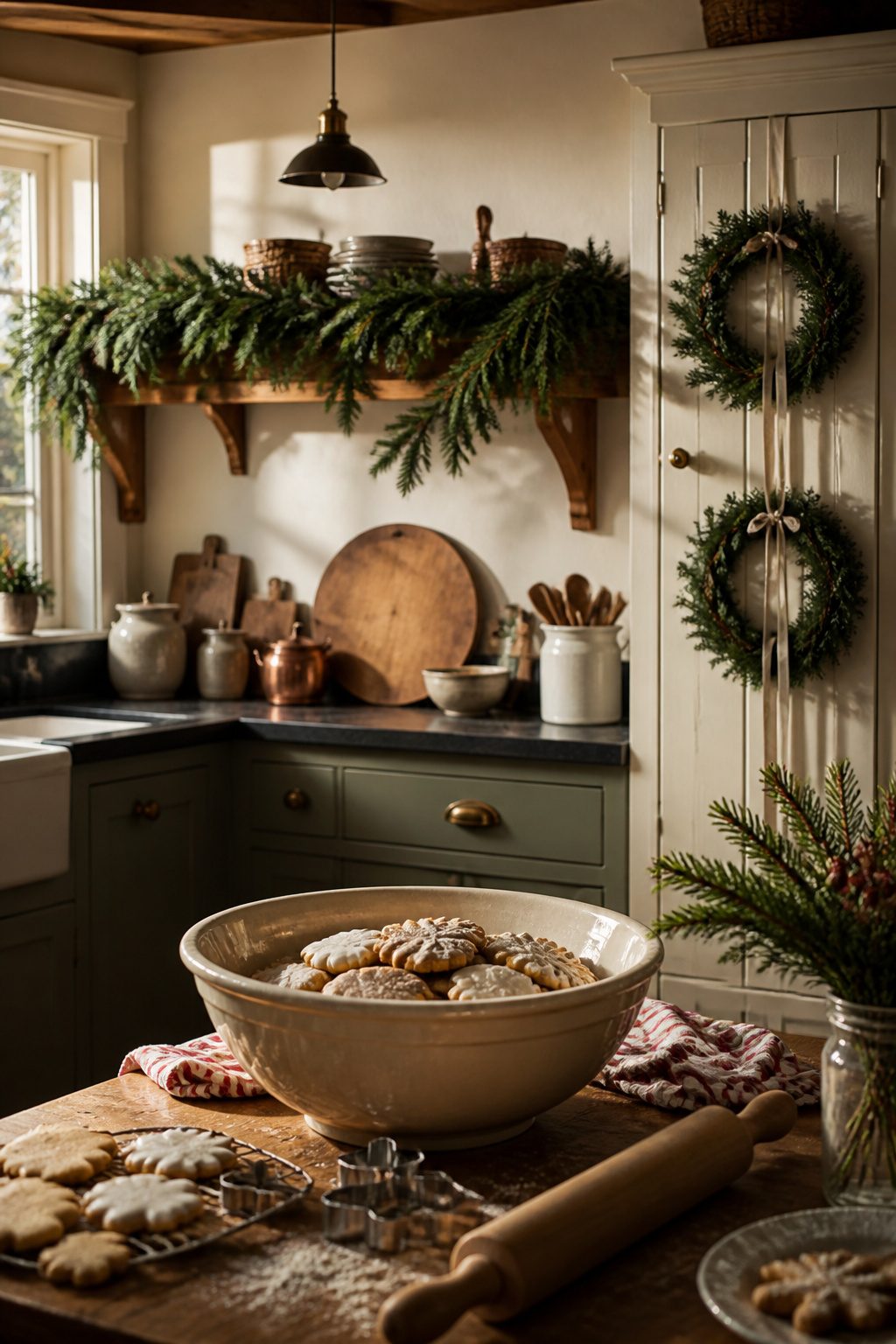
Fresh greenery reads traditional in a kitchen faster than anything else, but the shedding is real. Last year a garland of mixed pine across my open shelving dropped enough needles that I was vacuuming twice a day by Christmas Eve.
Command hooks on the inside of cabinet doors solved the wreath problem without leaving marks a landlord would charge for; I cut a small slit in the ribbon and hung them from there, and the hooks stayed put for a second year of reuse.
For renters without cabinetry that faces outward, draping garland over existing hardware like a range hood or shelf brackets skips the adhesion question entirely.
Faux greenery has improved enough that I have started mixing it in for anything above eye level, where no one is touching to check. The wreaths stay real, though.
The texture difference from three feet away still matters.
2. Use Vintage Decor
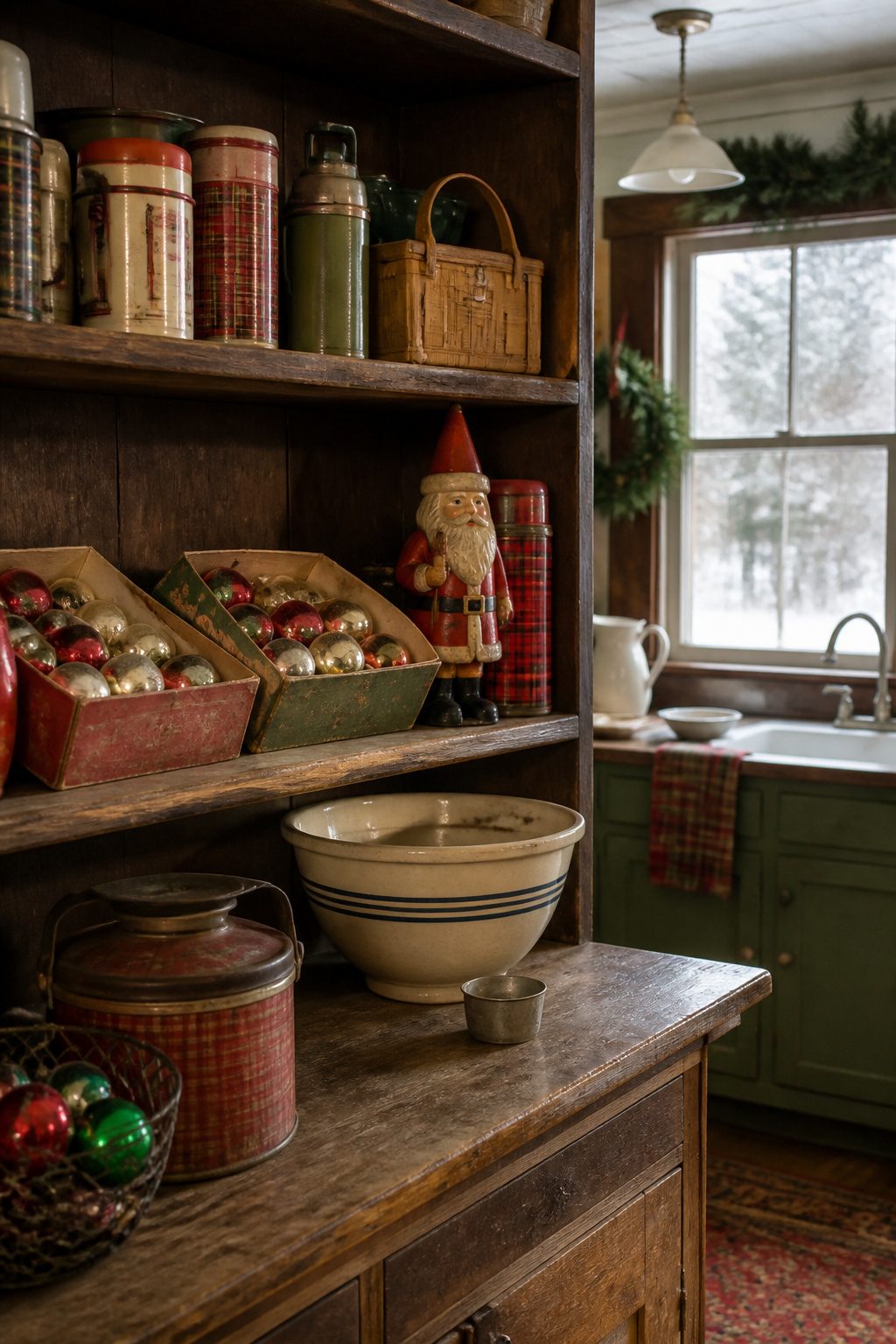
Shiny Brite ornaments in their faded red and green boxes do more to signal "traditional Christmas" than anything I could buy new.
The thin glass, the slightly crooked caps, the way they clink against each other when I lift the lid: these are the details that read as memory rather than decoration.
I found mine in a cardboard lot at an estate sale two towns over, mixed in with a 1950s nutcracker shaped like Santa and a set of plaid Thermoses that now sit on the open shelf above my stove.
Retro kitchenware works the same way. That nutcracker, the bottle brush trees in chipped ceramic mugs, the antique kitchen tools I hang from a hook rail: each piece carries a specific year rather than a vague old-time feeling.
The problem comes when I mix too many eras without noticing. Last year I paired the 1950s Shiny Brites with a 1970s plaid tablecloth and a set of 1990s resin carolers my mother-in-law passed along.
The kitchen looked like a thrift store exploded, not like one coherent Christmas morning. Two eras maximum, and they should sit at least ten years apart.
I pulled the carolers and the room settled back into something that looked lived-in rather than collected.
3. Create a Hot Chocolate Station
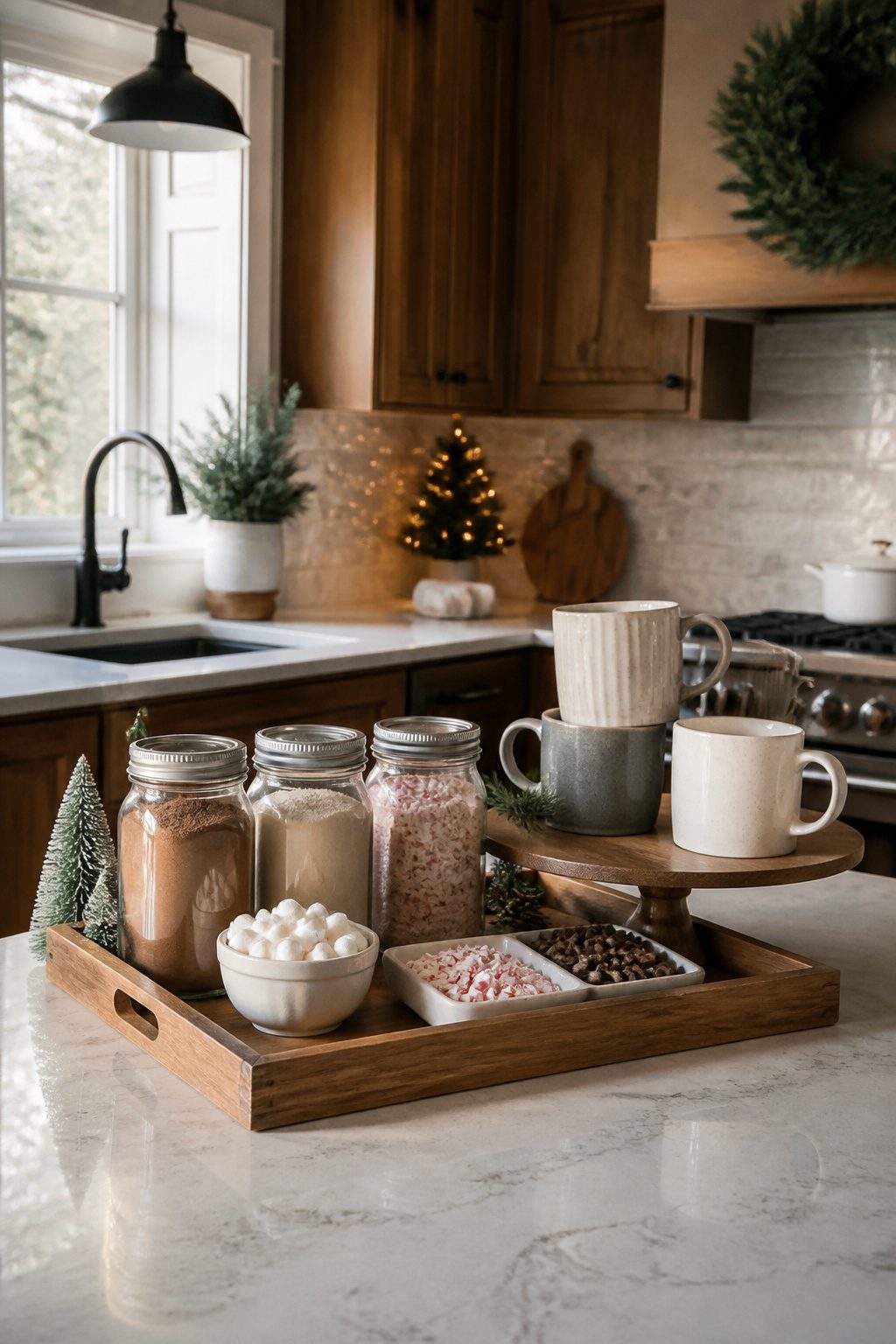
A hot chocolate station sounds small until it isn’t. My first attempt sprawled across half the kitchen counter, mugs crowding the cutting board and cocoa tins blocking the sink.
The whole thing dissolved into clutter by December 3rd.
Two square feet of counter space is the practical limit, about the size of a large baking sheet plus breathing room. That constraint turned out to be useful.
I corralled everything onto a single tray: three mason jars holding classic, white chocolate, and peppermint cocoa mixes, then a smaller dish for mini marshmallows, chocolate chips, sprinkles, and snapped candy canes.
Mugs stack on a cake stand to steal vertical space instead of spreading flat.
The holiday decorations stay minimal, a small Christmas tree or a few themed mugs doing the work. One year I added cookies and brownies to the spread; they lasted about twenty minutes and left crumbs in the cocoa jars.
Now treats live on a separate plate, if they appear at all. The station itself stays cleaner, and the two-foot footprint actually holds steady through New Year’s.
4. Decorate Shelves and Cabinets
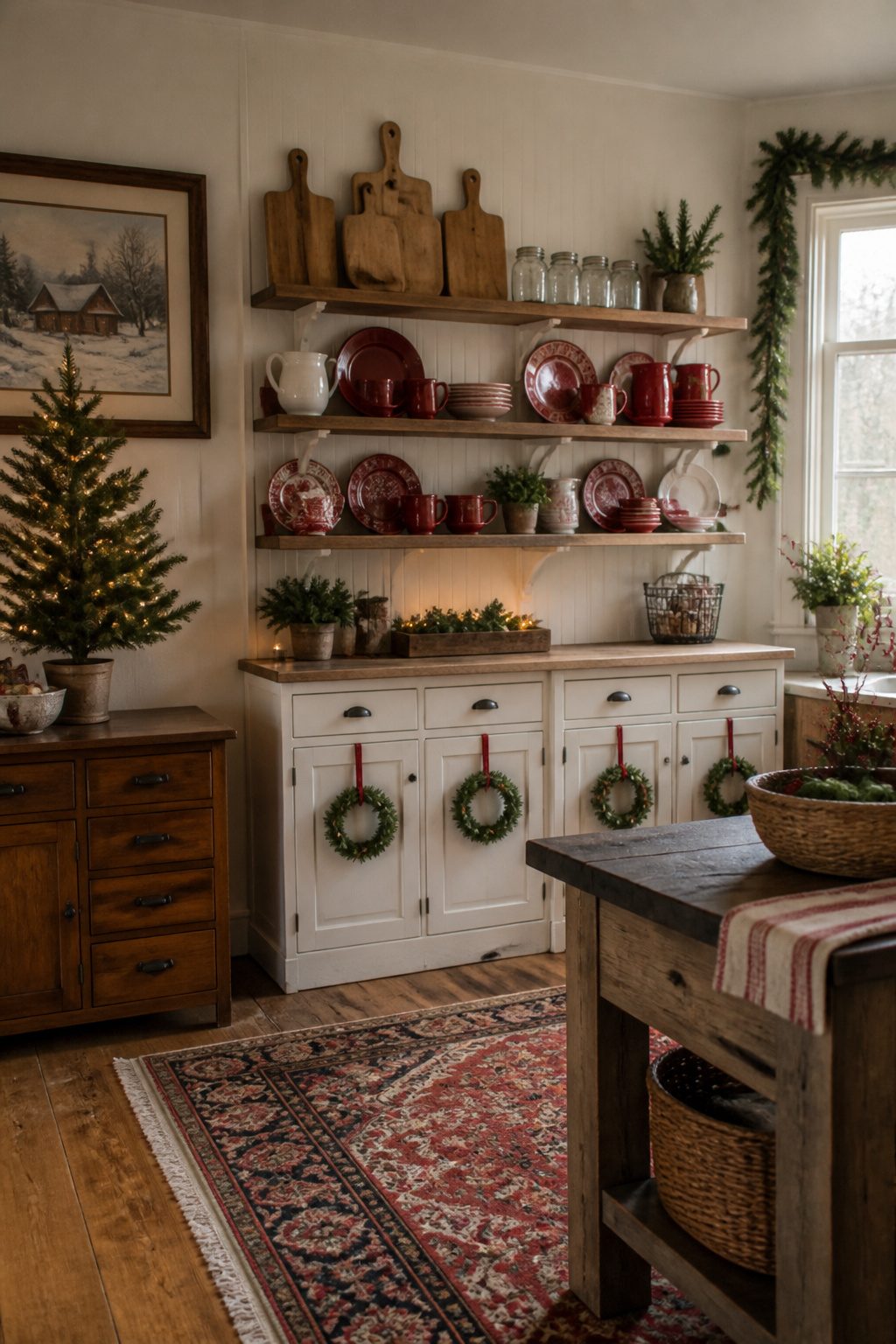
Open shelves are where the swap matters most, because every item you remove is something you use.
Last year I cleared the everyday white dishes from the lower shelf and set out a stack of red plates and mugs I’d collected from thrift stores.
The finches I’d bought a couple of years earlier perched on the edge of a small canvas print, a winter scene my grandfather painted. Up top, I left the base alone: the wooden cutting boards, the plain glass jars.
The change read as Christmas without the cost of storing an entire second kitchen.
The upper cabinets were simpler. I hung a mini wreath on each door with ribbon threaded through a Command hook, the same hooks I left up from the year before.
Scotch tape had worked in the past, but the hooks make the takedown clean.
Inside the hutch, I repeated the red-and-berry theme from the shelves so the room tied together, though the cabinet stays functional: that "capsule wardrobe" of entertaining pieces still rolls out for dinner.
What went back into the box? The cereal bowls, the everyday coffee cups, the blender base.
I missed the cereal bowls for about three mornings, then started eating from the red mugs instead. The blender stayed put on the counter; no holiday decoration is worth losing smoothie access for a month.
Keep one shelf at working height untouched, and the rest can go full festive without the kitchen becoming a museum.
5. Hang Wreaths and Garlands
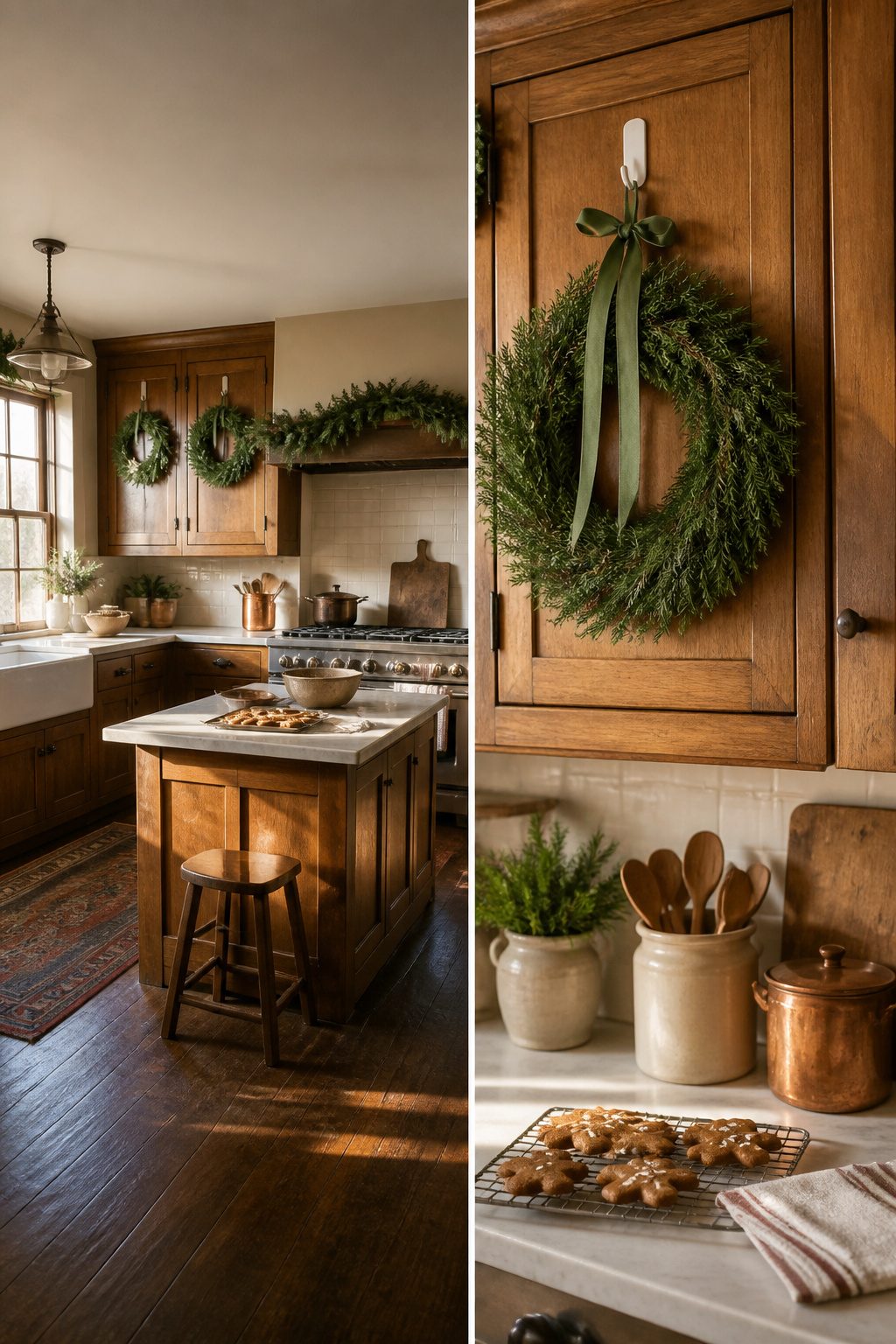
Simple wreaths on cabinet doors and garlands above the window or range hood are the most-backed traditional Christmas kitchen move I found reading through dozens of setups.
I hung mine with Command hooks after a tape experiment failed; the hooks stayed put for two years now and the ribbon just loops over.
On the range hood, a garland reads like a mantel for the kitchen, but one placement of mine drifted too close to the gas flame and had to move.
The slit-in-ribbon trick works for wreaths too: cut a small opening, hook, done. Greenery on open shelving or closed cabinet doors both play, though closed doors keep the visual quieter if the kitchen already has a lot going on.
6. Incorporate a Christmas Village
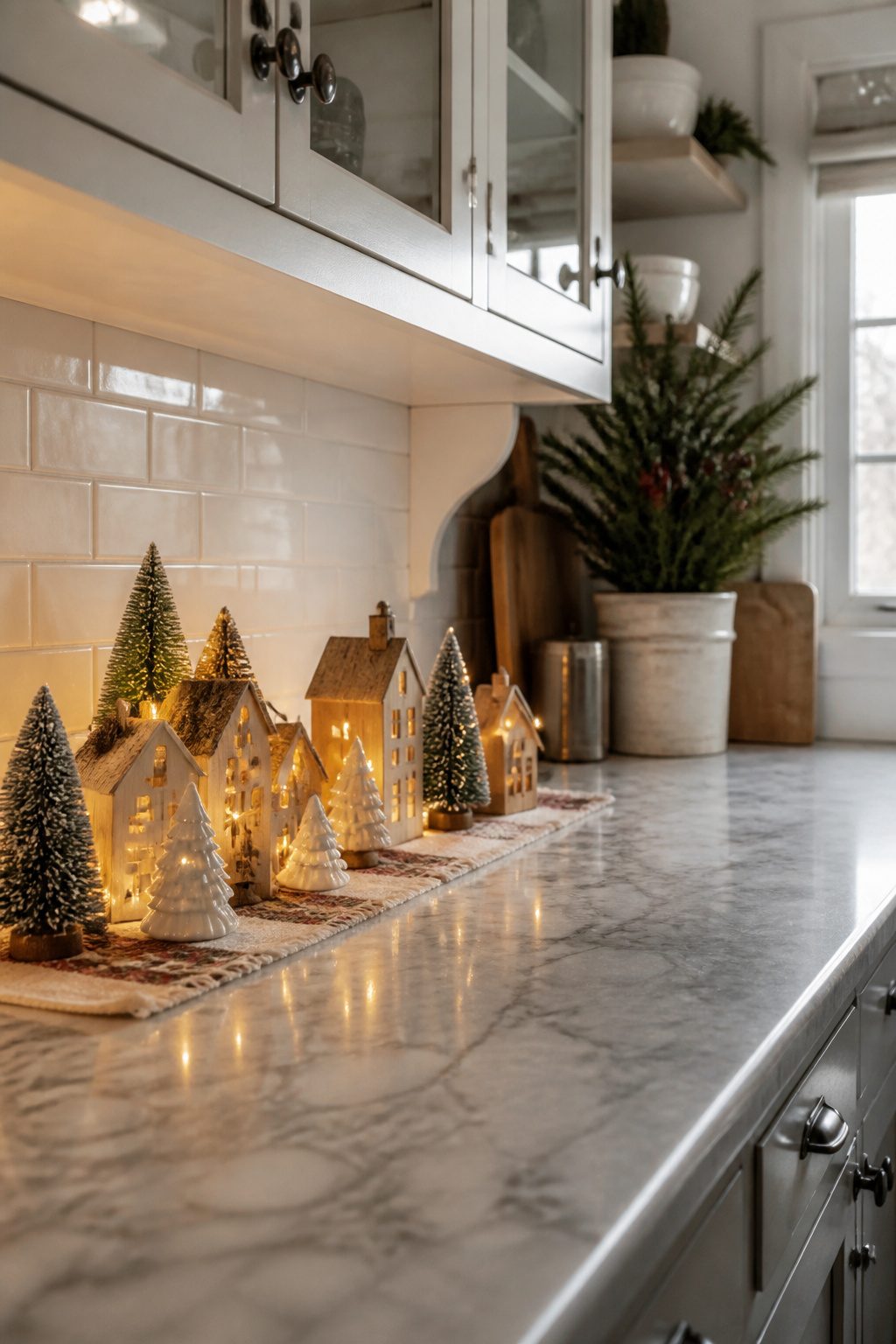
A Christmas village eats more real estate than anything else on this list, so placement matters more than the houses themselves.
I cleared the corner of my counter where the utensil canister and flour tin usually sit, a zone about the size of a baking sheet.
The ceramic trees and little wooden houses from Target’s dollar spot clustered there with a bottlebrush tree candle I added last year, and the grouping reads as one moment instead of clutter spread thin.
Scale keeps it from looking like a toy takeover. The houses sit low, maybe four inches at the roof peak, so they stay below eye level when I’m working at the counter.
LED fairy lights thread between them rather than draped overhead, which keeps the glow intimate and avoids the hardware-store-receipt look of visible cords.
The other eleven months, everything lives in a single lidded bin on the garage shelf, houses nested inside houses like Russian dolls to save the space a village demands.
The bin is the trade I accepted: one corner of counter for December, one corner of garage forever. If storage is tight, skip the village entirely and put that effort into a wreath or the tree.
A cramped display looks apologetic, and this is the one item on the list where half-measures show.
7. Use Festive Table Settings

Holiday dishware sits at the same tension every year: the plates look best when someone actually uses them, but the good stuff rarely tolerates a dishwasher.
The copper vessels and hand-built hutches Country Living spotlights are gorgeous, yet most renters do not own the furniture to store them, let alone the hours to hand-wash after Christmas dinner.
Put the Christmas china on full display this season.
What that means in practice: use the holiday pieces you already own, not the ones that demand a new hutch.
My compromise runs to ironstone with a pinecone transfer pattern, nothing finer than Crate & Barrel’s winter line from five years back.
It survives the machine on gentle cycle, stacks in the cabinet I have, and reads festive enough that guests notice.
For a centerpiece, a dough bowl of faux greenery and dried oranges follows the cottage look without the water damage risk on a rental table.
The faux clementines and clove-studded oranges from that same approach cost maybe $12 at Trader Joe’s in December, last the full season, and travel with me when I move.
The dishes work for Christmas morning breakfast and the display still photographs well for the two hours before people arrive.
8. Add Lighting
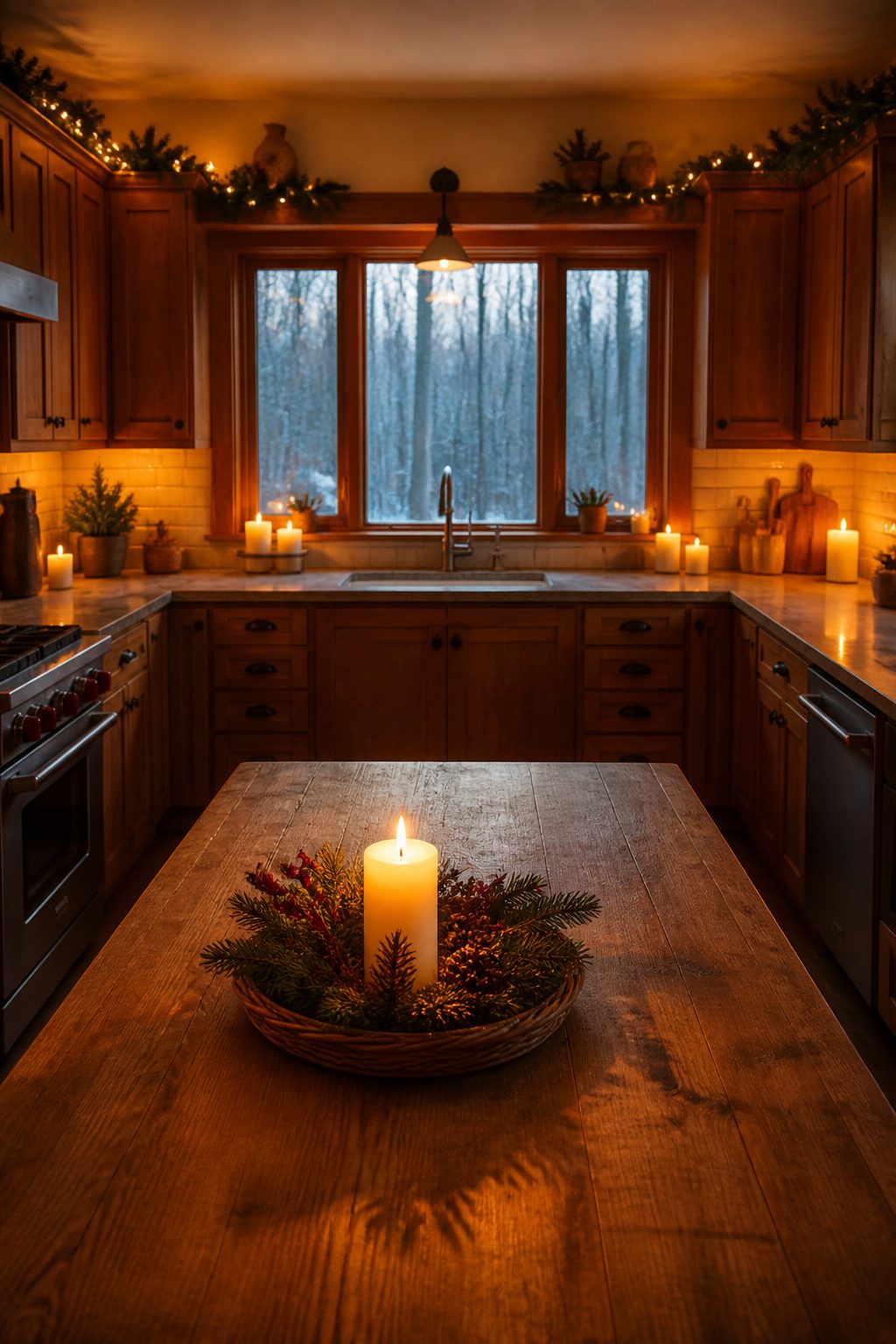
Warm light changes everything in a kitchen at Christmas, but open flame and cooking grease do not mix.
I learned that the hard way one December when a taper candle on my windowsill caught a dish towel that had drifted too close. The scorch mark on the sill is still there, a reminder I look at every year.
I stopped using tapers anywhere near the stove or prep areas after that.
Now I run plug-in string lights along the tops of my cabinets where the bulbs stay cool and the cords stay out of the way of burners and sinks.
Battery-operated LED candles go on the table and the counter that doubles as my baking station. They flicker convincingly enough for photos, and I can leave them on through dinner without hovering.
For the windows, I switched to suction-cup fairy lights that come down in January without leaving wax drips to scrape off.
The glow is softer than overhead fixtures, and the kitchen actually feels finished after dark instead of like a workspace I forgot to leave.
9. Display Holiday Treats
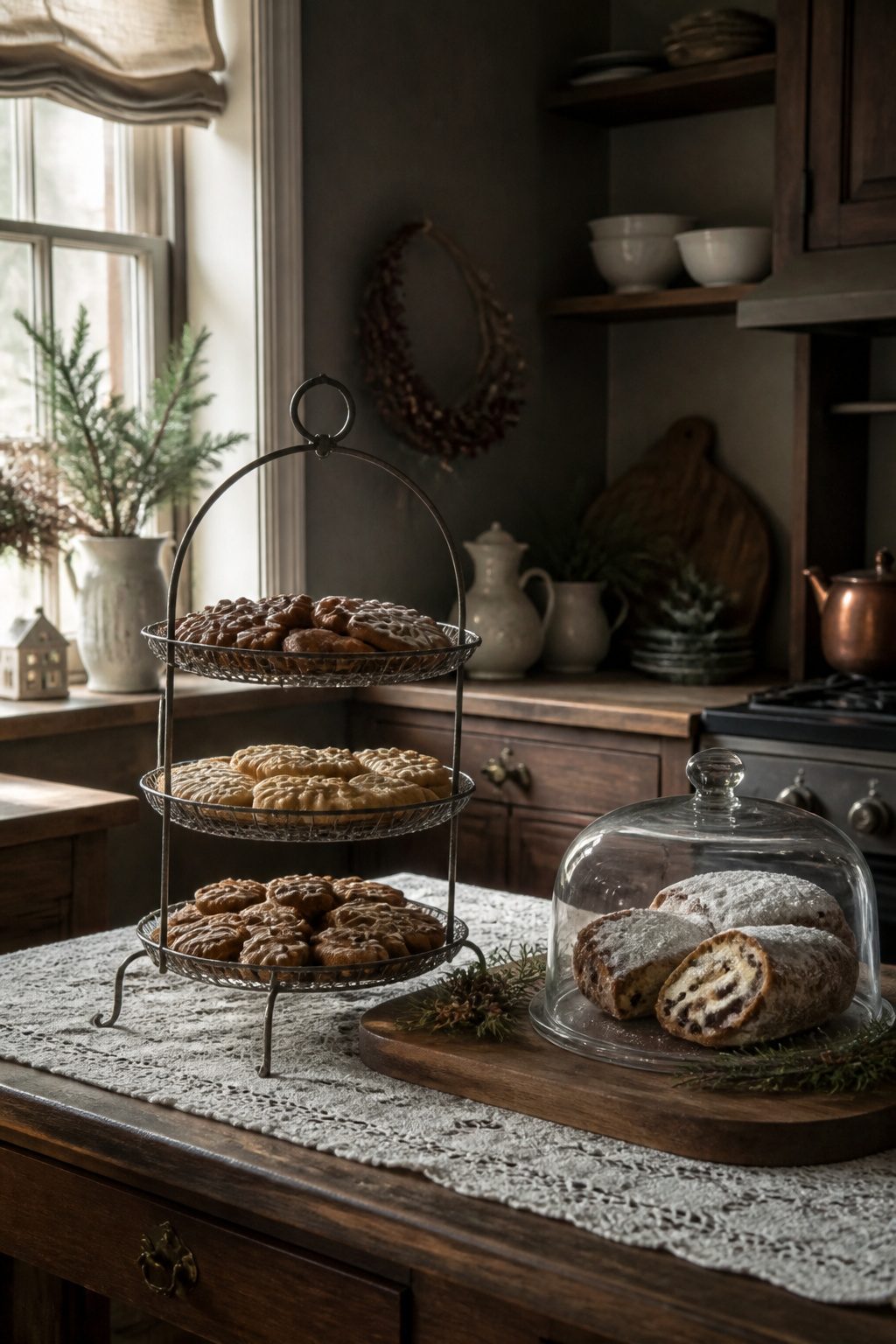
A three-tiered wire stand on the counter holds the gingerbread that actually makes it past breakfast.
I bake two batches in early December, the soft molasses kind that firms up by day three, and that third day is when the texture peaks for me.
The stand puts them at eye level where the kitchen light hits the glaze, but the real purpose is airflow; piled on a plate, the bottoms go damp in hours.
Shortbread lasts longer, maybe five days uncovered, so those go on the lower tier where humidity collects.
Anything with cream cheese frosting stays in the refrigerator; I learned that after a batch of cinnamon rolls sat out overnight and the frosting wept into the cracks.
The stand only works for dry cookies and quick breads, the ones you can wrap loosely in parchment and forget about.
A cake dome covers the stollen on the cutting board, more for the look than preservation. Sliced thin, that loaf disappears in two days at my house, so staleness is not the risk.
The risk is someone covering it in plastic while it is still warm and trapping the steam. Let baked goods cool completely before you seal them under glass, or the crust turns leathery and the display becomes a terrarium.
10. Incorporate Color Themes
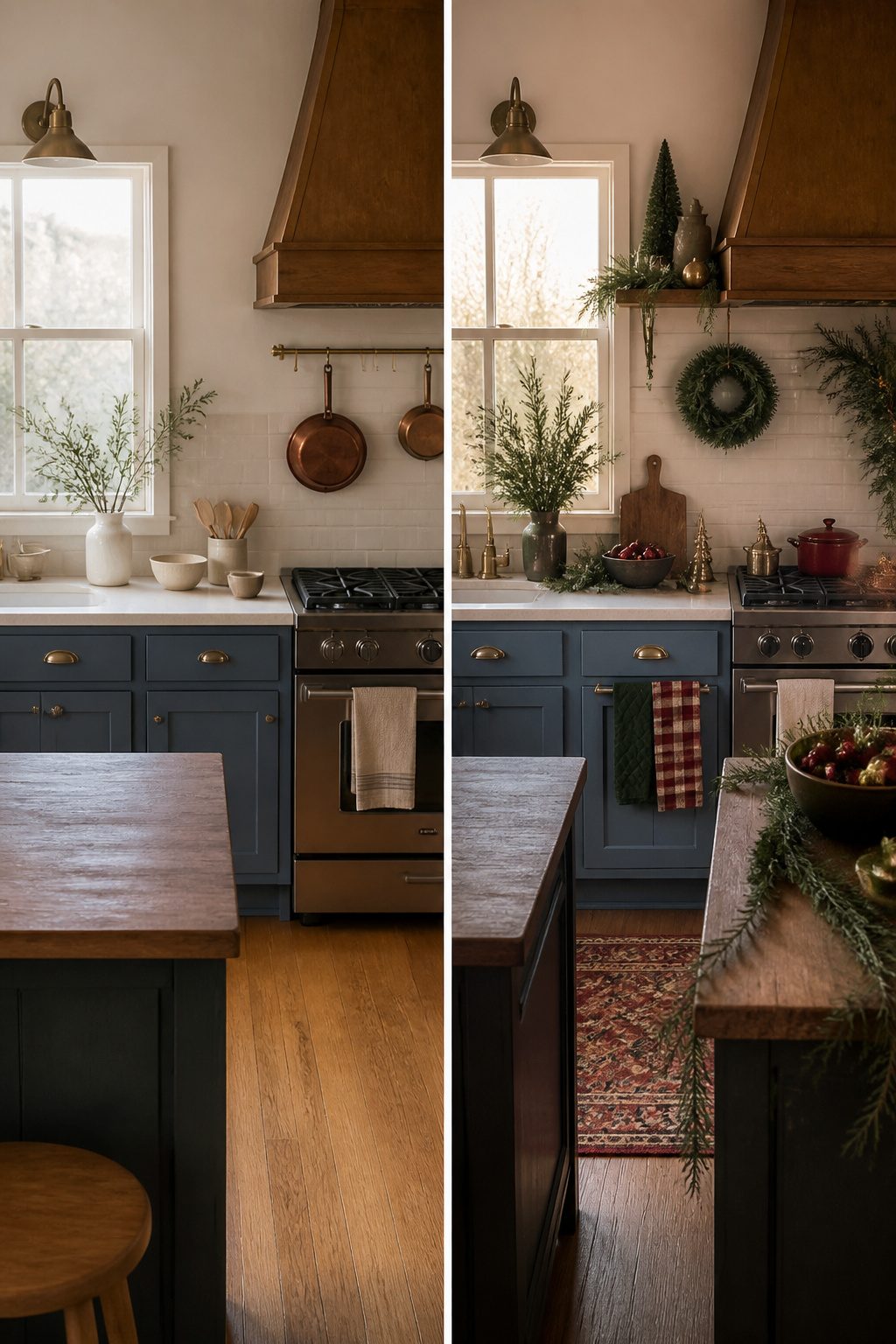
A traditional Christmas kitchen should build on what you already have rather than fight it.
Two years ago I loaded my counters with every red dish towel, red candle, and red ceramic deer I could find, then stepped back and saw the problem: my cabinets are a dusty blue, and the clash made the whole room feel like a holiday store aisle exploded in a beach house.
The red did not warm the blue; it just made both colors look cheaper.
The rule is to pick one existing tone and echo it. My blue cabinets carry a gray undertone, so the next year I swapped the red for deep greens, warm creams, and a single brass accent.
The kitchen looked intentional, not decorated.
Complementing your base colors costs nothing extra and takes no more time. It only requires holding the item up against the cabinet or wall before you buy it.
If your kitchen runs warm with wood tones or cream paint, traditional Christmas looks lean into golds, burgundies, and forest greens. Cooler kitchens, like mine, settle in with sage, cream, and navy.
The holiday feeling comes from cohesion, not from hitting every color on the Christmas checklist.
Why Personal Touches Matter More Than Matching Sets
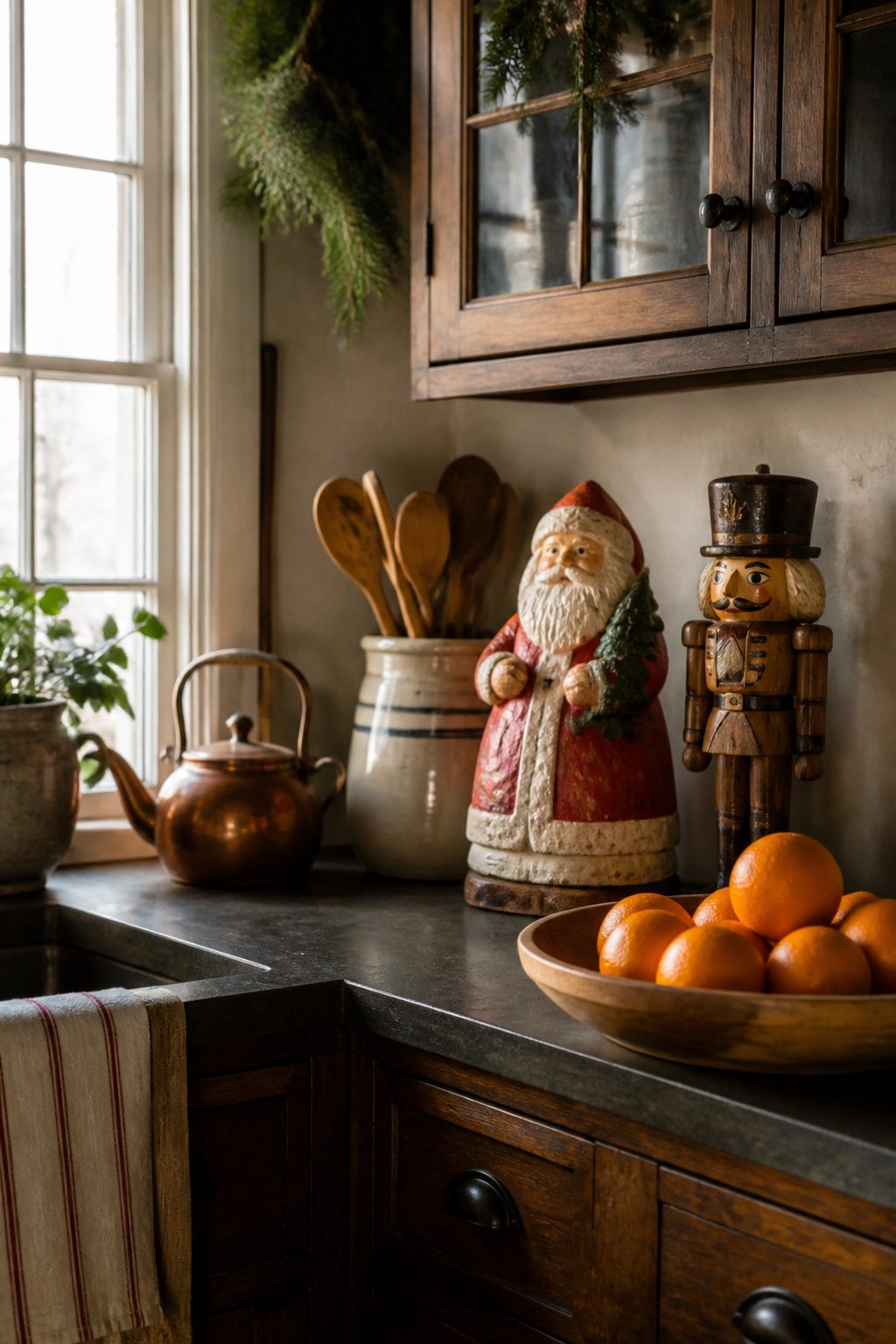
A kitchen that looks lifted from a catalog wears thin by December 26. The one that still feels right in January is held together by objects that carry weight no store can replicate.
My grandmother’s ceramic Santa, painted in the 1960s with a lopsided grin, sits beside my stove every year. The paint is chipped at the base where my toddler knocked it against the counter in 2019.
I glued it badly; the crack still shows. That flaw is the point.
Beside it hangs a wooden nutcracker my father carved, the jaw slightly misaligned so it never quite closes. These pieces tell visitors this is a kitchen where people actually live, not one staged for a single photograph.
Last year I broke the milk-glass candlestick my mother gave me, the one she received at her own first Christmas dinner in 1978. I found a replacement online within an hour, identical in shape, and paid $34 including shipping.
It arrived perfect, unchipped, with no wax residue from decades of use. I keep it on the shelf now, but it sits apart from the others.
The replacement proved that age and damage are what make an object irreplaceable. The new candlestick is merely clean; the old one was present.
Three inherited ornaments matter more to the room’s warmth than any matching garland I could buy. The trick is placing them where they earn attention, not scattering them into clutter.
One statement piece on the windowsill beats five small items competing on the counter.
DIY Elements That Look Handmade on Purpose
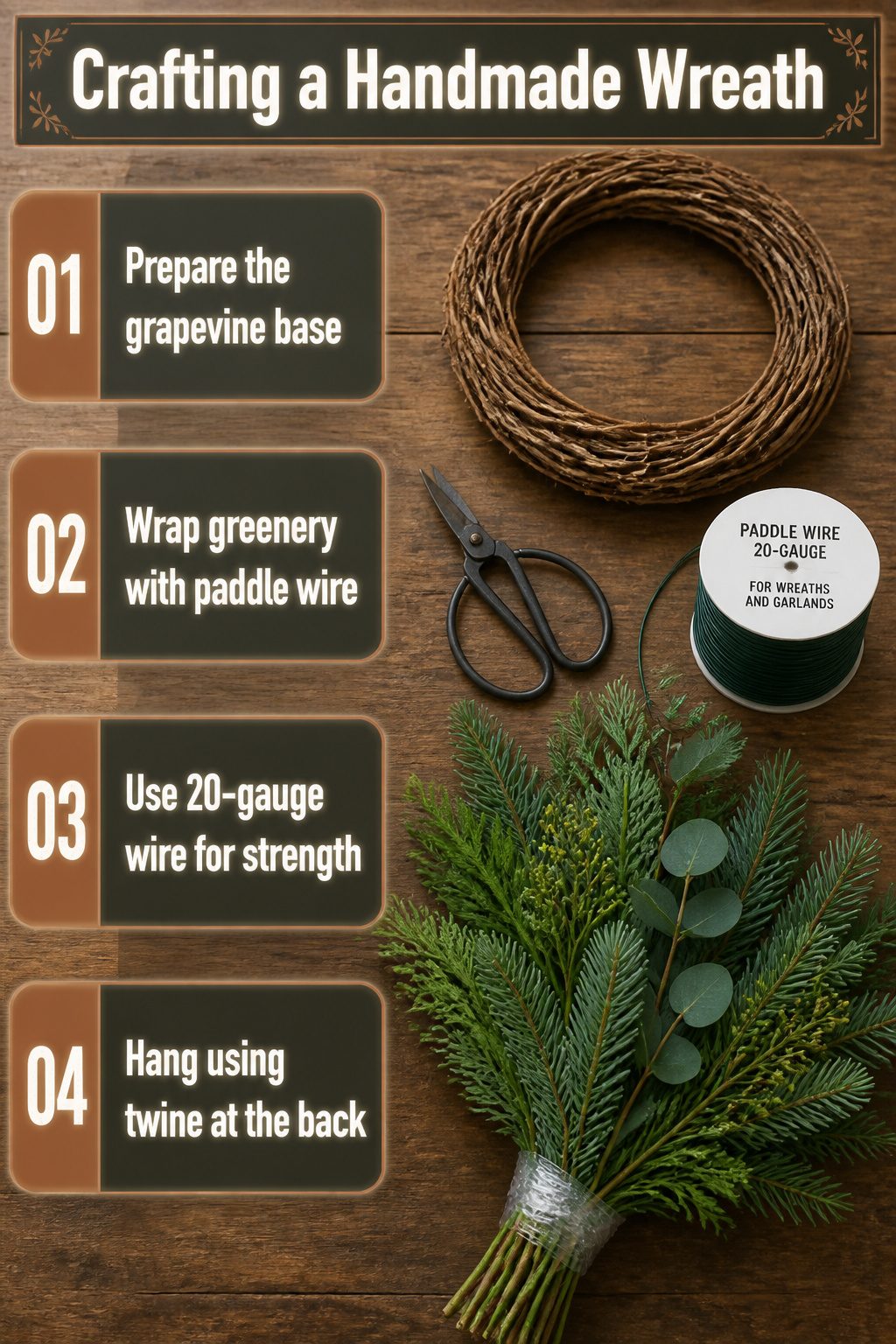
Grocery store greenery bundles, the kind sold wet-packed near the herbs, give you enough material for a small wreath that reads as handmade rather than homemade.
I split one mixed bunch, kept the stems long, and wrapped them onto a 12-inch grapevine base with paddle wire in short quarter-turns.
The wire disappears against the twigs, so the finished piece looks lashed together by someone who gardens, not someone who shops craft stores for a living.
The wire gauge matters more than the greenery. My first attempt used 22-gauge floral wire because it was what I had in the junk drawer.
It looked fine for two days, then the spruce dropped and the whole wreath sagged into an oval. Twenty-two gauge is too thin for the weight of fresh cuttings; 20-gauge paddle wire holds the tension through the season.
The grapevine base ran about $4, the greenery bundle $6, and the paddle wire another $3. Total time was under an hour, most of it standing at the kitchen counter with the stems still damp.
I hung it from a cabinet pull with twine looped through the back wires, not a hook, so the face stays flat against the door.
How Cultural Traditions Shape What Counts as Traditional
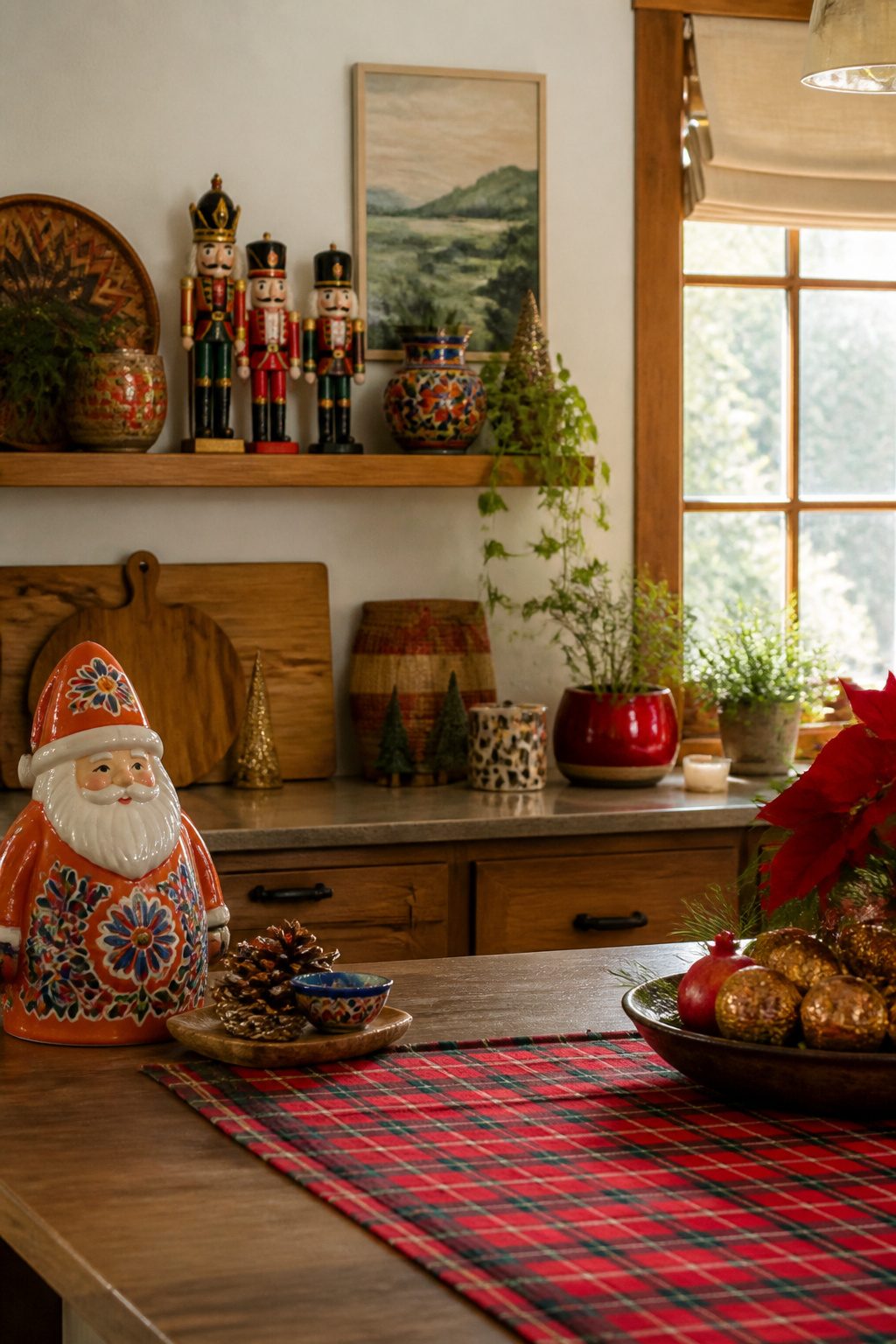
My kitchen at Christmas holds two sets of traditions side by side. The ceramic Santa my grandmother brought from Mexico sits on the same shelf as a mass-market nutcracker set from Target, and neither one apologizes for being there.
Guests always ask about the Santa first; the paint is worn where her thumb rested for sixty years, and that story matters more than any matching theme.
What counts as "traditional" in American Christmas decor is mostly a narrow German-English blend that got marketed hard in the mid-20th century.
Your own heritage pieces, whatever they are, belong in the same visual field without being ghettoized to a "multicultural corner." I cluster mine by color temperature instead of origin: the warm terracotta of the Santa reads as cozy next to a red plaid runner, not foreign.
The conversations these pairings start are the real decoration. A neighbor once recognized the pattern on a Polish paper star I hung and told me her grandmother made identical ones.
That moment cost nothing and lasted longer than any store-bought vignette.
What I Skip and Where I Stop
A working kitchen at Christmas is still a working kitchen. The stove stays hot, the sink backs up, and the mail still lands on the counter.
After a few years of boxing up gingerbread villages every January, I started measuring setup against takedown and the weeks in between. The math did not flatter my ambitions.
Here is where I drew the line:
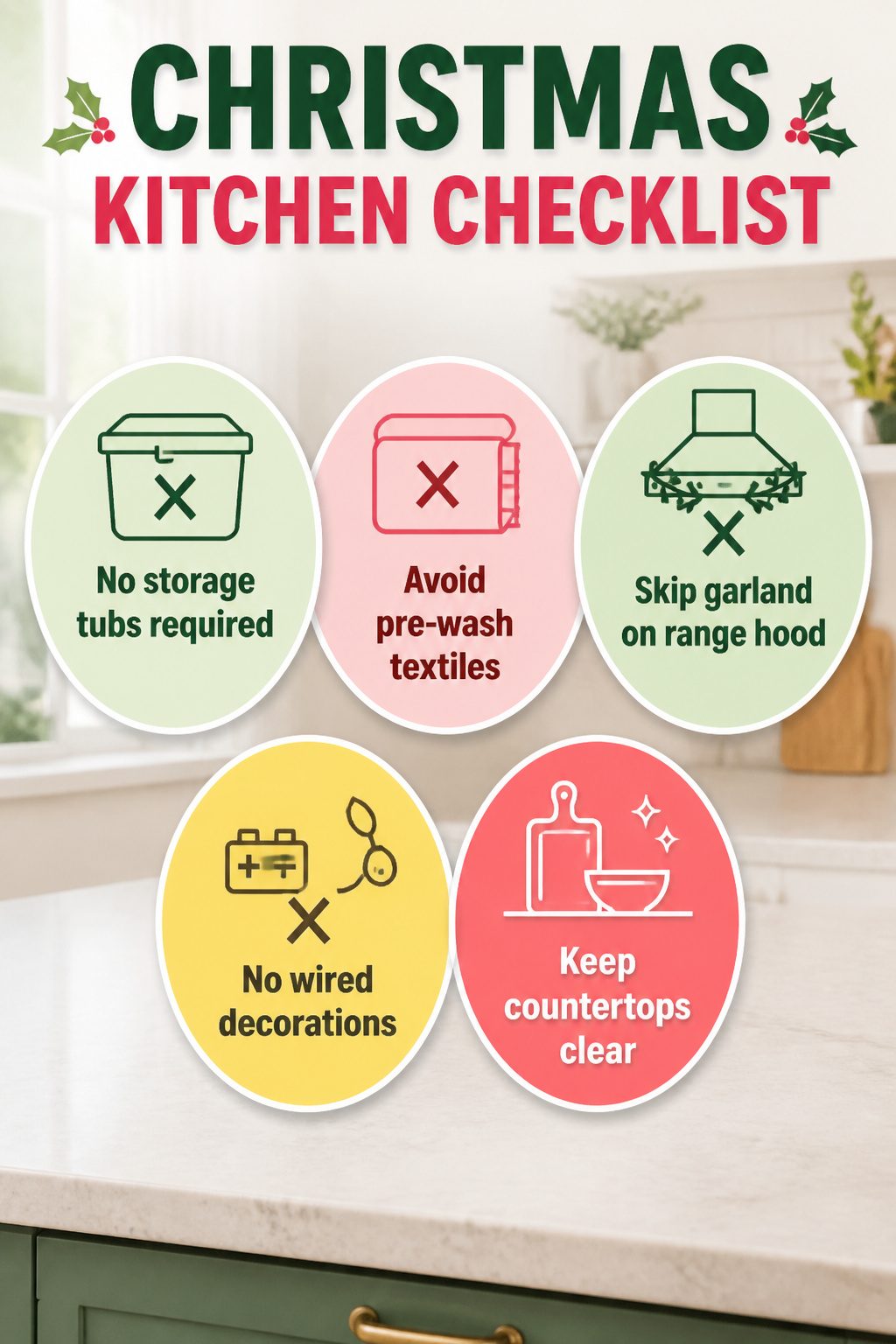
- Nothing that needs its own storage tub. Renters without an attic or basement do not have shelf space for a third set of dishes that come out for three weeks. If it does not fit in the box the Christmas lights already live in, it does not come home with me.
- No textiles that require washing before they can be packed. Table runners with candle wax or flour dust become a February chore I will avoid until March.
- No garland across the range hood. Grease settles on it by December 28, and the takedown is sticky work.
- Nothing wired into the cabinetry. Battery clips and adhesive hooks only; the deposit comes back in full.
- The village and the cocoa station are lovely in other rooms. The kitchen counter is for chopping, not for dusting miniature evergreen trees.
Two bins, one hour to deck, one hour to strike. That is the budget that survives the season.
Frequently Asked Questions
How can I decorate my kitchen for Christmas?
Fresh greenery, vintage ornaments, and small wreaths on cabinet doors give a kitchen traditional Christmas character without taking over the workspace.
Command hooks let renters hang wreaths without losing a deposit, and mixing in faux greenery above eye level cuts down on needle cleanup.
The key is swapping a few everyday items for seasonal ones rather than adding clutter on top of everything.
What are some easy Christmas kitchen decor ideas?
Wreaths hung with ribbon loops over cabinet pulls, garlands draped on existing hardware like range hoods, and themed mugs or plates swapped onto open shelves all read festive with almost no setup.
Battery-operated candles and suction-cup fairy lights add warmth without open flame near cooking areas. Two bins, one hour to deck, and one hour to strike is the practical limit for a working kitchen.
How do I create a hot chocolate station?
Reserve about two square feet of counter space, roughly the size of a large baking sheet plus a little breathing room, and corral everything on a single tray.
Three mason jars hold different cocoa mixes, a smaller dish manages toppings, and mugs stacked on a cake stand save horizontal space. Keep treats on a separate plate so crumbs do not migrate into the cocoa.
What colors should I use for Christmas kitchen decor?
Pick one tone already in your kitchen and echo it rather than fighting the existing palette. Warm wood or cream cabinets lean into golds, burgundies, and forest greens; cooler painted cabinets like dusty blue settle with sage, cream, and navy.
Two years of clashing red against blue cabinets taught me that cohesion, not checking every Christmas color, creates the holiday feeling.