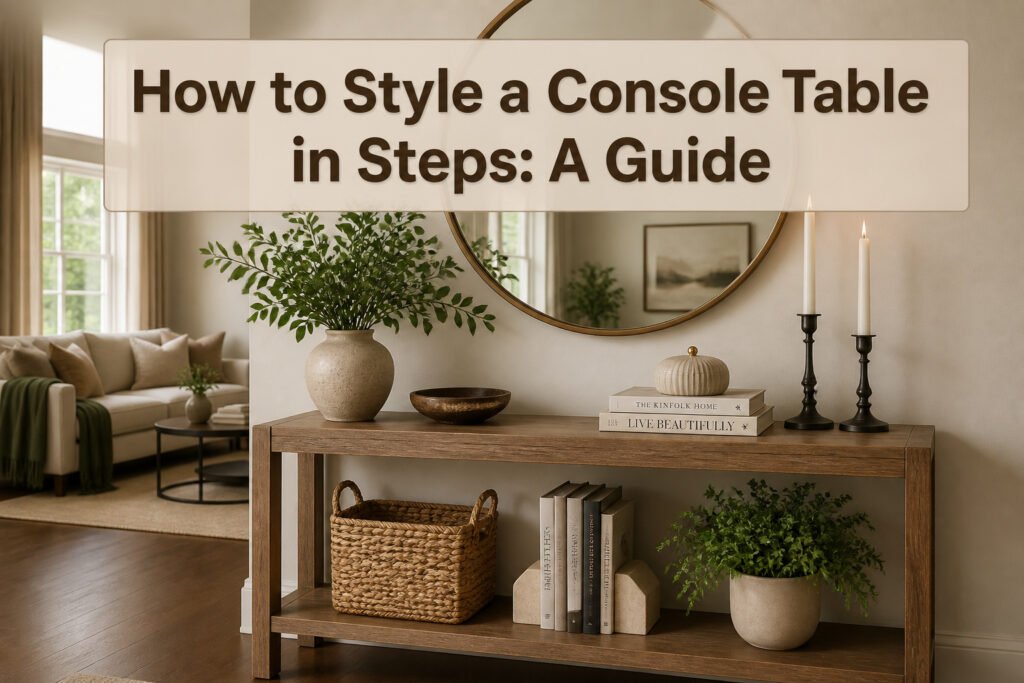
A styled console table takes about twenty minutes and zero new furniture, but most people stop at the anchor and wonder why the surface still looks scattered. The mistake is treating the wall and tabletop as separate jobs. Hanging the mirror 4 to 8 inches above the tabletop, tight enough to read as one unit, is what keeps the rest of the arrangement from floating away into randomness.
1. Hang the Anchor First
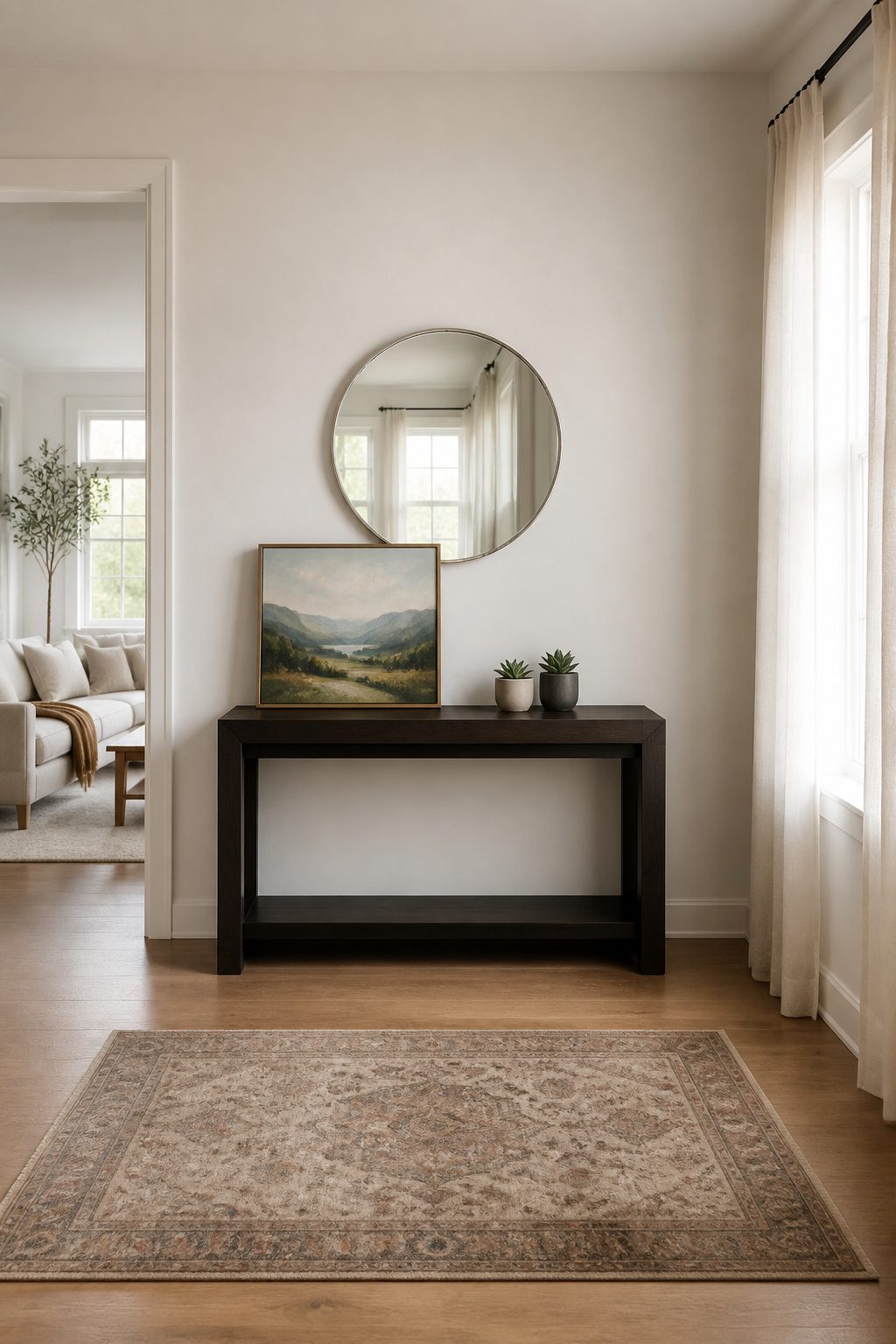
A mirror hung 4 to 8 inches above the tabletop sets the tone for every layer that follows. That gap is tight enough to read as one unit, loose enough that a lamp or tall vase won’t crowd the frame. I learned to measure this first after hanging a round mirror too high and watching the whole arrangement float away from the table like a balloon.
Mirrors bounce light into entryways that typically get little natural sunlight and give guests somewhere practical to check their appearance before heading out. Artwork leans more decorative, adding color and personality where a mirror reads neutral. For lower ceilings, a taller vertical mirror stretches the perceived height; a wide horizontal mirror suits a longer console better than a small round one that leaves too much bare wall on either side. Leaning art against the wall rather than hanging it flat creates a slightly more relaxed, collected look, and layering a smaller piece in front of a leaned mirror adds depth without extra hardware. The anchor you choose decides whether the table feels like an intentional drop zone or a surface that collected objects by accident.
2. Add Height With Lamps or Vases
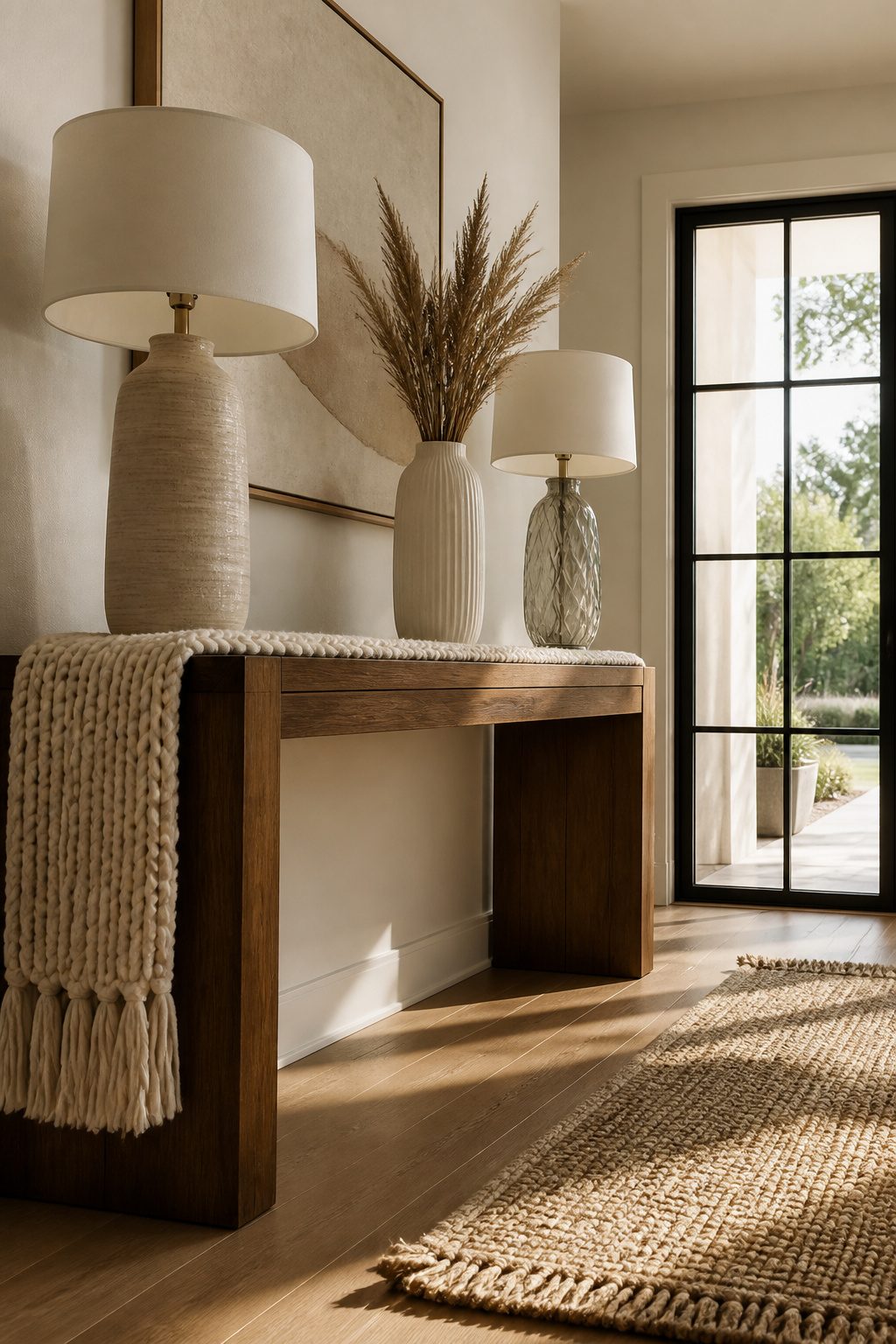
A console table without height reads like a shelf that gave up. The eye lands flat and stays there, so lamps at 26 to 30 inches tall do more than light a hallway; they force the arrangement upward and give the whole surface a backbone.
Table lamps on either end pull double duty. They add that vertical line, and they actually work for living in the space. One sculptural lamp off-center can carry a whole side if the shape is interesting enough. Vases do something lamps cannot: they bring in whatever is alive or dried outside the window, and they need no cord. A tall vase on one end balanced by stacked books or a smaller object on the other keeps the weight even without requiring matching pairs.
The high-medium-low rule is what separates styled from scattered. One tall piece, one mid, one low, read as a stair-step the eye follows naturally. A narrow console might only fit one grouping; a wider piece has room for two clusters toward either end. Without that height variation, everything sits in a line and the table disappears into the wall behind it.
3. Layer Books, Trays and Bowls
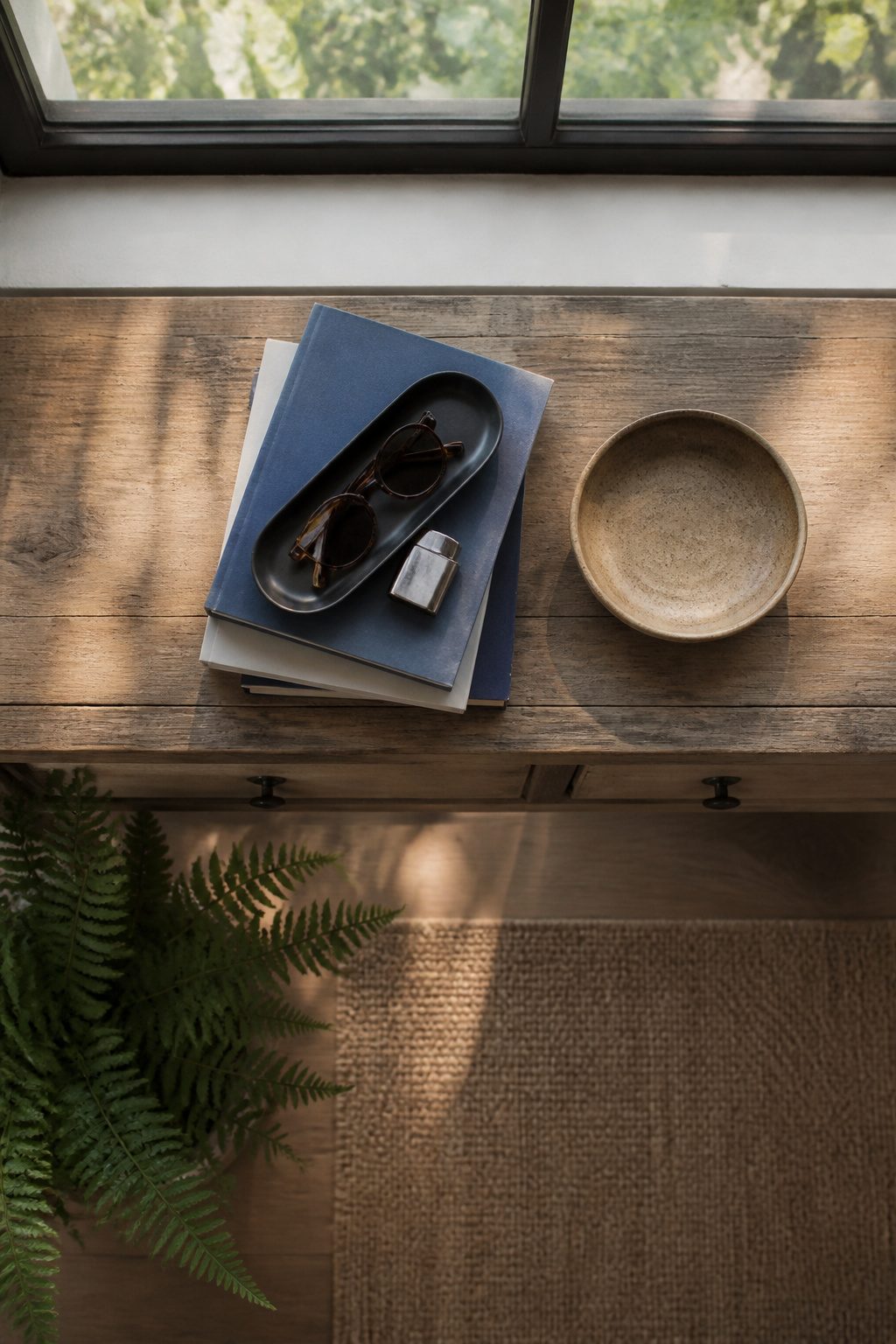
A stack of three or four books on a console table does more than fill space. The titles you actually own say something the rest of the room cannot, and the height they add lets a smaller object sit on top without disappearing. I keep mine to a single color family so the stack reads as one piece, not a yard sale pile.
A tray beside the books corrals the loose stuff that otherwise migrates across every flat surface. Mail, a lighter, the pair of sunglasses you shed coming through the door: it all lands in one rectangle that still looks deliberate. The tray is what lets the table stay styled Monday through Thursday, not just the hour after you rearrange it.
A bowl finishes the grouping. In an entryway it earns its spot as a catchall for keys; anywhere else it still gathers the small things you do not want rolling onto the floor. Two or three substantial pieces like these fill a console without crowding it. Add a fourth or fifth and the eye starts hunting for a place to rest. That rest is the point.
4. Mix Textures and Colors
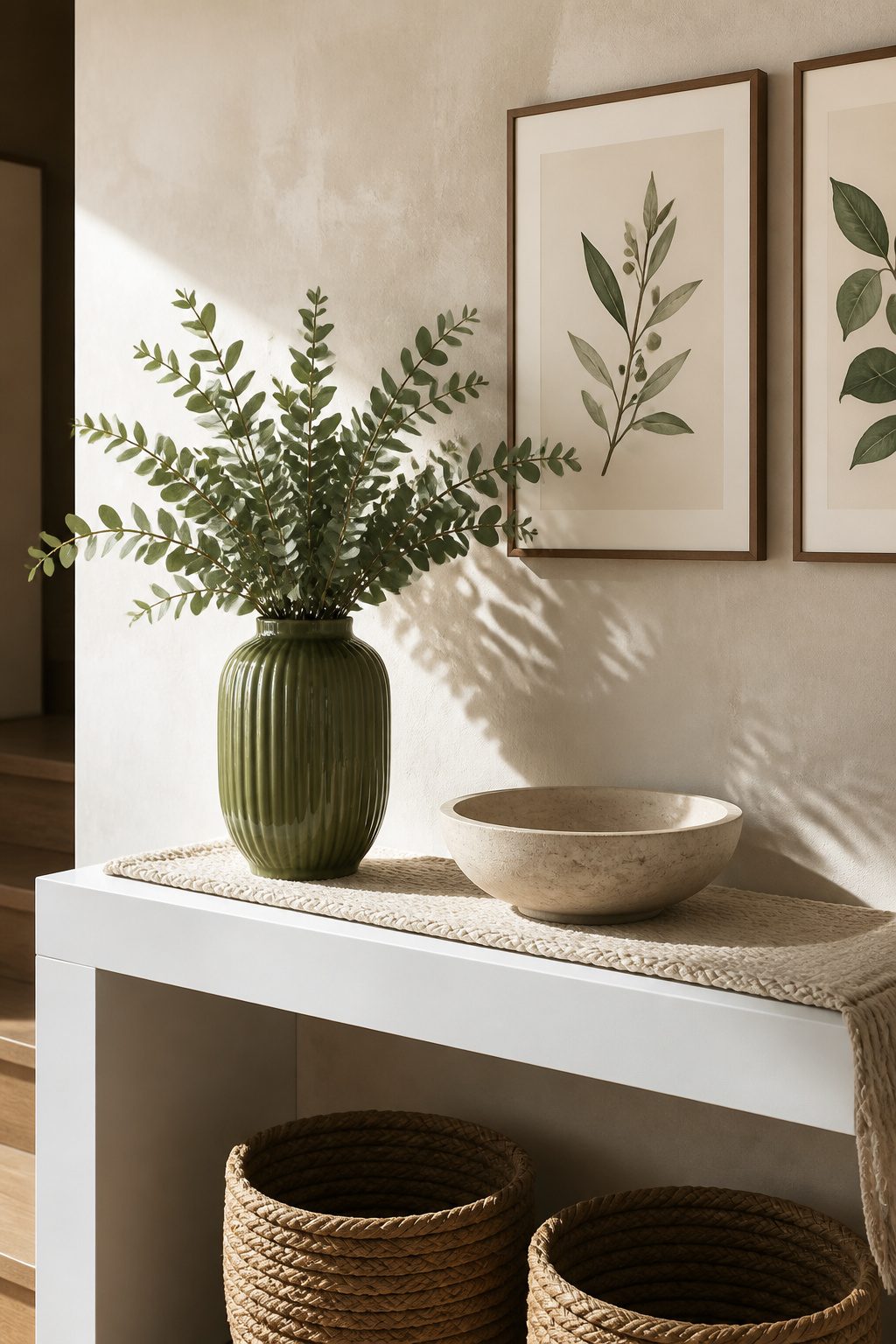
Smooth finishes everywhere read flat, even when the heights and colors are right. Last year I styled my own console with a ribbed glass vase next to a stone bowl and a chunky knit runner underneath, and the difference was immediate. The tactile variation made the whole thing feel intentional rather than like I’d ordered a single page from a catalog.
The balance sits between too similar and too competing. All wood and all white turns one-dimensional fast. But a woven basket, marble candlesticks, and a ceramic vase in clashing palettes fight each other instead of layering. What worked for me was pairing warm with cool: a wooden bowl against marble bookends, both in muted tones rather than high contrast. The materials did the work while the colors stayed quiet.
Natural texture helps most in entryways, where architectural detail and natural light are often missing. A slow-growth plant that holds its shape with minimal care adds organic texture without demanding the weekly attention fresh-cut flowers need in a space people pass through rather than linger in. The goal is evolved, not staged: enough variation that the eye travels, enough restraint that it rests.
5. Step Back and Edit
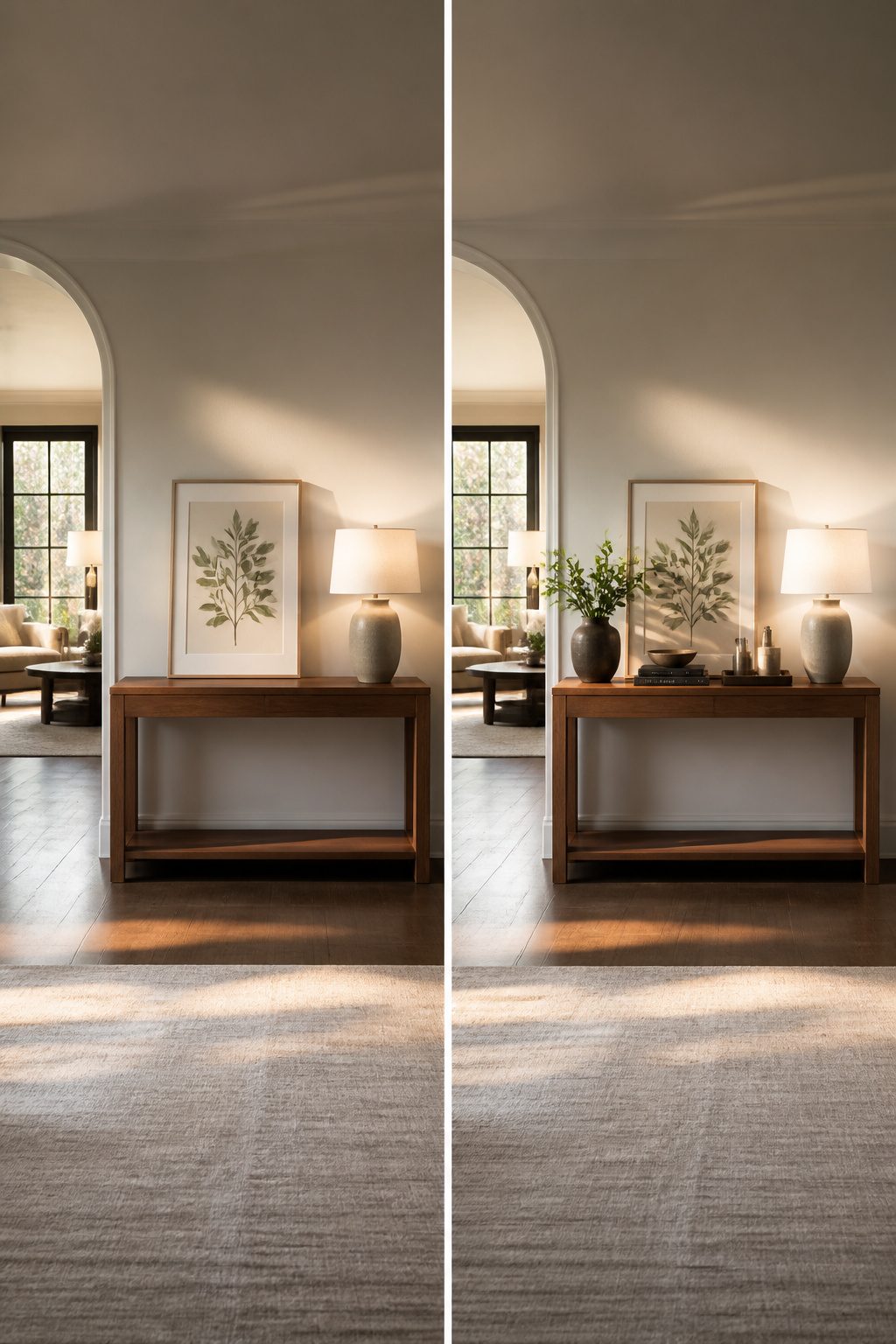
Standing six feet back from the console table changes everything. Objects that read as charming up close merge into noise at a distance, and the wall above stops reading as a composition. Remove one item after that first long look, even if every piece felt essential when you placed it. The table is not a storage unit; it is a gallery, and negative space is what lets the eye rest on what remains.
Check the sight line from the doorway you actually use. The arrangement may face a window beautifully and still collapse when viewed from the entry. Live with the edit for a day before calling it finished. Morning light and evening shadow both shift how the pieces sit against the wall, and the difference between intentional and accumulated is usually one object too many.
6. Use the Space Underneath
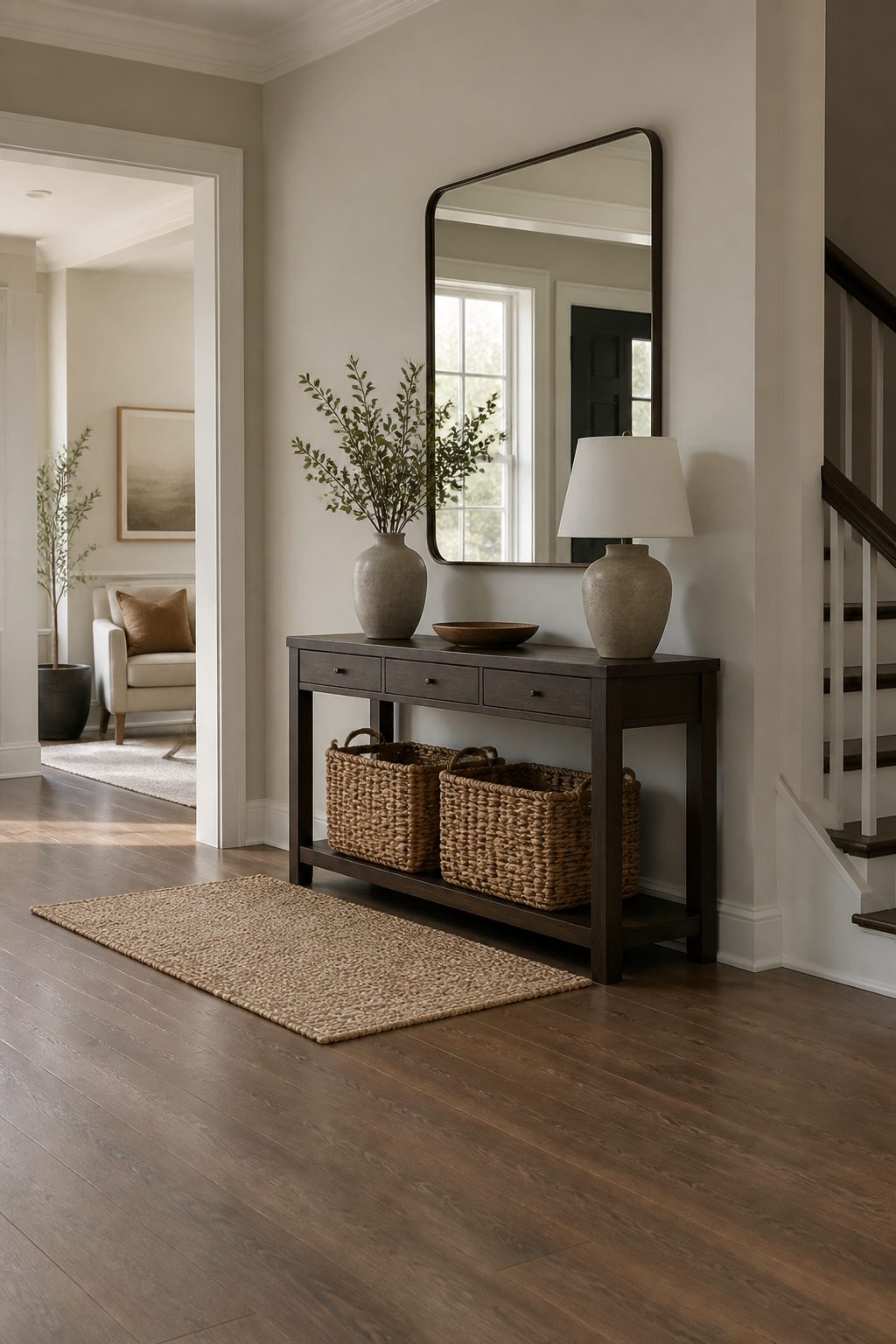
The space underneath a console table is where most entries either get functional or get cluttered. Console table depth usually runs 30 to 45 cm and height 75 to 85 cm, which leaves enough room for storage but not enough to treat the lower shelf as a catch-all.
Woven baskets are the most reliable choice because they hide what you do not want seen, scarves and returns and pet gear, while adding texture that warms up metal or stone surfaces. A boxier basket reads more intentional than something that slumps against the legs. I swap mine by season, sun hats in summer, gloves in winter, without touching the arrangement above.
Stools or ottomans underneath only work when the console is long enough and the hallway wide enough that they do not block circulation. In a narrow entry they become obstacles. A small rug in front can ground the whole piece, but it should read as material first; if the pattern shouts louder than the lamp and objects, the eye drops to the floor and stays there.
Symmetrical Against Asymmetrical
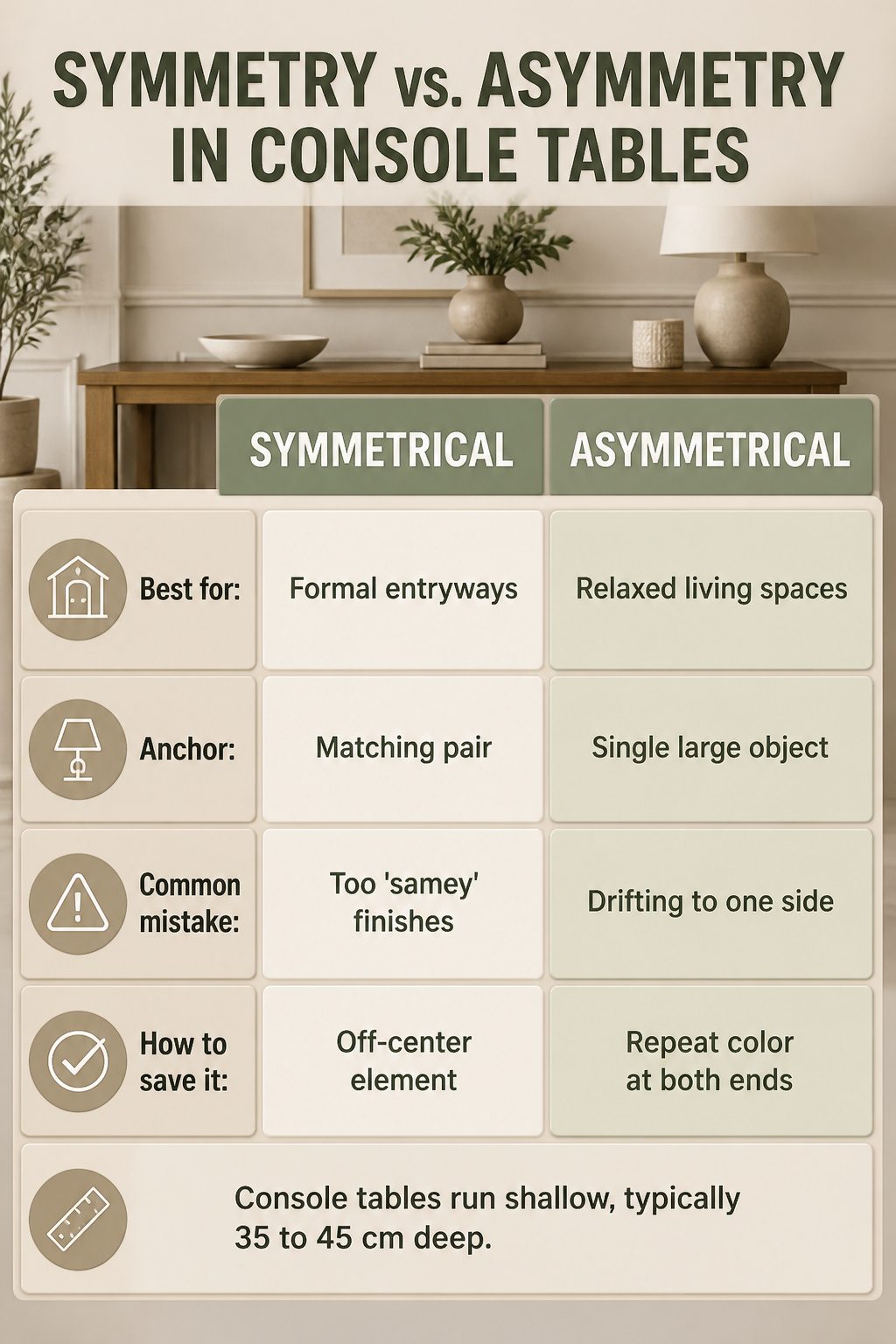
Symmetrical arrangements feel easier because they are. Two matching lamps, a centered stack of books, and the job is half done. The eye reads the balance instantly, which is why hotel lobbies use it. My own first console table stayed symmetrical for months because I could not tell what was wrong: it looked finished before it felt interesting. The fix was small but telling. I kept the twin lamps and baskets, then let a brass turtle sit slightly off-center on the books and draped one blanket so it spilled over a basket edge. That little asymmetry kept the calm without the stiffness.
Asymmetry takes more thought, not less. A heavy lamp on the left needs real visual weight on the right: a tall stack of oversized books topped with coral or a vintage magnifying glass, not a random object that happens to be nearby. The height should step down across the table so the eye travels left to right with purpose. Where symmetry relaxes into formality, asymmetry risks looking accidental unless every piece earns its place.
| Symmetrical | Asymmetrical | |
|---|---|---|
| Best for | Formal entryways, narrow tables where balance reads as breathing room | Relaxed living spaces, editorial or collected looks |
| Anchor | Matching pair: lamps, vases, or candlesticks | Single large object, then descending heights |
| Common mistake | Too "samey" if every finish matches; vary eras and textures | Everything drifts to one side; the table feels lopsided by Tuesday |
| How to save it | Pull one element slightly off-center, like a plant or draped textile | Repeat one color at both ends so the eye still travels across |
Console tables run shallow, typically 35 to 45 cm deep, so overcrowding hits faster than on a sideboard. Symmetry can hide that by keeping the center clear. Asymmetry needs the discipline to leave real empty space, or the narrow surface turns into clutter.
What I Change for Narrow Entryways
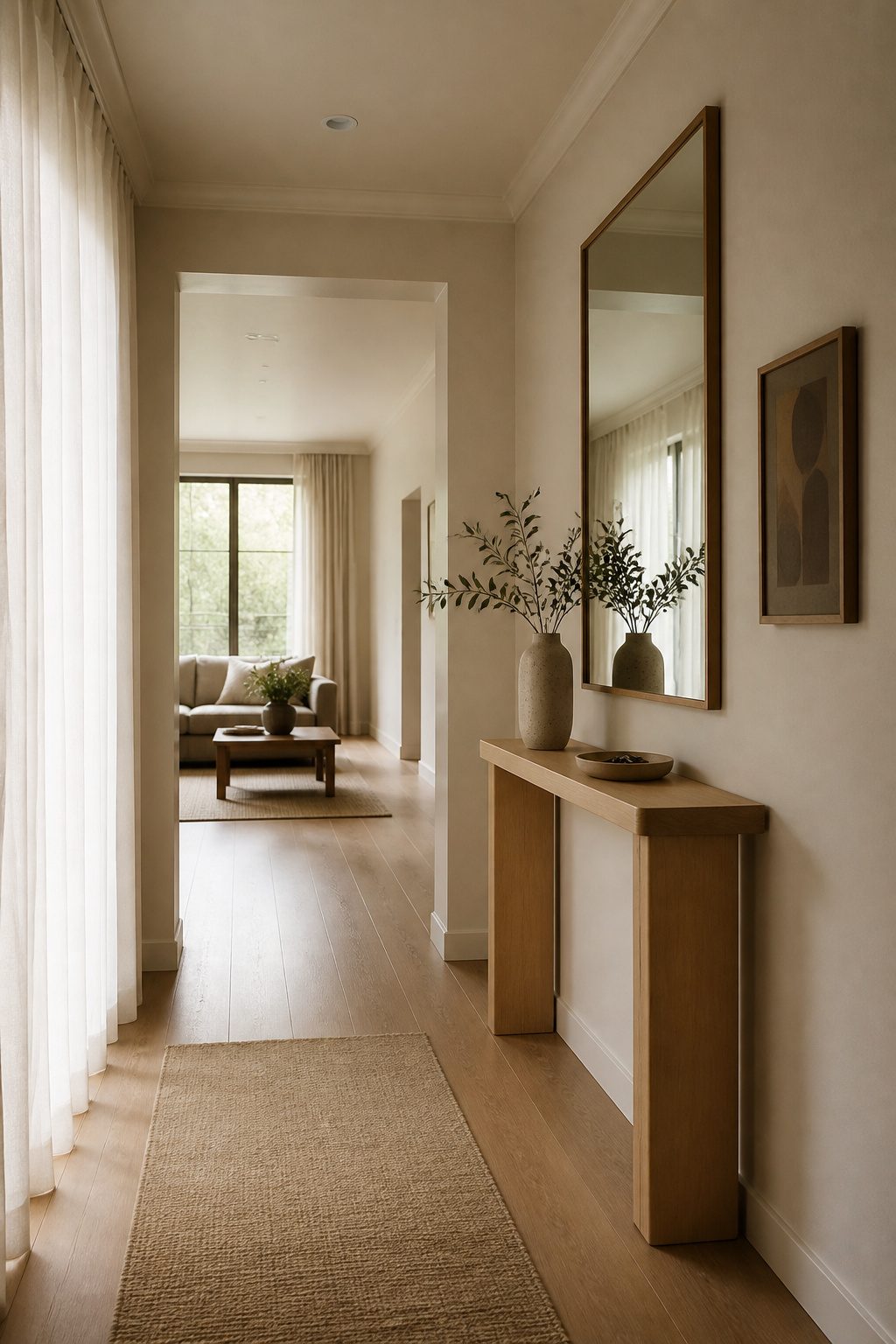
A console table in a narrow entryway has to earn its keep without blocking traffic. Most run 35 to 45 cm deep, which means the same five objects that look curated on a buffet read as clutter here. I start by cutting the count in half, then I cut it again.
Vertical elements save the surface. A tall vase, a slender lamp, or a stack of books standing on end draws the eye up without eating the 30 cm of usable depth. The wall above matters more than the tabletop itself. A mirror or art piece wide enough to relate to the table below it closes the gap between furniture and architecture, especially in rentals where the walls themselves offer nothing.
The functional layer still has to live somewhere. A slim tray for keys, a small bowl for mail. Skip it and the clutter arrives on its own within a week, no matter how styled the rest looks. I keep one drawer or one lidded box if the table allows it; if not, the tray sits at the back edge where it does not interrupt the walk path.
Door swing and closet clearance get checked before anything is placed. A console positioned too close to an opening door becomes a daily obstacle, not a welcome. The slim proportion that works in a tight entry, 30 cm deep or even less, only works if the passage around it stays clear.
Seasonal Switches That Actually Happen
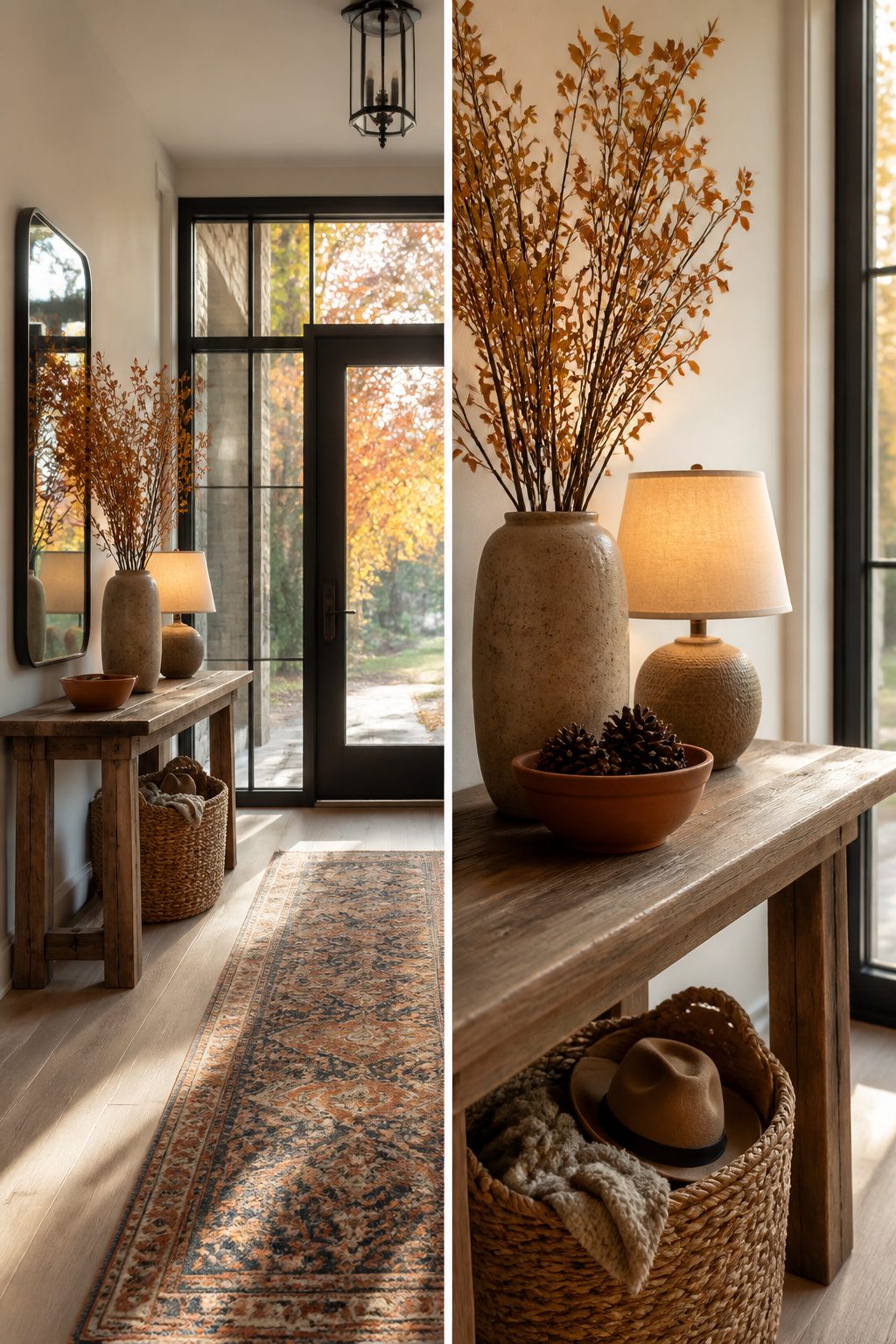
A console table’s small footprint makes it one of the easiest pieces in a home to refresh without a full redecorating effort. I swap stems season to season to keep the space feeling current: fresh clippings or Trader Joe’s stems in spring and summer, then branches in fall. The lamp, the mirror, the console itself stay exactly where they are.
The same swap applies underneath. Baskets in the lower shelf or tucked beneath rotate by season: sun hats and sandals in summer, gloves and scarves in winter. That storage keeps the surface itself clear for whatever is current.
The investment in higher-quality anchor pieces pays off across every season this way. You are replacing a $12 bunch of stems or a woven basket’s contents, not the lamp you saved for. The entryway feels deliberate without the budget of four complete tableaus. Richer tones and candlelight work for fall and winter; lighter ceramics and airy textures read as spring. I have never managed a full Ramadan lantern or festive greenery rotation myself, but the principle holds: one seasonal accent does the lifting, and the rest stays put.
Personal Items Without the Clutter
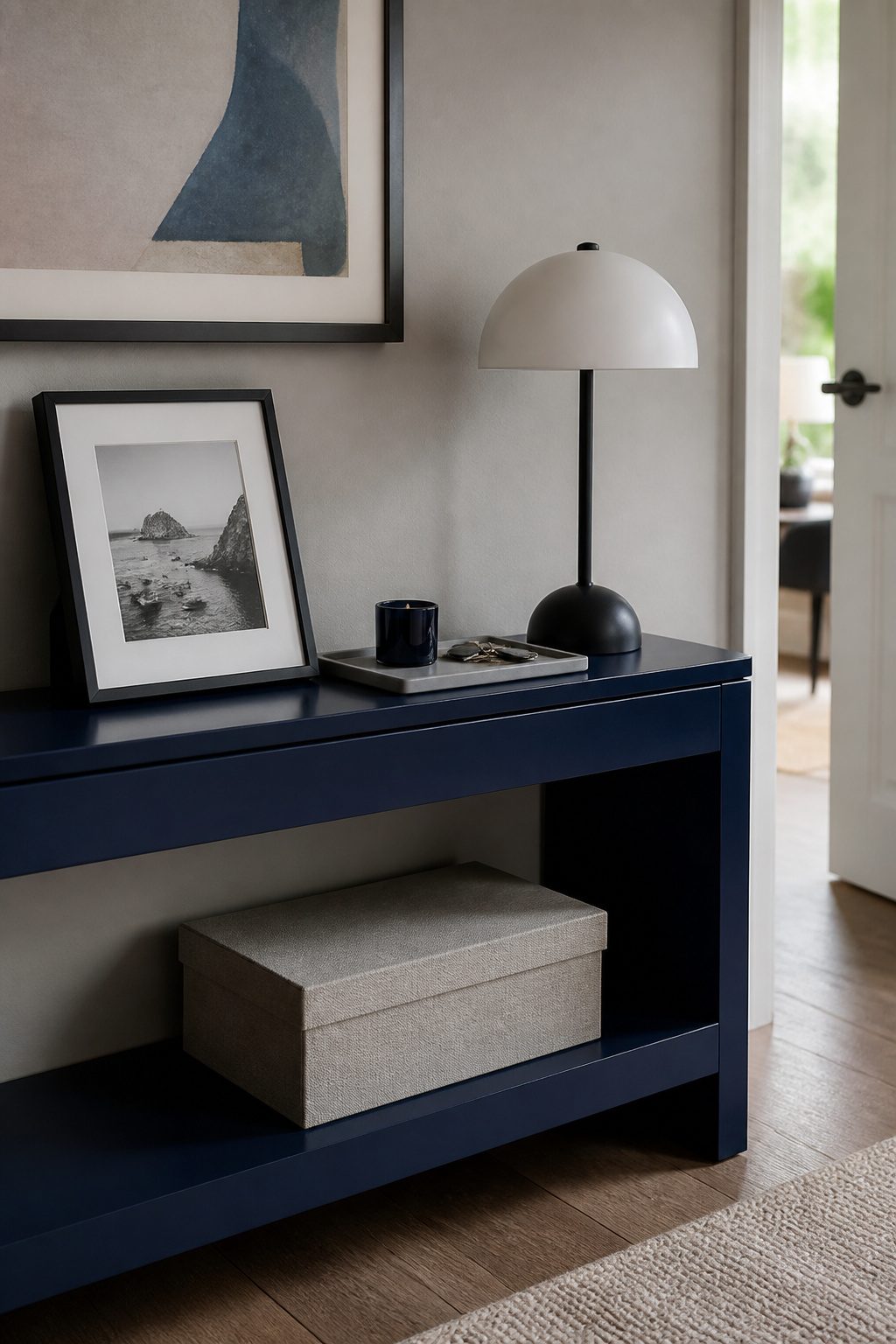
A single framed photo or a small souvenir from a trip reads as intentional when it sits among your other layers. Two or three personal objects at most keep the table from becoming a shrine. I learned this the hard way after covering mine with frames of every size; the console disappeared underneath them.
The rule is one personal item per zone, the same way you would place one sculptural accent or one stack of books. A travel souvenir tucked beside a lamp anchors the light and gives guests something to ask about. A photo in a slim frame laid flat on a stack of books feels collected rather than staged.
Trays help here too. Corralling keys or a candle inside a sleek tray keeps the surface tidy, and the same tray can hold a small keepsake without letting it sprawl. Woven baskets underneath hide the daily clutter that would otherwise compete with whatever personal piece you chose to display.
The eye needs somewhere neutral to rest. If every object carries a memory, none of them stand out.
Odd Numbers and Why Three Works
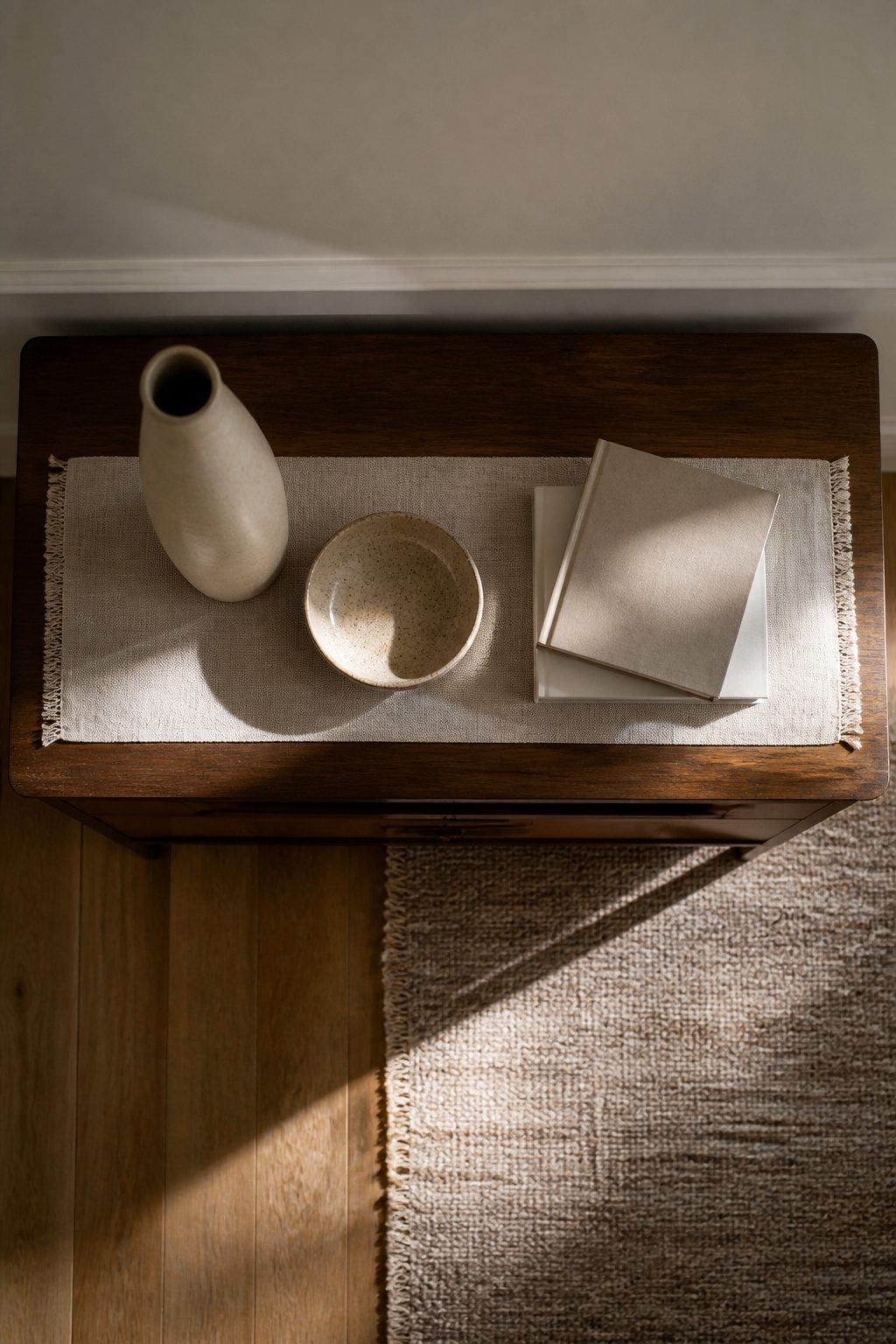
The first time I styled a console table, I set out two candlesticks and a framed photo in a neat little row. It looked like a store display that had given up. What fixed it was pulling one of the candlesticks and shifting the remaining pair so they sat at different heights, then adding a low brass bowl to make three. That triangle of heights, high-medium-low, is what the eye reads as intentional rather than leftover.
Three to five substantial objects is the limit before a surface starts feeling busy, and three itself tends to land better than two or four. A pair of matching lamps flanking a mirror reads symmetrical but flat; swap one lamp for a tall vase and a mid-height stack of books, and the same wall suddenly has movement. Two tiny frames and two candles scatter your attention. One taller frame, one candle in a holder around six inches, and one shallow dish gives the eye a place to land, then travel, then rest.
The rule scales with the table. A narrow console, around 43 inches, usually holds one compact trio. Wider pieces at 60 inches or more have room for two separate clusters toward either end, each with its own high-medium-low rhythm. Four of anything competes; three cooperates.
Frequently Asked Questions
What should I put on my console table?
Style a console table with a mix of functional and decorative pieces: a lamp or tall vase for height, a stack of books, a tray for corralling daily items, and a bowl for keys or small objects. Two to three substantial pieces fill the surface without crowding it; add a fourth or fifth and the eye loses its place to rest. The high-medium-low rule, one tall piece, one mid, one low, guides the eye naturally across the arrangement.
How do I style a console table in a small space?
Cut the object count in half, then cut it again, and rely on vertical elements like a slender lamp, tall vase, or books standing on end to draw the eye upward without eating the limited depth. Most narrow console tables run 30 to 35 cm deep, so the wall above matters more than the tabletop itself; a wide mirror or art piece closes the gap between furniture and architecture. Keep one slim tray for keys at the back edge so it does not interrupt the walk path.
How high should a lamp be on a console table?
A lamp on a console table should stand 26 to 30 inches tall to force the arrangement upward and give the surface a visual backbone. Table lamps on either end pull double duty, adding vertical structure and actual usable light for the hallway or entryway. One sculptural lamp placed off-center can carry a whole side if the shape is interesting enough, especially on narrower consoles where two lamps would crowd the surface.
How often should I change the decor on my console table?
Swap stems or branches season to season to keep the space feeling current, while the lamp, mirror, and console itself stay exactly where they are. The baskets underneath can rotate by season too, sun hats and sandals in summer, gloves and scarves in winter, without touching the arrangement above. You are replacing a $12 bunch of stems or a basket’s contents, not the anchor pieces you saved for, so the entryway feels deliberate without the budget of four complete tableaus.
Can I use a console table for storage?
Yes, and the space underneath is where a console table either gets functional or gets cluttered. Woven baskets are the most reliable choice because they hide what you do not want seen while adding texture that warms up metal or stone surfaces. A boxier basket reads more intentional than one that slumps against the legs, and you can swap the contents by season without disturbing the styled arrangement on top.