
A finished bed takes anywhere from thirty seconds to build a two-pillow stack to a morning removal project with six pieces layered deep. The cost is not money; it is deciding how many pillows you will actually move before sleep.
Getting that number wrong is where most beds fail. Four to six pillows on a king looks full; on a queen, the same count crowds. The difference is real estate, not taste.
I learned the hard part after trying to prop sleeping pillows upright like Euro shams. They slouch, they gap, and by morning the bed looks already slept in. The Euros at 26 inches square exist specifically to stand; the standards at 20 by 26 exist specifically to lie flat. Treat them as interchangeable and the whole stack collapses into a single plane.
Pillow Types
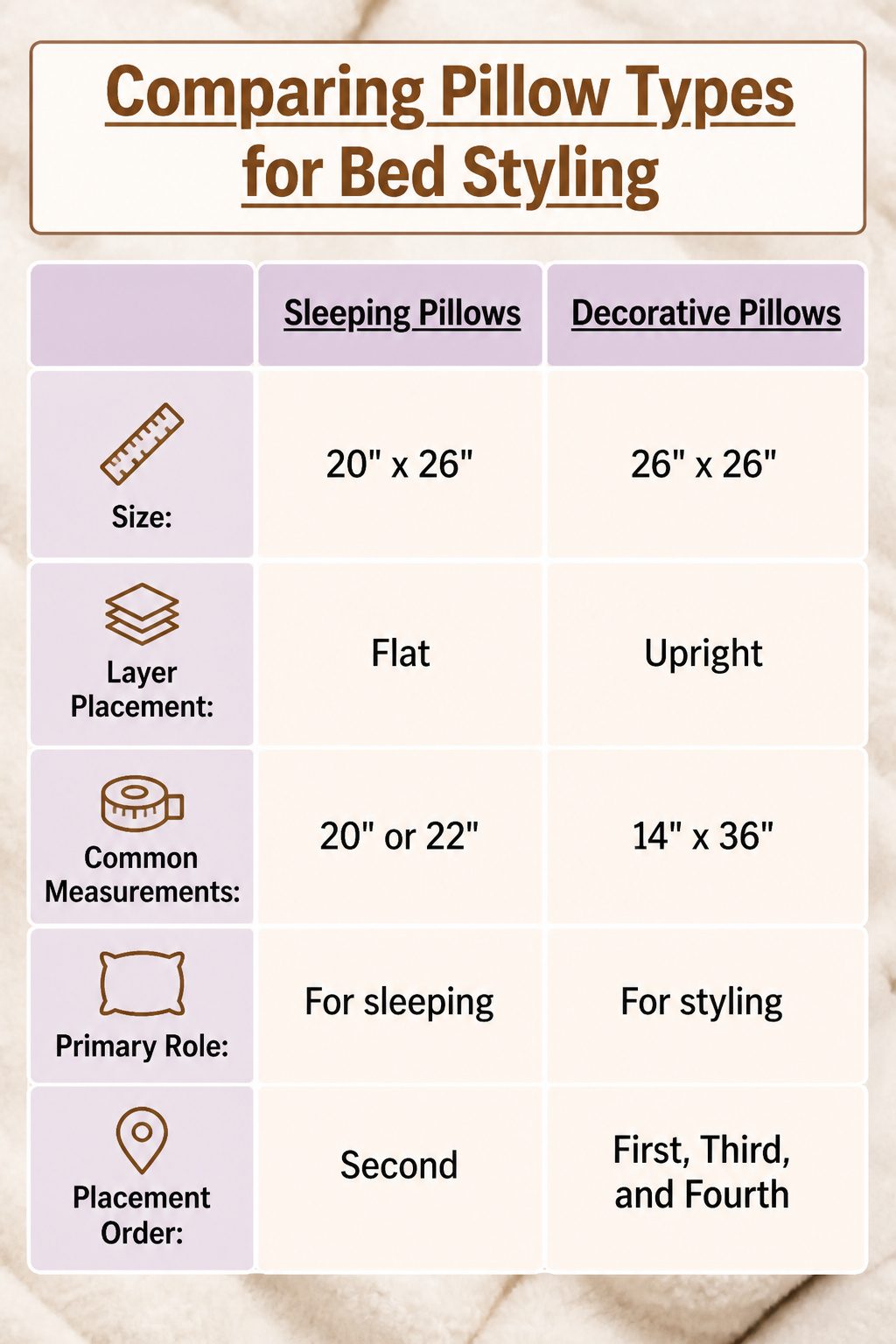
Sleeping pillows and decorative pillows do two different jobs, and treating them like the same thing is the mistake that makes a bed look cluttered instead of styled. A standard sleeping pillow measures 20" x 26" and lies flat, the one you actually use. Euro shams are 26" x 26" squares that stand upright against the headboard to create a backdrop. Without that backdrop, your sleeping pillows read as the end of the story instead of the start.
Square accent pillows, usually 20" or 22", and lumbar pillows at 14" x 36", finish the front edge. The lumbar’s length matters more than its height; it anchors the arrangement and keeps smaller pillows from looking scattered. Size dictates placement order, not preference. Euros go against the headboard because their height fills the vertical space. Sleeping pillows come next, then the smaller squares, then the lumbar at the front. Skip the Euro layer and the whole stack collapses visually into a single plane. I learned that the hard way after trying to prop sleeping pillows upright like a Euro; they slouch, they gap, and by morning the bed looks already slept in.
Layering Basics
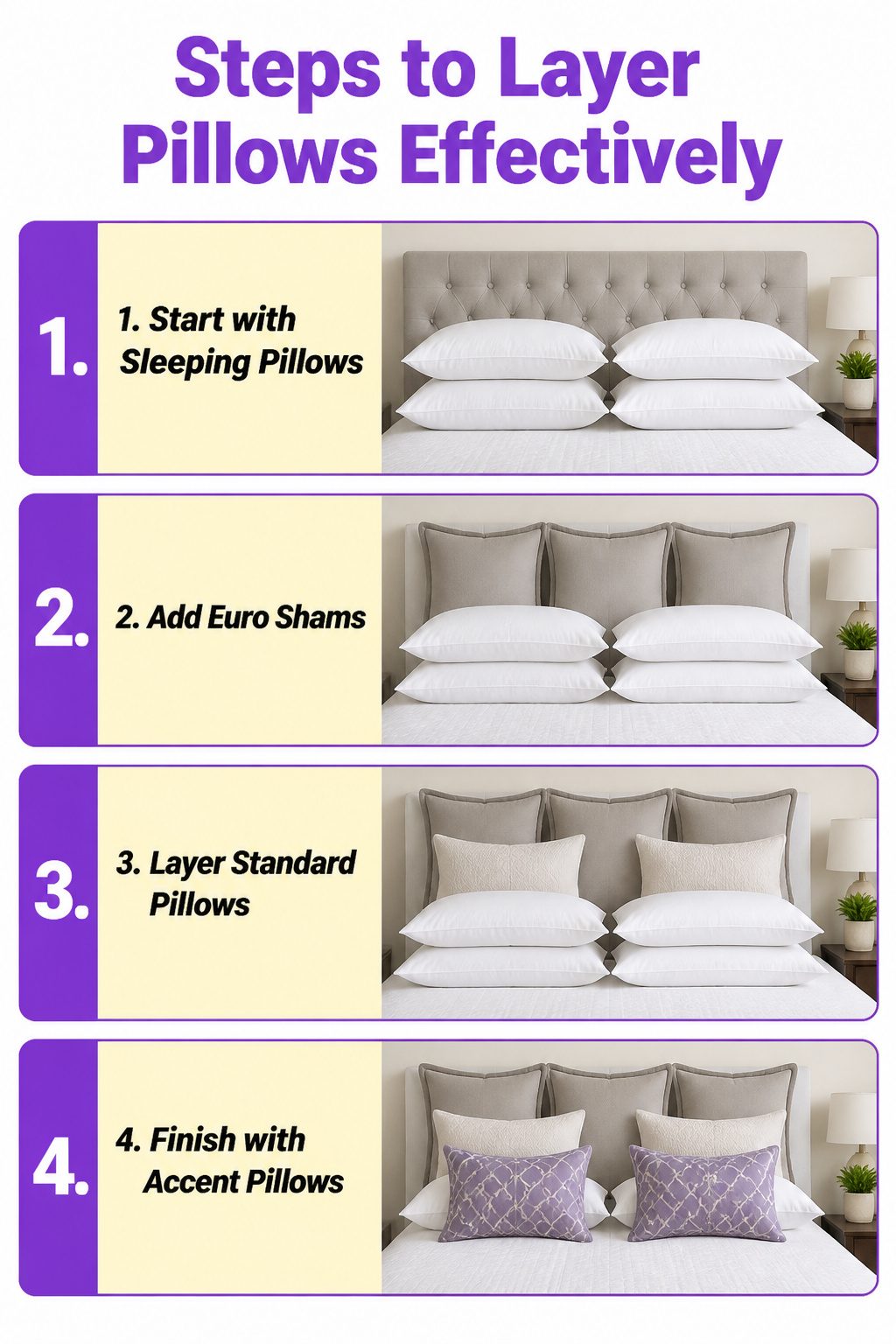
Sleeping pillows are the backbone of any bed styling, and they go down first. On my queen bed, two standard pillows stacked flat create the base layer, while a king-size bed can take either three standard pillows or a pair of king pillows before anything decorative enters the scene. The order matters more than the total count: sleeping pillows flat against the headboard, then decorative layers in front, largest to smallest. Euro shams, those 26-by-26-inch squares, sit behind standard sleeping pillows when used, or serve as the rear anchor on larger beds where three across fill the width properly. A twin or full bed collapses this quickly; four sleeping pillows in two flat stacks often finishes the job without any throw needed. The mistake is treating decorative pillows as the starting point and wedging sleeping pillows around them afterward. That backward build leaves the bed looking piled instead of layered, and the proportions read off no matter how many pieces you own.
Count by Bed Size
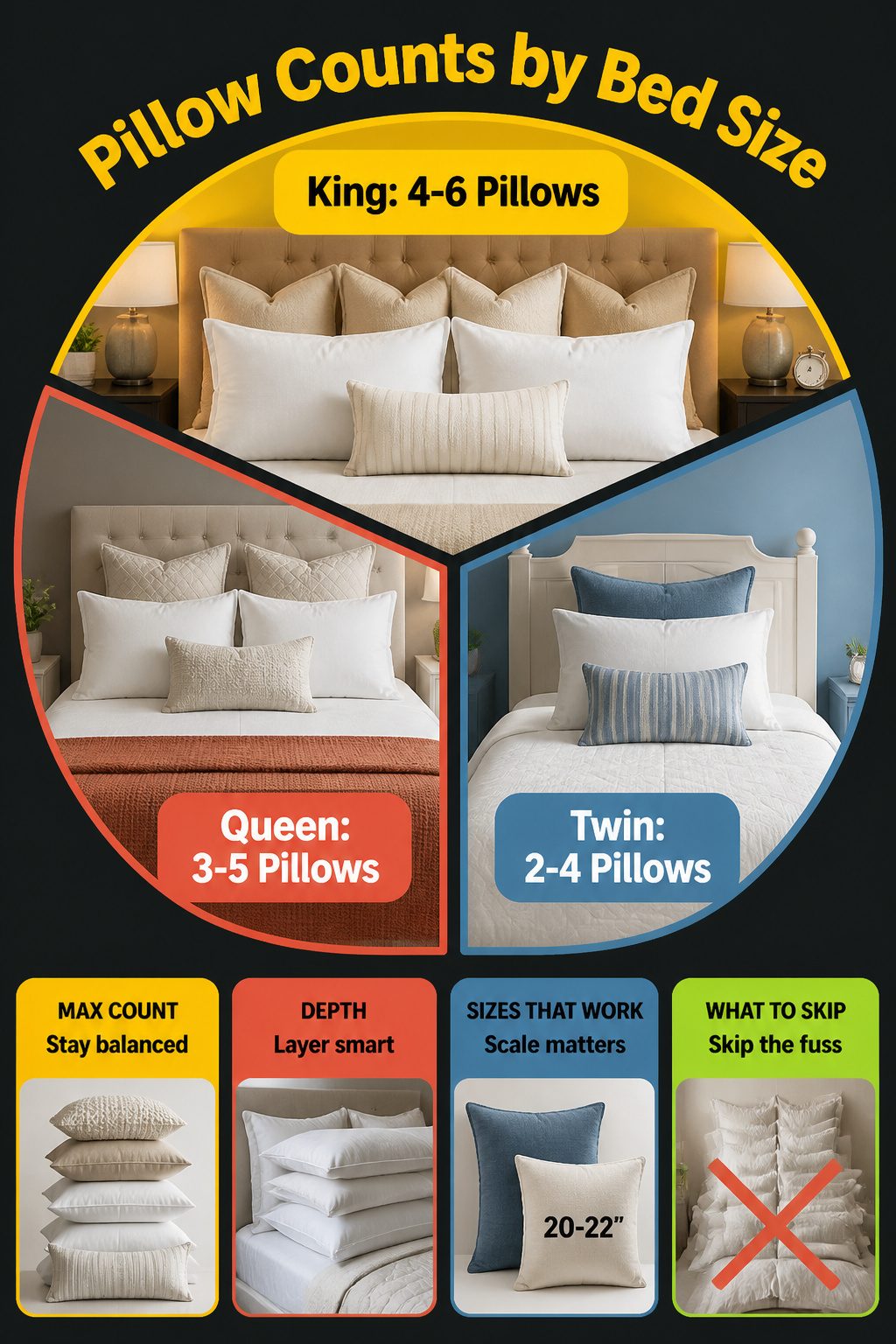
A king bed holds four to six pillows before it starts looking fussy or dated; a queen or smaller bed tops out around three to five. The difference is real estate. A 76-inch king mattress swallows standard sleeping pillows whole, so either you go large with king-size shams and Euro squares or you pad the width with numbers.
Three Euro shams across the back, a pair of king pillows in front, and one lumbar centered at the front edge lands me at six. That is the maximum I will live with; anything more becomes a morning removal project I skip. On a queen, the same formula collapses to two Euros, two standards, and one accent piece. The bed still reads full, not crowded.
Where I cheat is depth without count. Three standard sleeping pillows layered with a second set in shams gives the same visual weight as a Euro setup on a king, but every piece is useful at night. For renters buying once, 20- or 22-inch squares are the workhorse size; on a king, 24- or 26-inch squares hold the scale better and save you from buying extras to fill the gap.
Color and Texture Rules
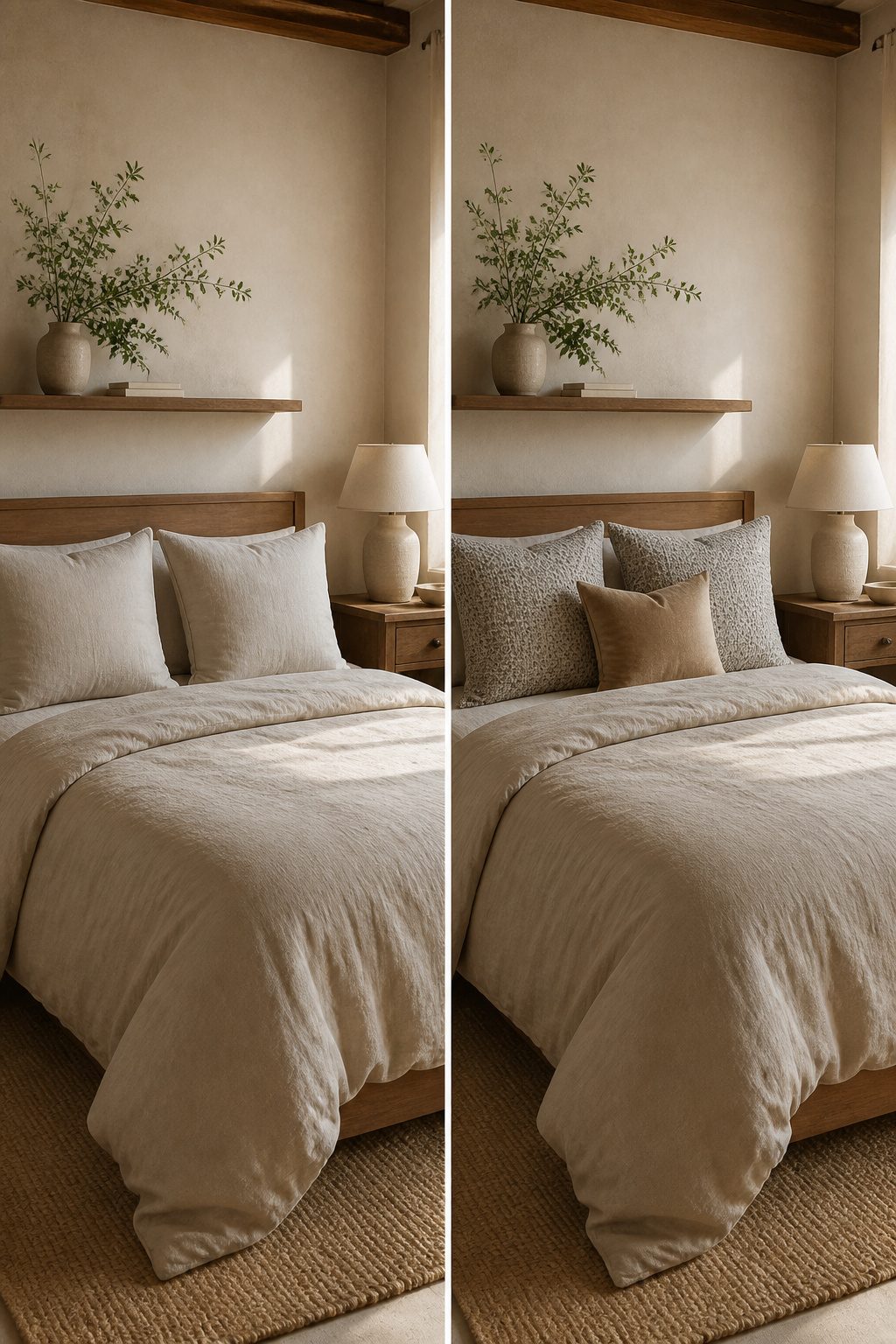
Throw pillows that match your bedding exactly read like a department store display, not a room someone lives in. The better move is staying inside one color family while shifting the finish or texture so the arrangement feels gathered over time rather than bought in a single afternoon.
A solid linen duvet, for example, pairs well with two Euro shams in a low-contrast weave and a smaller 22-by-22-inch pillow in something with a slight sheen or a quieter pattern. The variation keeps the eye moving without tipping into clutter. Two pillows can share a fabric and size, but the third should break the rhythm in a coordinating color, maybe a smaller rectangular shape in front.
Pattern works the same way. Layer prints within the same tonal range instead of matching them directly to the bedspread. One busy print against a busy bed set competes; the same print against a calm ground reads intentional. Tall headboards over two feet can handle more of this contrast, while short headboards or bare walls need restraint so the pillows do not overwhelm what little vertical space exists.
What convinced me, reading through the arrangements that actually hold up, is that contrast in texture matters more than contrast in color. A nubby bouclé against smooth cotton does the heavy lifting even when both sit in the same neutral. That shift in surface is what makes the bed look styled rather than stocked.
1. Clean and Simple
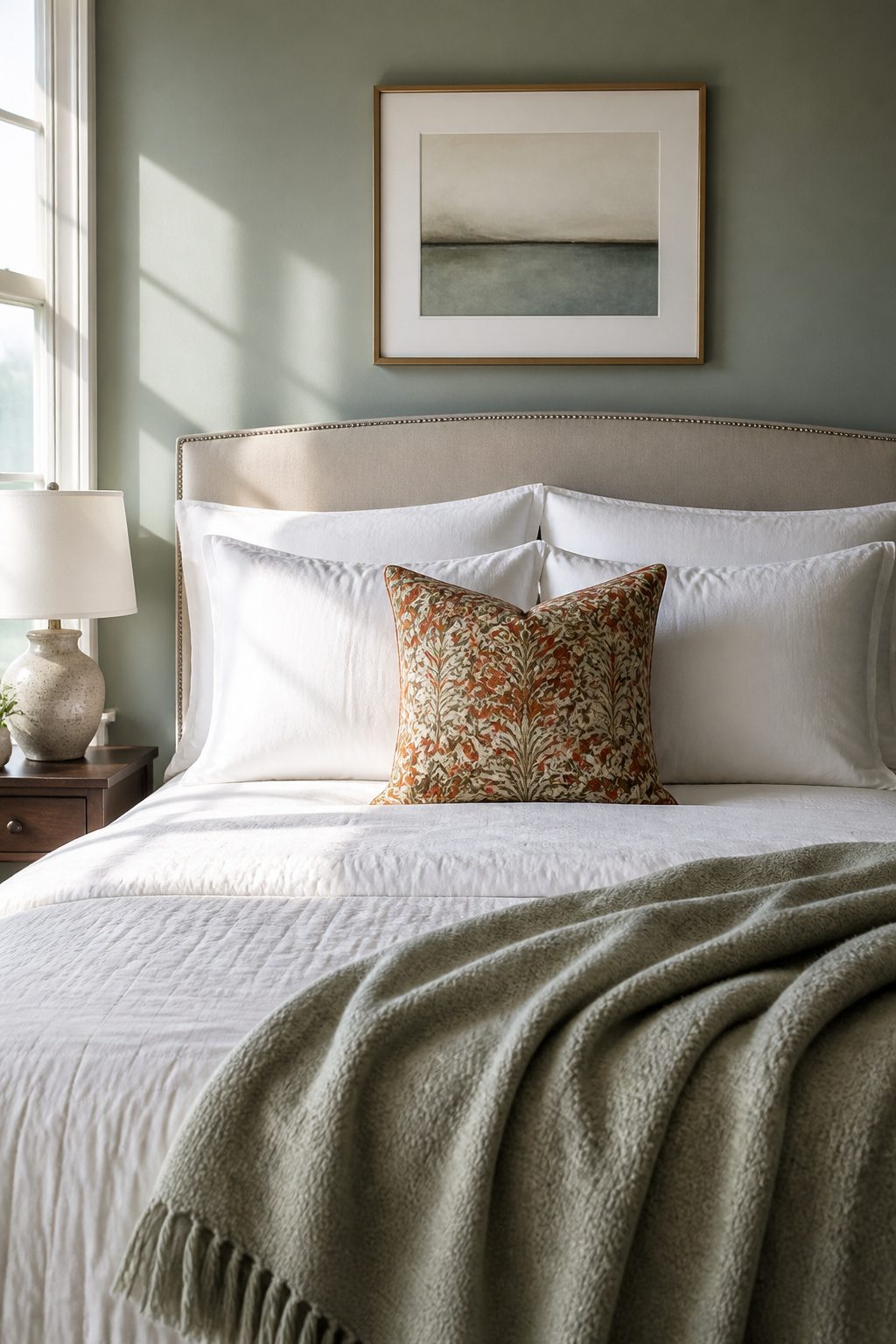
Two sleeping pillows and a single accent pillow is the arrangement I reach for when the bed needs to look finished before coffee cools. The sleeping pillows stand upright against the headboard, side by side with their edges just touching, and the accent pillow leans against them dead center. That centered placement reads as intentional rather than leftover, especially when the accent cover carries a pattern or a color that pulls from somewhere else in the room.
Even if you’re a swish-the-duvet-and-be-done-with-it type, with five more seconds spent stacking your sleeping pillows, you can create a clean bedding scheme.
— Matouk
The five seconds is the whole point. This is not a look that asks for a morning ritual; it asks for a quick stack and a single prop. What sells it as designed rather than lazy is the accent pillow’s placement and its contrast against the sleeping pillows. A bright cover or a bold pattern on that one pillow does the work of three. I skip this when the headboard itself is the statement, like the Cecilia Upholstered Bed, because competing focal points flatten everything.
2. Stacked and Propped
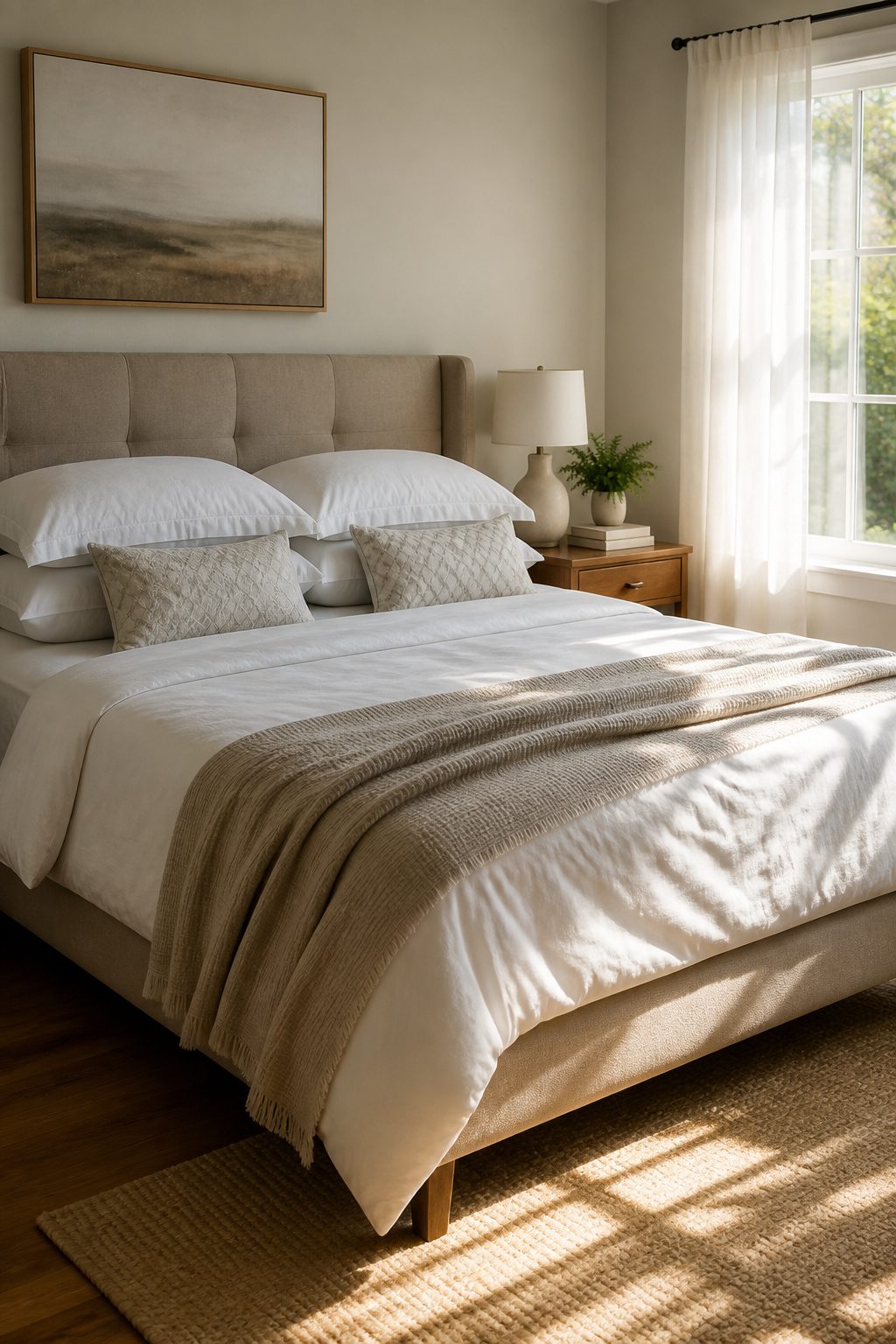
Four sleeping pillows stacked in two piles of two against the headboard gives guests options they actually use. I started leaving the back row in place after catching my mother-in-law reading against them at midnight; she never touched the decorative Euro shams I’d carefully arranged. Two lumbar pillows propped in front finish the look without blocking the functional stack behind them. Place the lumbars slightly apart, not centered as a pair, so a guest can pull one aside without disturbing the other. The gap also reads as intentional rather than afterthought. On a queen bed this fills the width cleanly; anything larger and the pillows swim, anything smaller and the stack crowds the nightstands. I keep the sleeping pillows in white percale and let the lumbars carry any color or pattern, which makes seasonal swaps cheap and fast.
3. Layered Neutrals
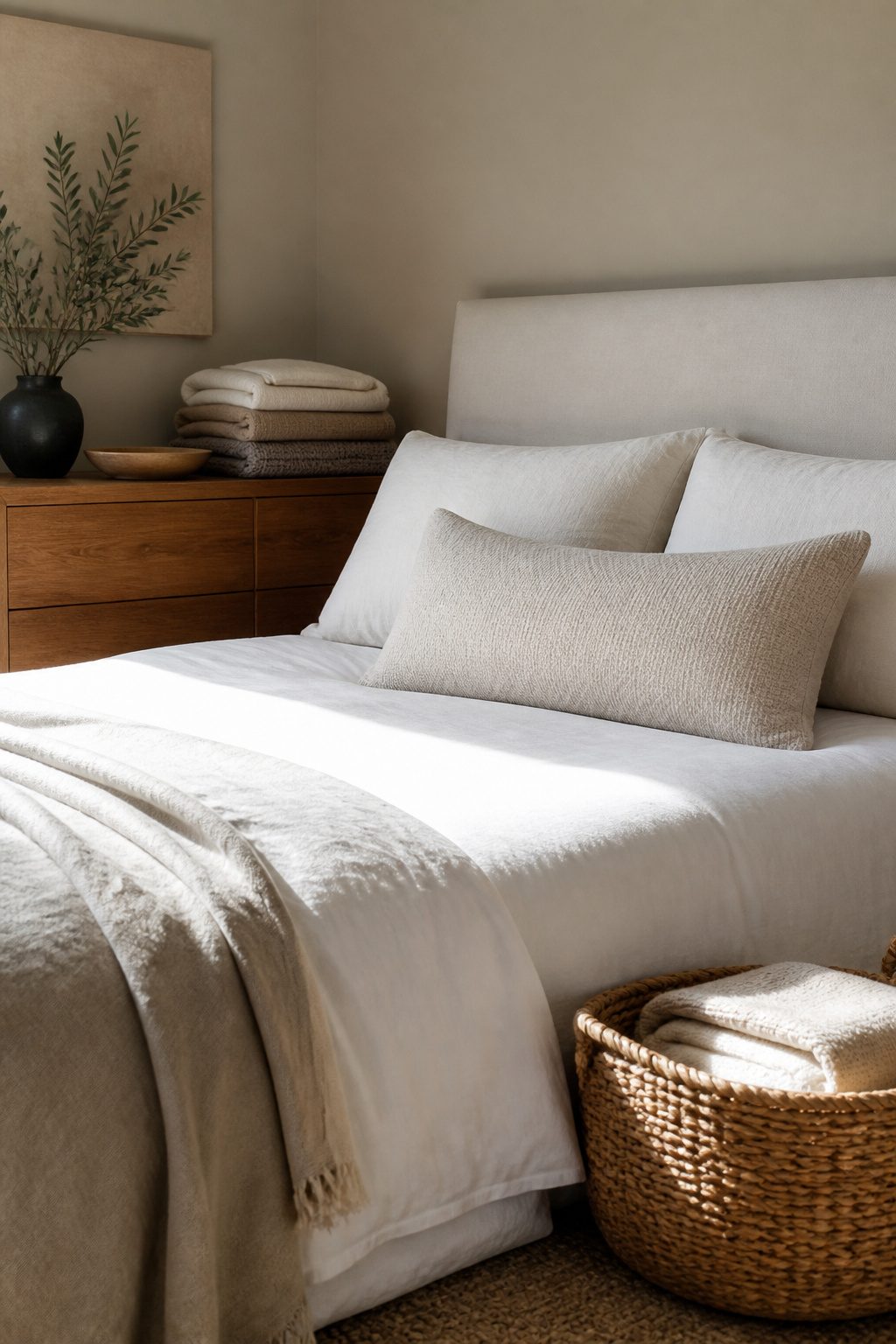
Smooth cotton reads clean for about a day, then the whole arrangement goes flat. Two neutral sleeping pillows against the headboard give you the foundation, but the front layer is where the life sits. A nubby linen lumbar, even in the same oatmeal tone as everything else, breaks the surface enough that light catches differently across the bed. That single texture shift fixed the dead look without pulling in a color I would have tired of by March.
Boucle works the same way if linen feels too casual for your frame. The point is the bump and shadow, not the fiber name. One lumbar in front, centered or slightly off depending on your headboard width, and the bed stops looking like a catalog spread and starts looking like someone actually sleeps there.
4. Luxe Layers
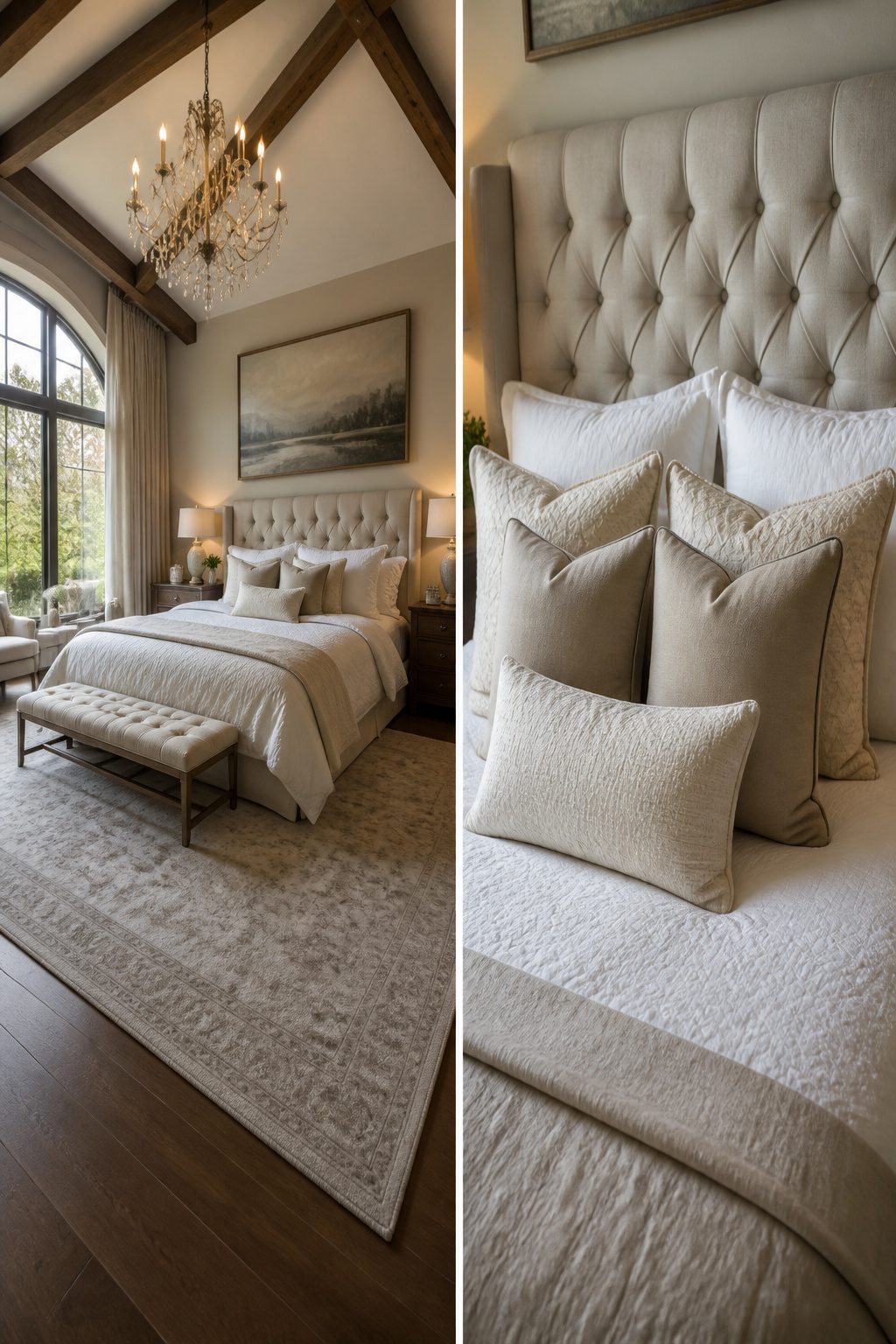
The nine-pillow build starts with four standard sleeping pillows stacked flat, then two 26-by-26-inch Euro shams standing upright to cover the width, two 20-inch square pillows in front of those, and a single lumbar across the front to finish. I tried this once for a photograph and never again for actual sleep. The Euros look stately against a tall headboard, but the stack depth pushes everything so far toward the foot that my feet hit the pillow wall. Two of the square pillows went into storage the same week; the lumbar stayed because it works alone on a made bed. For daily use, I kept just the four sleeping pillows and one Euro sham as a backdrop, which still reads as intentional without the full parade. The complete arrangement suits a main bedroom suite where the bed is staged more than lived in, and the symmetry forgives mixed colors and patterns that would look chaotic in a smaller setup.
5. Minimalist Look
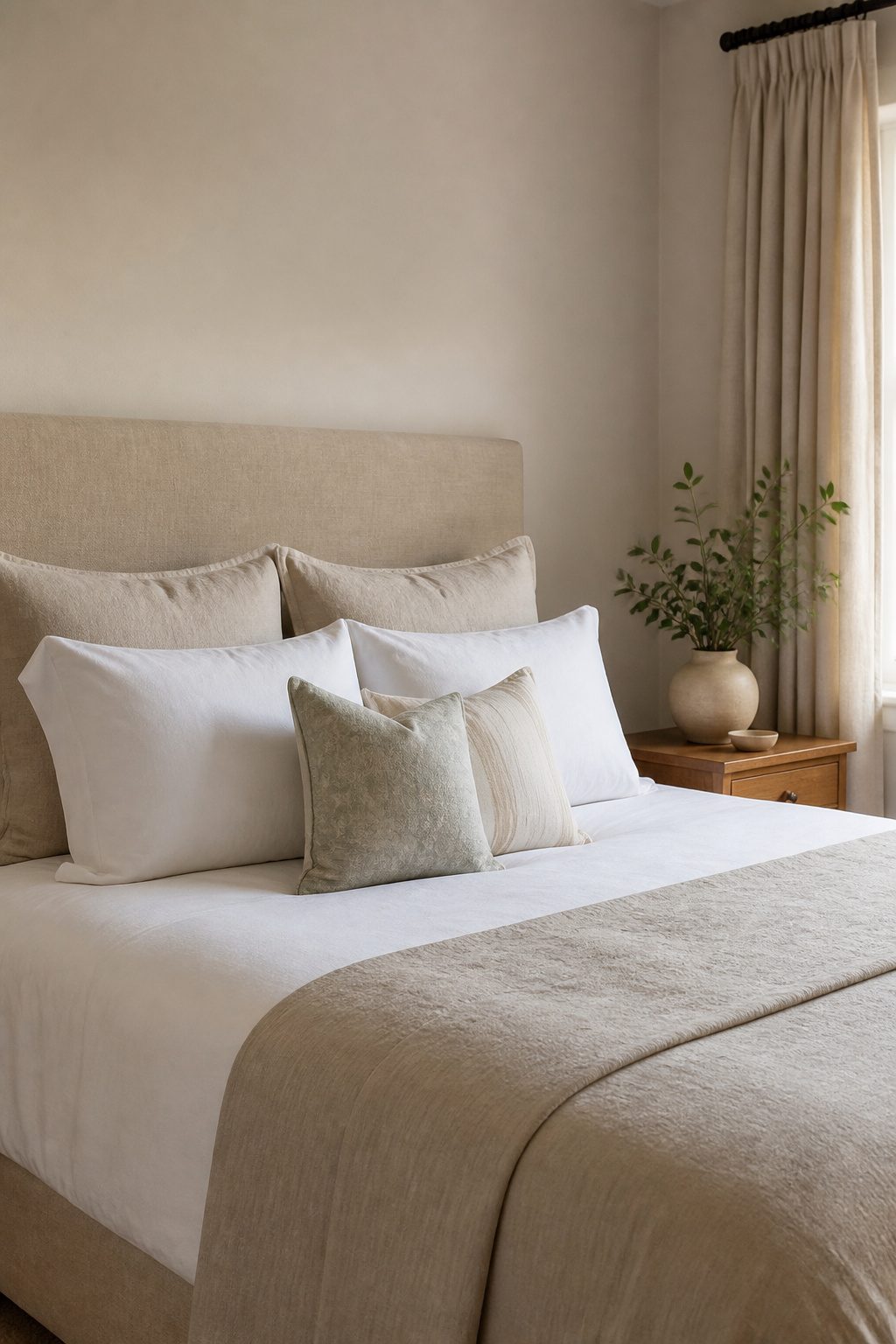
The minimalist look I keep coming back to runs two bed pillows standing upright, two standard shams, then two decorative pillows in front. Six pieces total, and the shams are doing actual work here, not just hiding sleeping pillows.
That distinction matters. The Clean and Simple section drops shams entirely; this look keeps them as a deliberate layer that breaks up the wall of white and gives the arrangement a crisp edge. Standard shams sit at 20-by-28 inches, the same footprint as the sleeping pillows behind them, so the line stays low and rectangular rather than stepping up to the square bulk of Euro shams.
I tested this with a $40 Target sham set in a warm linen blend, and the texture against cotton percale sleeping pillows was enough structure to make the bed feel finished without reading decorated. The decorative pillows in front were 20 inches; anything larger started to compete with my lower headboard and the whole point of this look collapsed into something pillowfied instead of restrained.
6. Eclectic Look
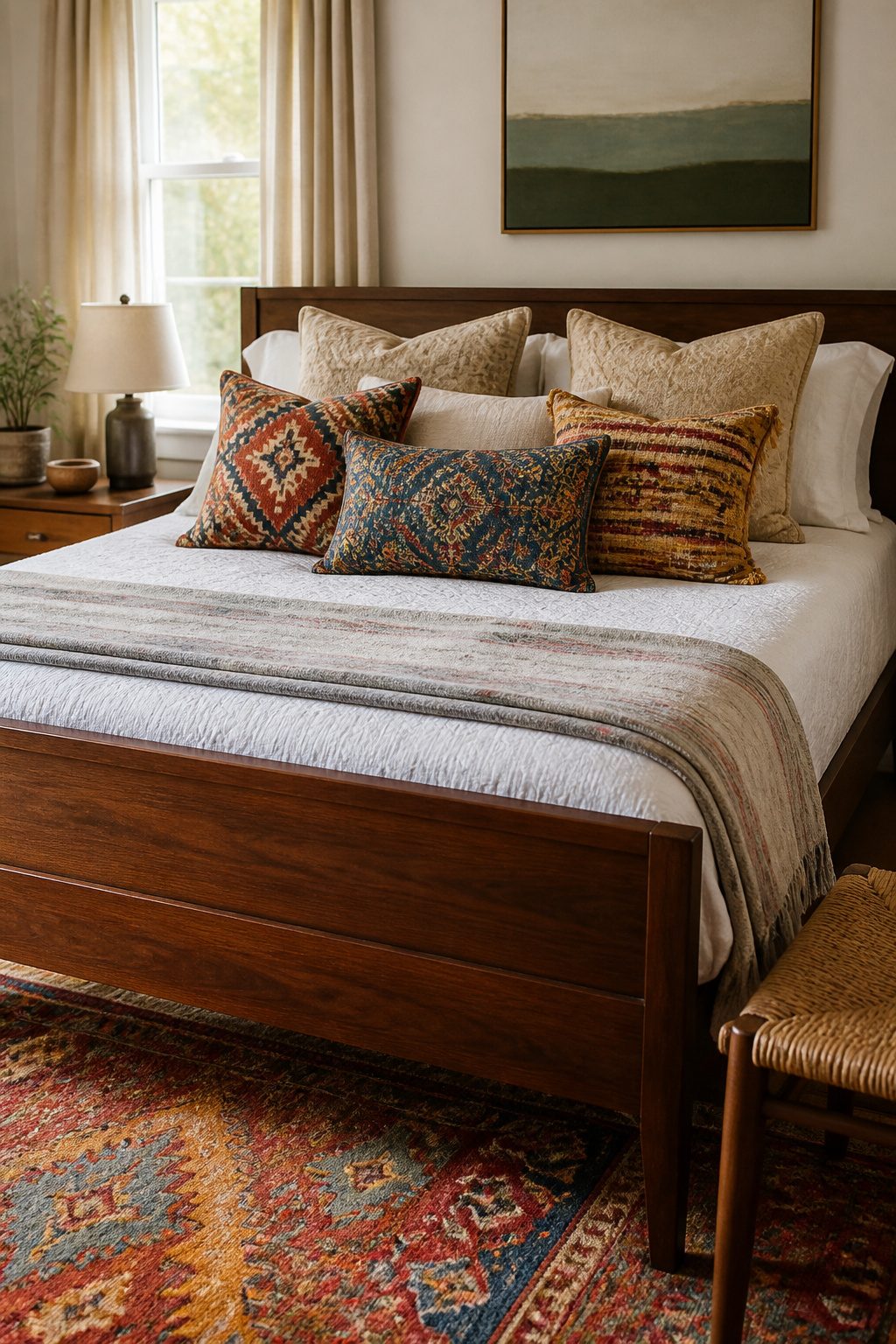
Two sleeping pillows and two 26-inch squares form the back row, then three front pillows in different patterns overlap rather than sit side by side. The largest of the three goes in back, the next size overlaps it slightly, and the smallest overlaps both. The rule of three patterns is what keeps the mix from looking like a clearance rack.
I learned that limit the hard way. Four patterns on one bed, each one shouting over the others, and the whole thing looked like I had grabbed whatever was left on the shelf at Tuesday morning. Three gives enough variety to feel collected without tipping into chaos.
A tight color palette still matters. Mismatched sizes and prints read as intentional when the tones talk to each other, random when they do not. Two of the three front pillows can share a color family while the third introduces contrast, or all three can pull from the same base hue in different directions. The overlap is the move that sells it: each layer visible, none fully exposed, so the eye travels instead of fixing on any single clash.
7. Hotel-Inspired
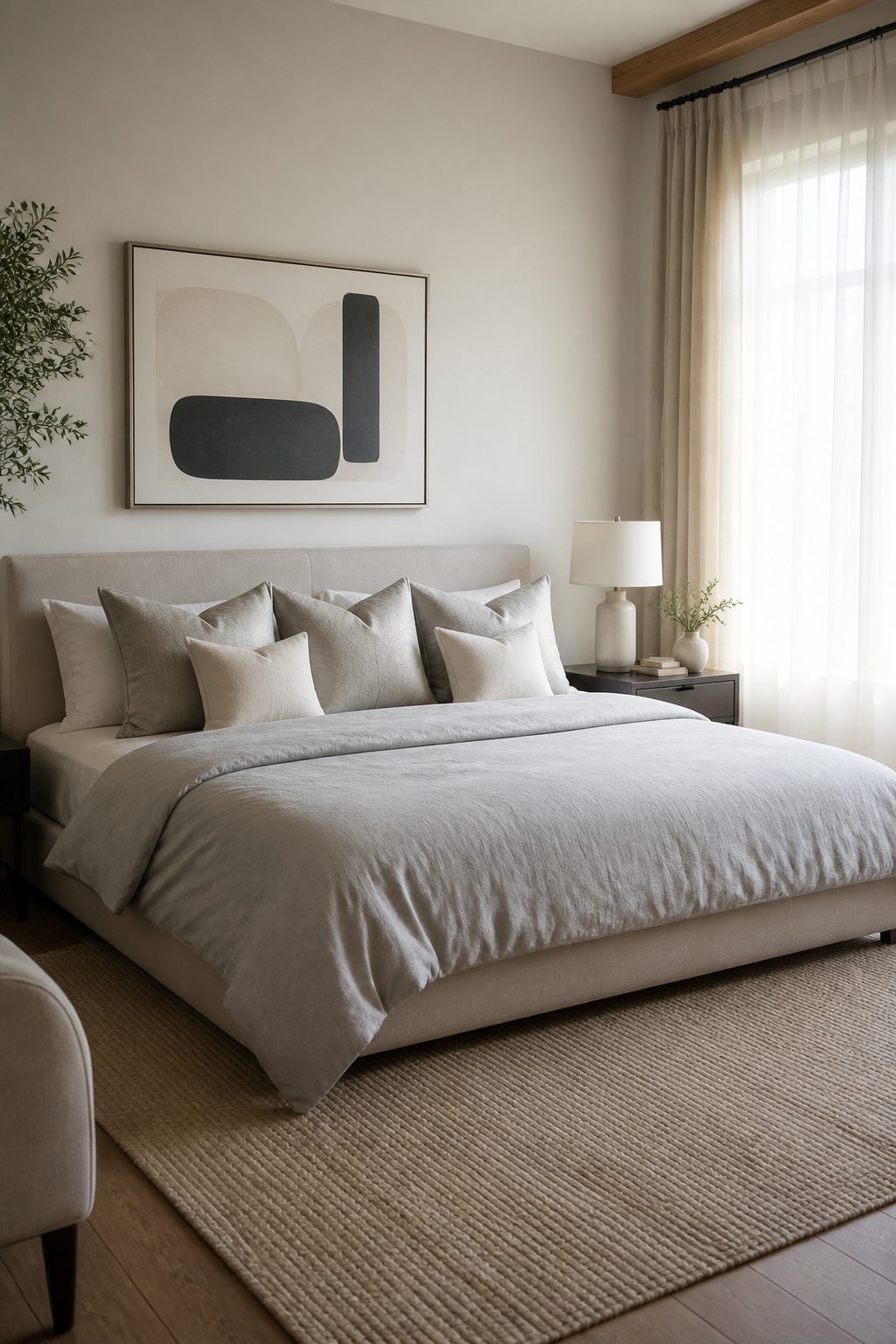
Three Euro shams across a king is the width that actually fills the headboard without leaving awkward gaps at the edges. I measured the W placement at a stay last spring, the kind where the pillows are staged so precisely you half suspect they glue them: two king sleeping pillows flat against the headboard, three 26-by-26-inch Euros propped in front in a shallow arc, then two square accents centered on the gaps between the Euros. The king pillows give the height, the Euros give the span, and the third Euro is what keeps the arrangement from looking like it is sliding toward the middle.
Most sources suggest two Euros for a king, which leaves roughly ten inches of bare headboard on either side unless your shams are overstuffed to the point of doming. Three lets each sham sit at a slight angle, corners just touching, which reads as intentional rather than apologetic. I recreated this at home with a pair of standard king sleeping pillows in back and the Euro layer in front; the two 20-by-20-inch squares in front of that sit low enough that you still see the W shape from the doorway. For inserts, size up by one inch so the corners stay full rather than floppy.
8. Asymmetrical Elegance
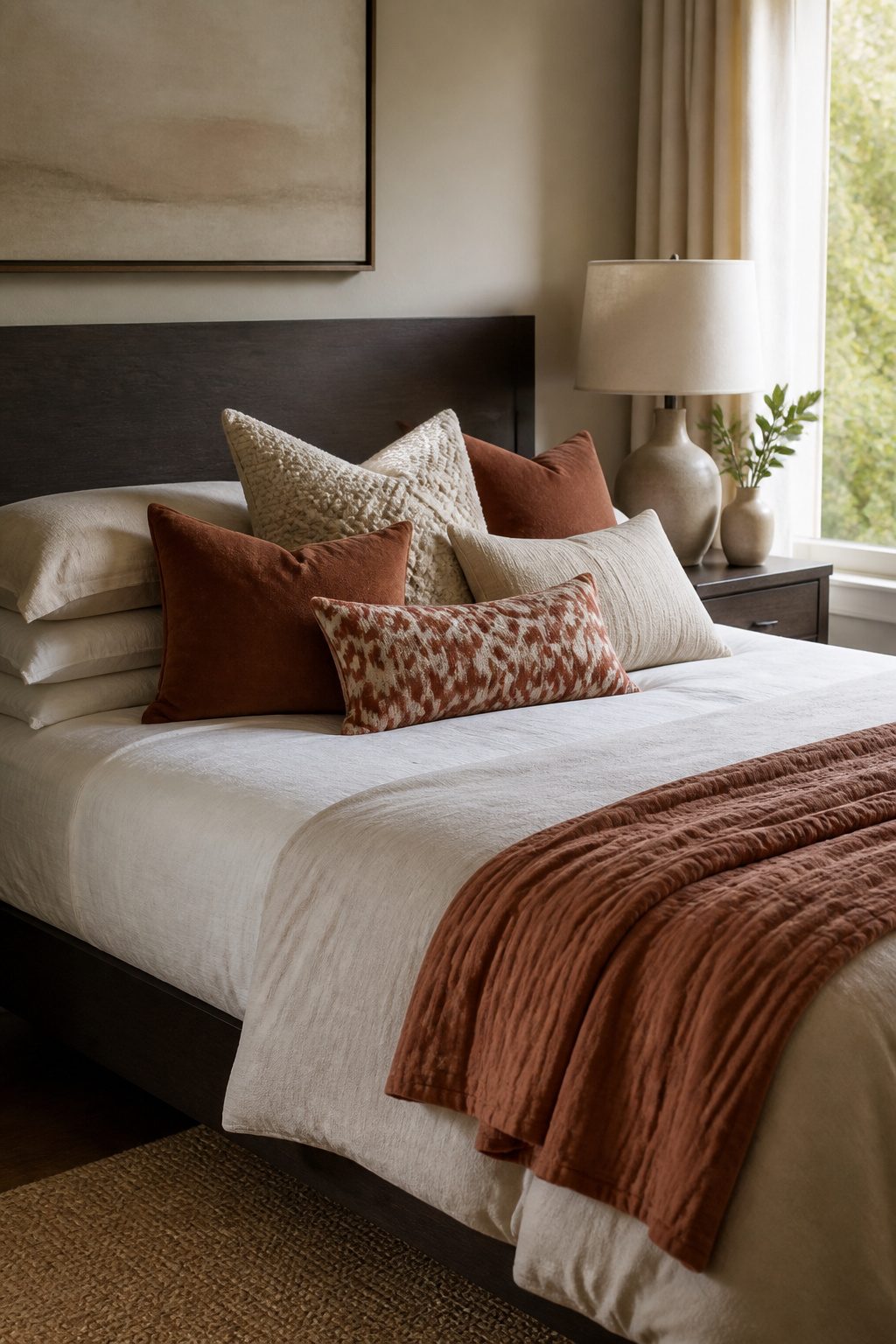
Asymmetrical elegance lives or dies on one decision: whether the mismatch looks chosen. Two standard pillows go at the back, stacked flat. In front of them, four or five pillows in different sizes and patterns settle into a cluster that is heavier on one side than the other. A 26-inch square anchors the grouping, flanked by 22- or 24-inch squares, a 20-inch square, and a lumbar tucked in last. The sizes themselves do not need to mirror each other. What saves the look from reading as unfinished is a tight color palette that runs through every piece. Without that restraint, the imbalance tips into sloppiness. With it, the odd numbers and uneven weighting feel like the point. I have tried this with prints that shared only a navy ground and watched the bed look like a laundry pile; the same shapes in three tones of rust and cream read as intentional the moment they hit the mattress. The rule of three still operates underneath, two of the throw pillows matching in a 22-by-22 fabric while the third breaks smaller and rectangular, but the overall silhouette stays deliberately off-center rather than balanced.
9. Reverse the Order
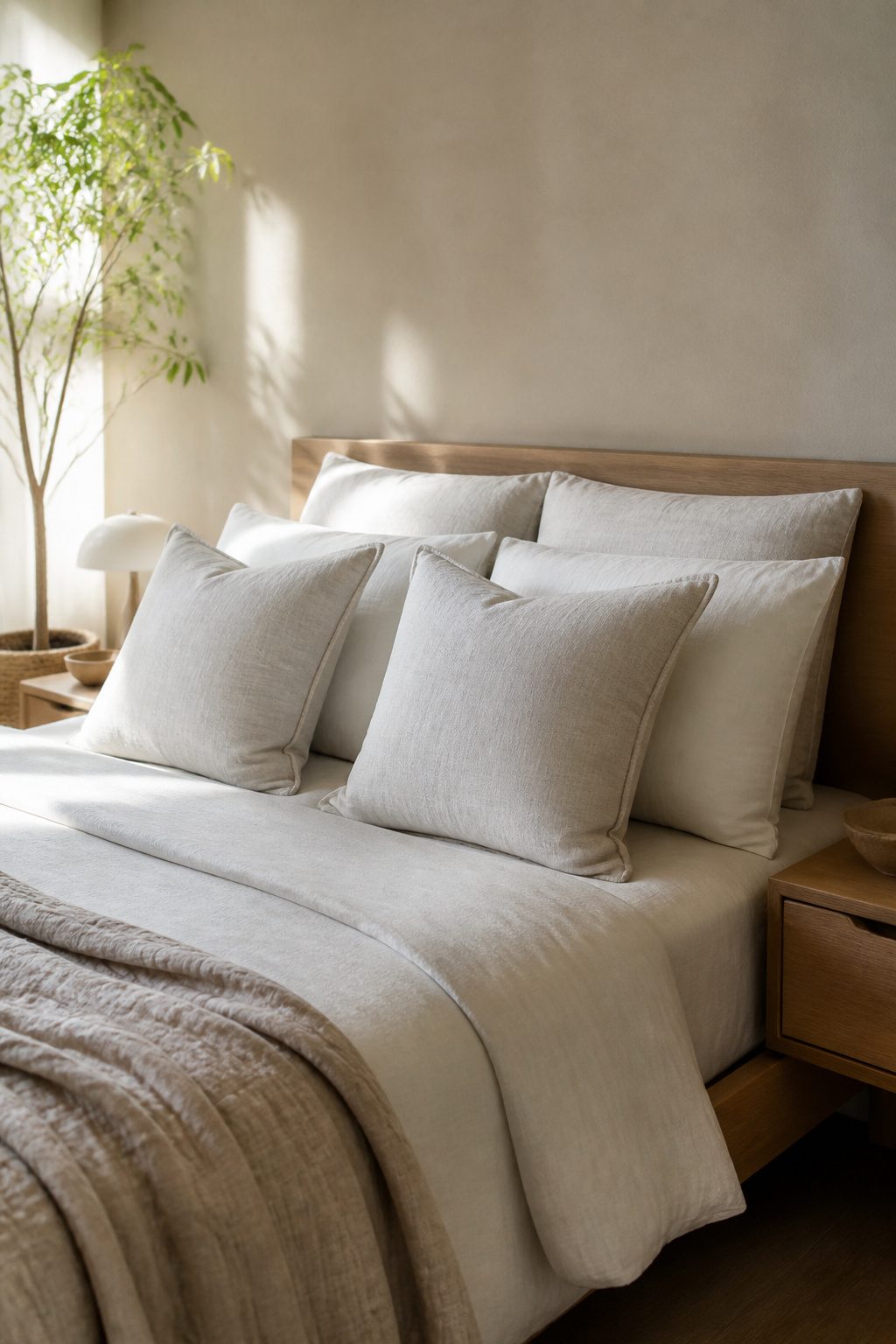
Most pillow builds start small in front and large in back. Flipping that order puts four sleeping pillows stacked two-by-two against the headboard, with standard shams in front and larger Euro shams pulled forward where they usually sit behind. The result reads more modern and opens up visual breathing room across the bed.
This inverted stack works best on low headboards that would otherwise disappear behind a wall of Euro pillows. On taller headboards, the standard forward build still wins: two bed pillows upright, two Euros, two standards, then lumbars, leaving a few inches of frame visible above the back row. A low headboard has no height to spare, so keeping the biggest faces at the front preserves the silhouette without the bulk eating the whole wall. Scale down the decorative layer too; 20-inch squares center nicely where 26-inch ones would crowd the frame.
10. Practical Look
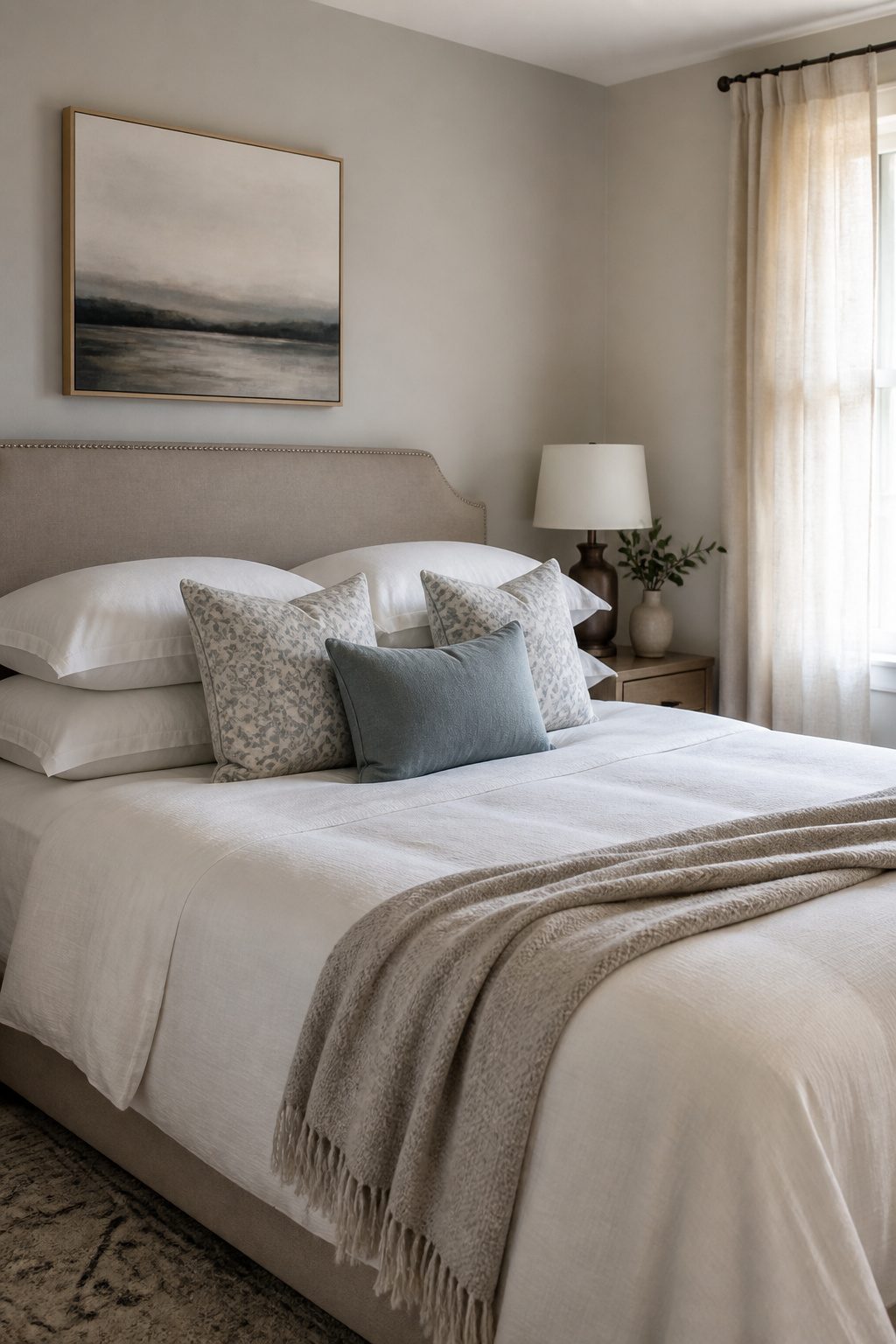
The practical arrangement runs four bed pillows, two decorative pillows around 22 inches down to 20 inches, and one smaller pillow at 18 to 20 inches. Two stacks of two sleeping pillows each sit against the headboard, with the three decorative pieces layered in front. This is the setup that stays put through flu season and laundry weeks, when anything fussy feels like mockery.
Patterned pillowcases and a patterned top sheet work well here, especially on a guest bed where the extra sleeping pillows solve the problem of where to store spares. The side view stays clean because the stacks are equal height and the decorative pillows sit in a simple triangle, largest to smallest.
Pro tip: different textures on the pillowcases and shams keep the look from going flat, even when the arrangement itself never changes.
11. High Contrast
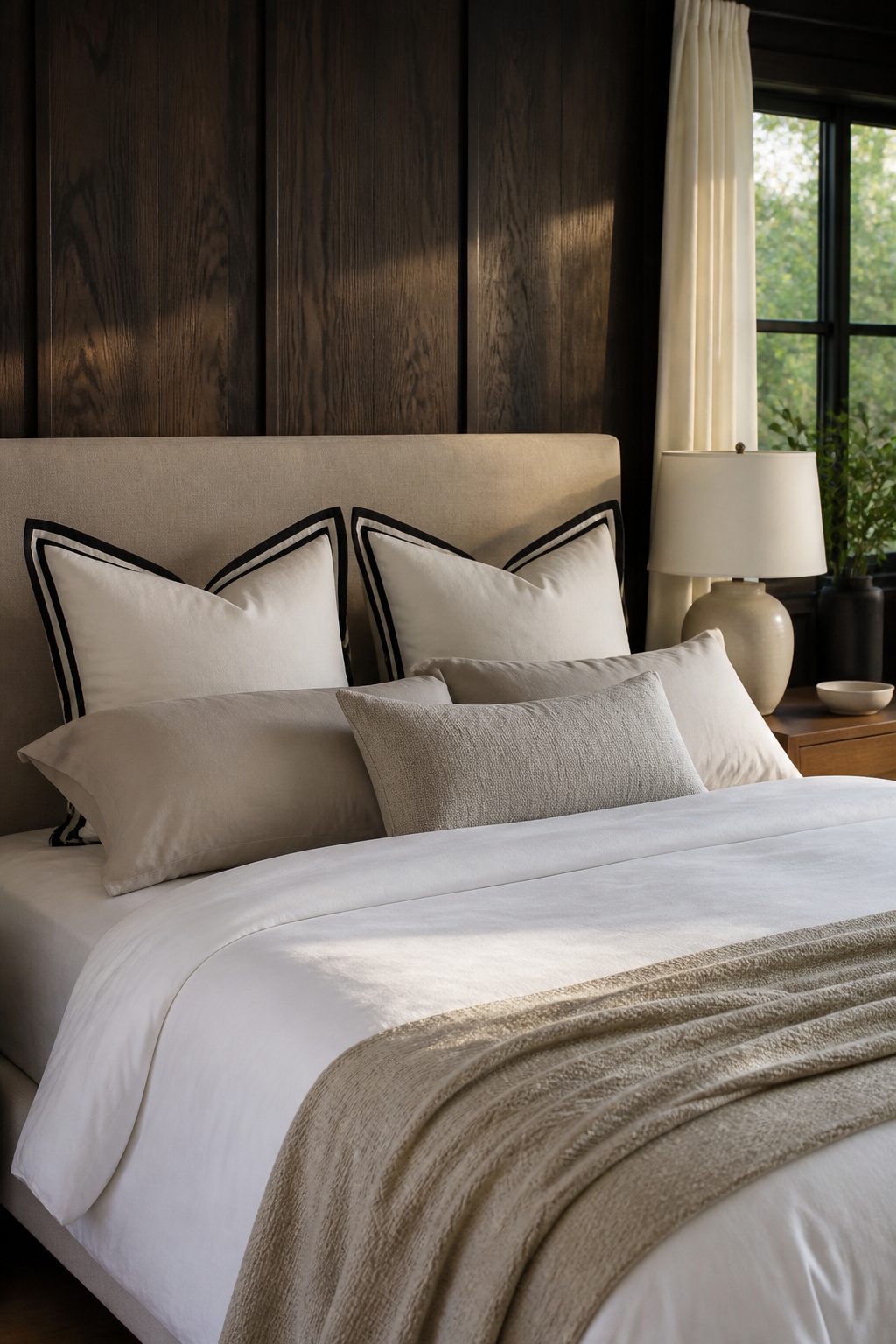
Most people prop trimmed pillows in front, but reversing that order puts the detail where your eye lands first. Two standard pillows in contrast-trim cases sit against the headboard, with two neutral sleeping pillows layered in front of them. The trim does the work of a whole second color without overdoing it.
I bought black-piped white shams for $24, and that thin line of piping against white bedding reads as intentional rather than busy. A whole second pillow color at the front would have fought for attention; the piping gives the contrast once, quietly, and lets the neutrals do their job of calming the stack down. The result reads as detail-driven and cool rather than decorated.
For anyone who wants the look without the nightly pillow migration, this arrangement keeps everything you actually sleep on in play. No throw pillows to toss aside, just the two sets you already own, ordered so the interesting bit sits where you’ll see it and the plain faces where you’ll rest on it.
12. Peekaboo Color
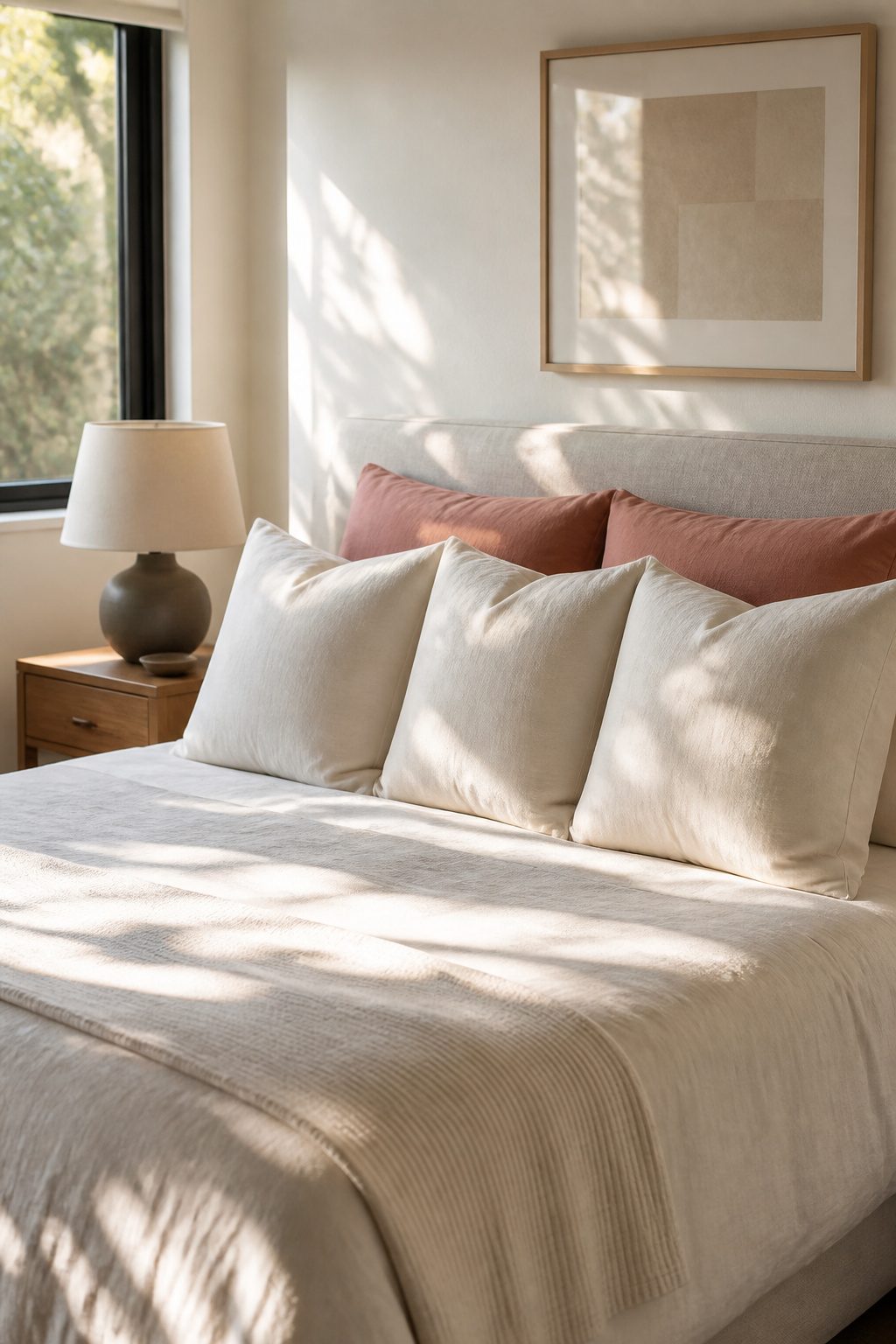
A bed that reads as neutral from the doorway still carries a quiet jolt of color when you walk closer. Two 20-inch Euro shams in a bold solid sit flat against the headboard, and three 18-inch Euro shams line up in front so only a two-inch band of that bolder color shows at the edges. The effect is a color block that disappears when you stand at the foot of the bed and reappears as you move toward the pillows.
I keep a set of deep teal Euros for exactly this. They have outlasted three duvet covers, two of them cream and one charcoal gray, because teal against white reads coastal and against gray reads moody without my changing anything else. The trick is keeping the front shams the same fabric as the duvet so the peekaboo color is the only statement. Patterned bedding fights the clean edge you are trying to create.
13. Sweet Simplicity
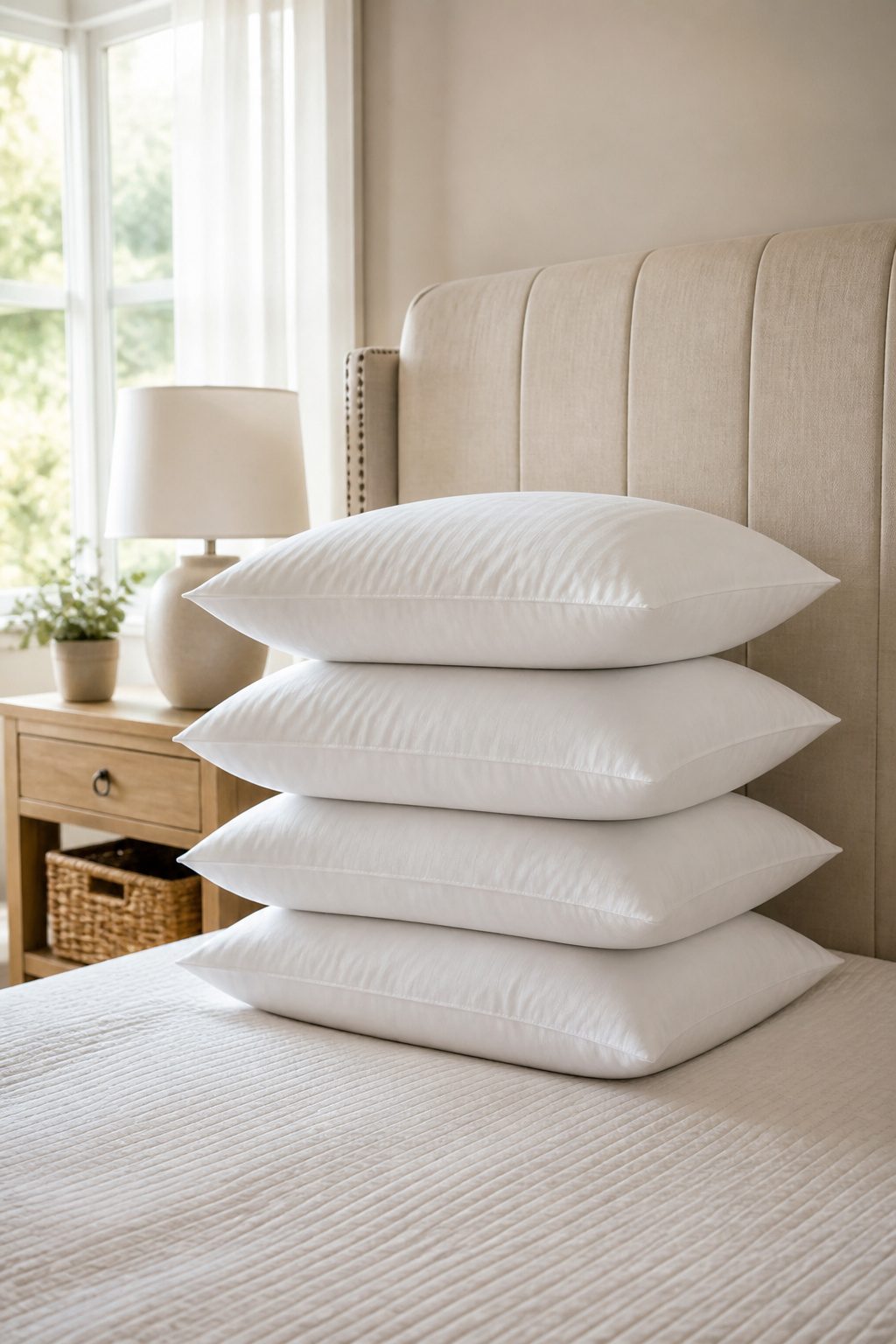
My brother keeps his bed like a barracks inspection: four standard sleeping pillows folded in half, stacked two high against the headboard, no shams, no extras. I used to think it looked unfinished until I tried it myself for a week between laundry days. The stack sits about 16 inches tall, enough to read against without the pillows sliding apart, and the folded edge gives a clean line that rumpled sleeping pillows usually lose by morning.
The restraint has its own dignity. Pillowcases matter more here because there is nothing else to look at, so a small pattern or a stripe does the work that three accent pillows would. On a queen bed, two stacks of two fill the width without crowding. It is the arrangement I put in the guest room now, since some people sleep with two pillows and this way the spares live where they are already needed. No storage hunt, no decorative pile to move at midnight. The look is done in thirty seconds and stays done until the next wash.
14. Solitary Standout
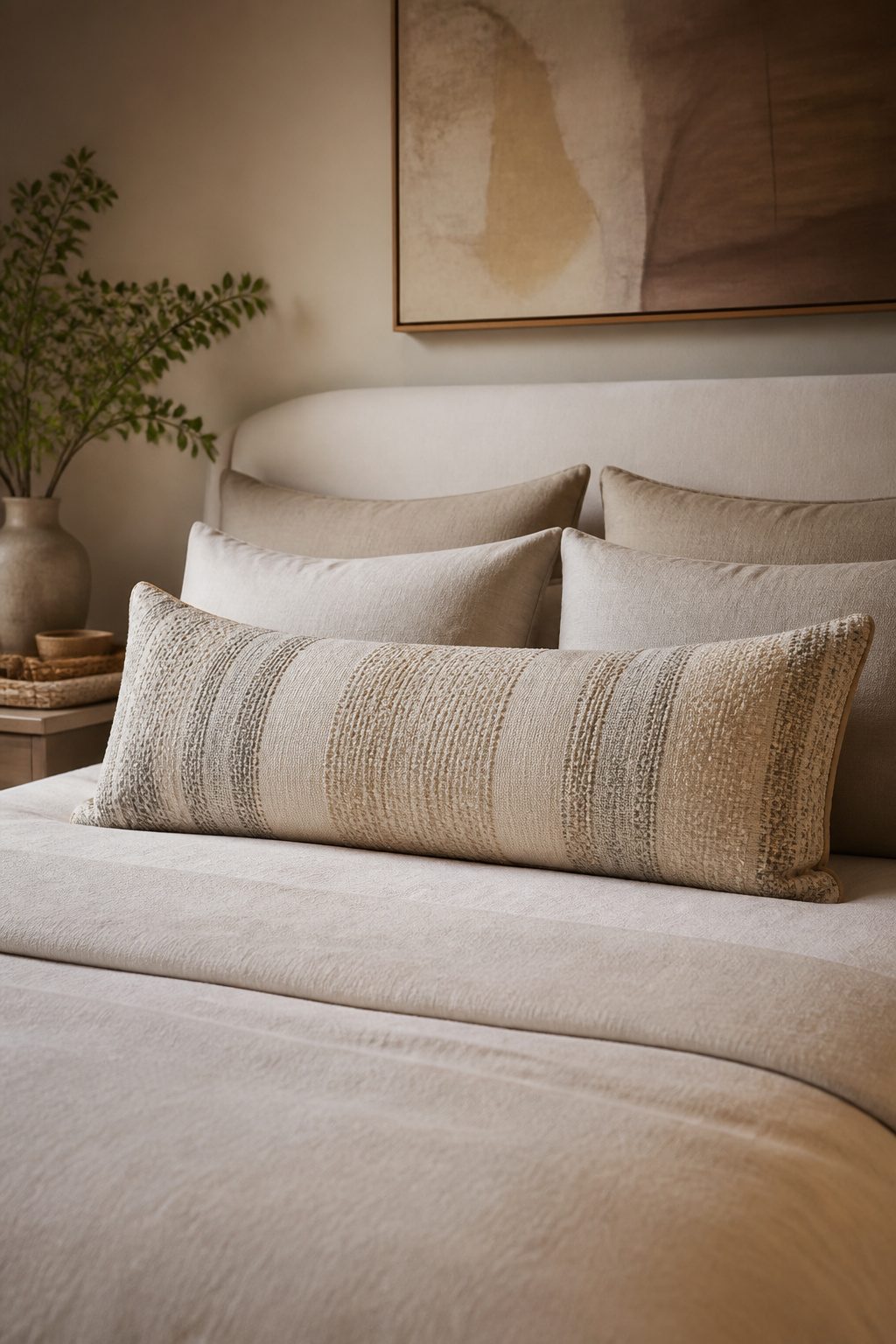
A single lumbar pillow can carry the whole bed if you size it right. Four standard sleeping pillows, stacked two against the headboard and two in front, disappear into the background and let the accent piece do the work. The measurement that hits without overhanging is 14 inches by 36 inches, roughly mattress width on a queen and clean-lined on a king.
White or neutral cases on the sleeping pillows keep the stack quiet. The lumbar brings the texture or pattern, and because it is the only decorative piece, you can go bolder than you would in a busier arrangement. I like textured shams on the back pair for subtle depth without competing.
Two ways to play the base stack. Standard pillowcases on all four keep it spare, or trade the front two for standard shams if you want a little more structure. Either way, the bolster sits centered, horizontal, and alone. This is the setup for anyone tired of tossing pillows to the floor each night: everything behind the lumbar is actually sleepable, and the one accent piece lifts off in a single move.
15. Layered Leather
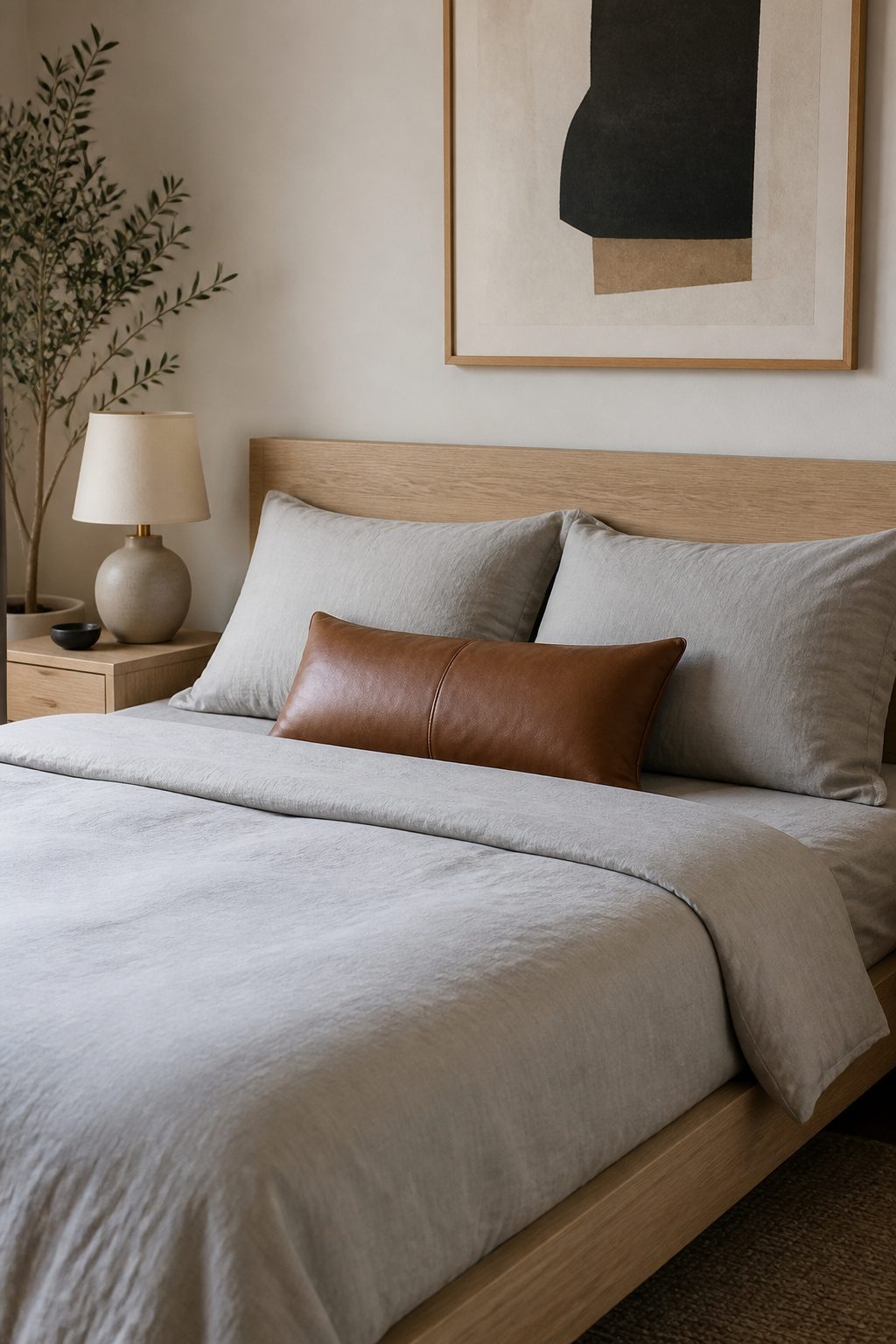
A leather lumbar pillow in front of two standard sleeping pillows reads modern instead of rustic because of the finish. Suede or distressed hide would steer toward cabin territory, but a smooth, matte hide with clean edges keeps the look current and works against crisp hotel-style bedding without fighting it.
Real leather outlasts faux for this specific spot because the surface takes abrasion from the weight of the pillow behind it and from being grabbed to fluff or move. Faux leather peels after roughly a year of that friction, leaving flecks on the sheets and a surface that looks cracked rather than aged. The real material costs more upfront but develops a soft patina where the oils from handling darken the high points, which reads as intentional wear rather than failure.
Two standard pillows lean against the headboard. The lumbar sits centered across them, low enough that you do not have to remove it to sleep. A 12-by-20 inch size fills the width of a queen without crowding; on a king, a 14-by-22 inch version keeps the same proportions.
16. Effortless Minimalism
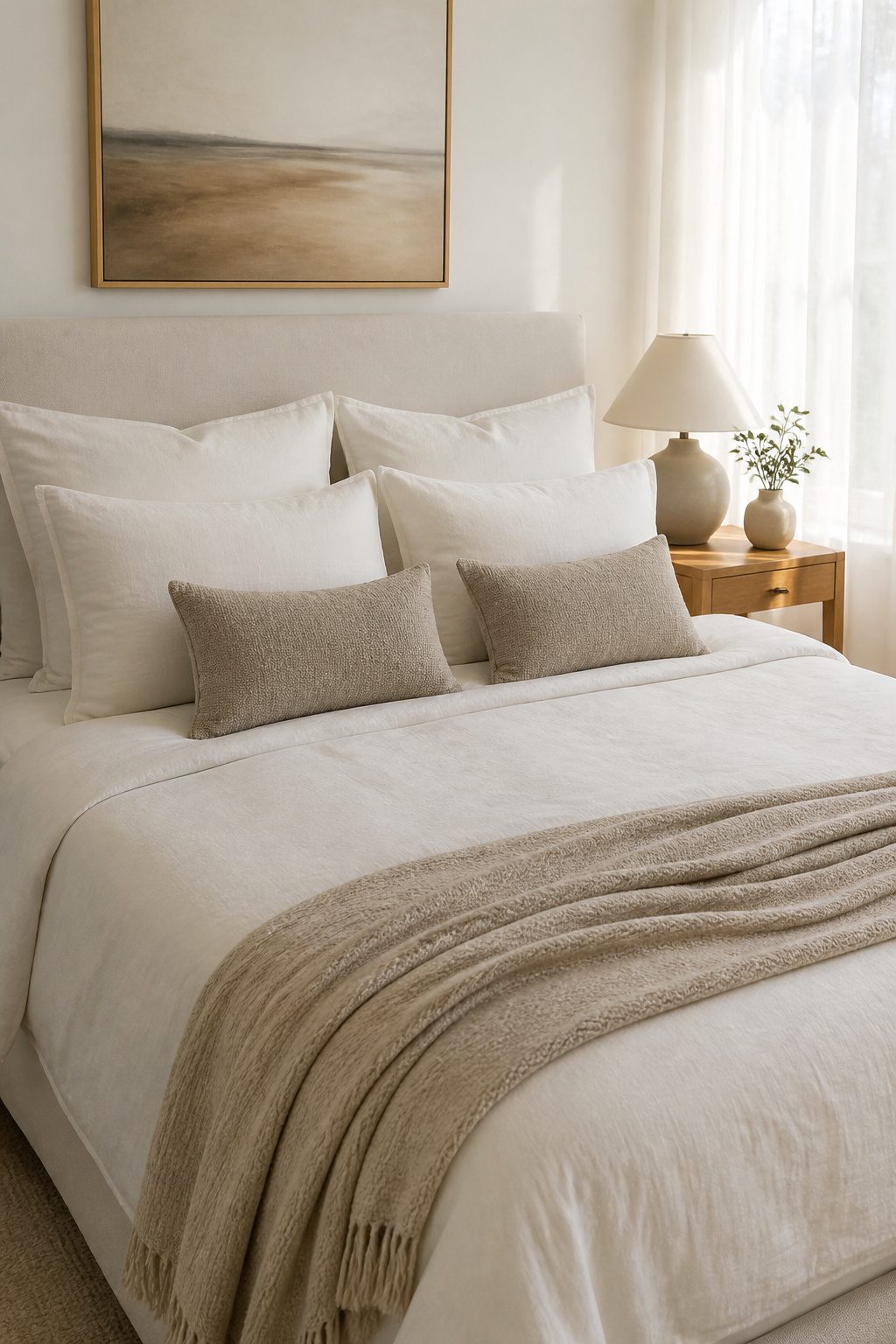
A full bed leaves almost no room for error once two people are in it, which is why the scaled-down version of Stacked and Propped works when the full-size original would spill onto the floor. Four standard sleeping pillows, stood upright against the headboard, give the height without the width of shams that eat into sleeping space. Two 12" x 20" lumbar pillows in front finish the look without crowding shoulders.
That 12" x 20" size is the detail that makes this possible on a full. A standard 16" x 16" throw or anything larger starts to read as a third row, and on a 54-inch mattress you run out of real estate fast. The smaller lumbar keeps the layering but sits low enough that it does not fight you when you actually lie down.
Skip the shams entirely here. Linen pillowcases with some texture do the quiet work that shams pretend to do, and you lose one more thing to store. The result reads as Wabi-Sabi without trying for it, which usually means you stopped one layer sooner than you thought you should.
17. Relaxed Refinement
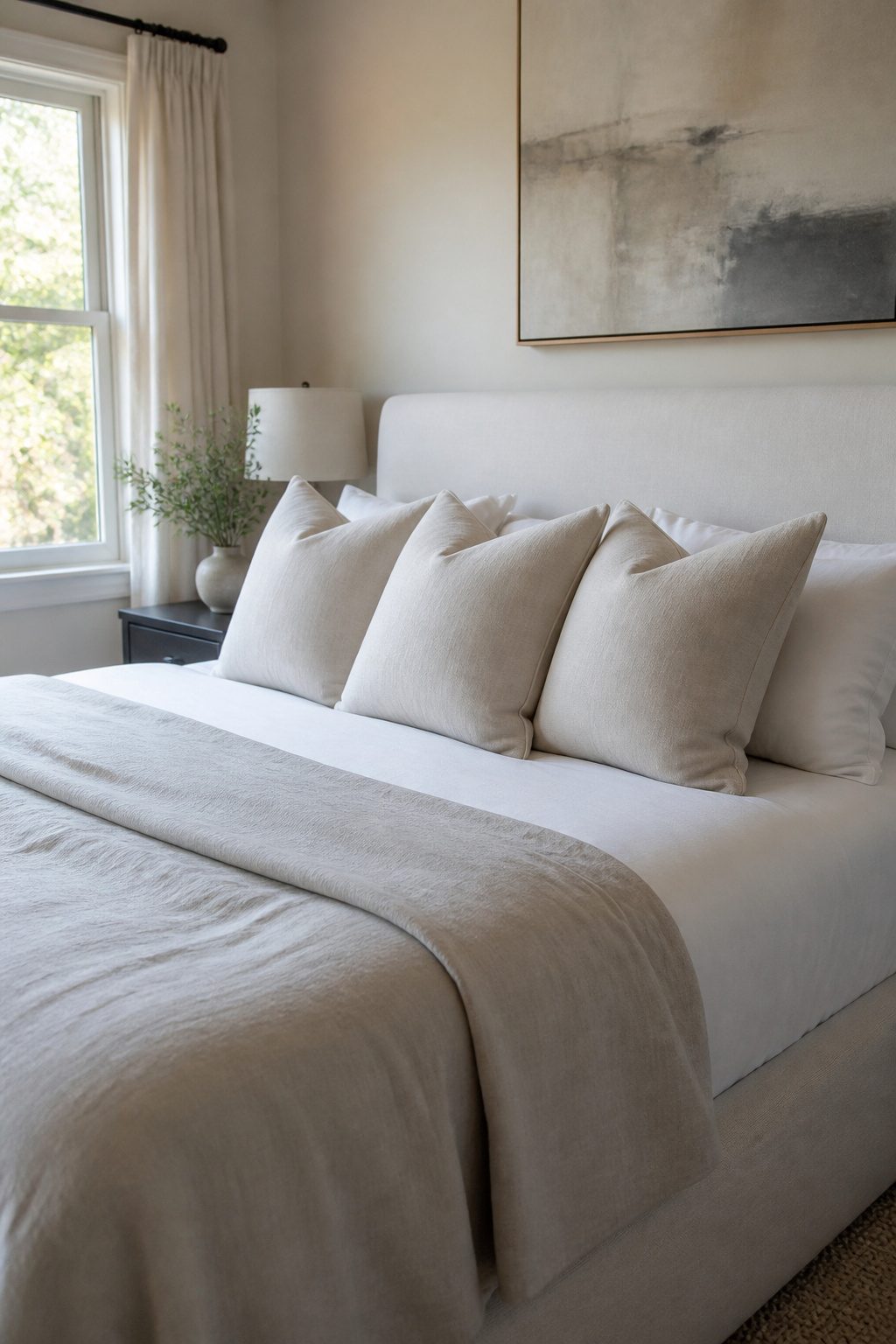
A double or triple Euro sham group reads as intentional the moment the edges kiss instead of aligning perfectly. Three European squares across the back of a king bed, or two on a queen, fill the width without looking measured out with a ruler. The shams lean rather than stand at attention, which means the fabric does the work and the arrangement forgives a morning shake-out.
I learned the difference between relaxed and messy on my own bed, though the lesson came from watching hotel setups fall apart in photographs. When the Euro shams sit flush and parallel, the whole stack looks rigid; let them overlap by an inch or two, or tilt one five degrees off vertical, and the same pillows read as lived-in. The key is keeping the lean consistent across the group. One sham collapsing sideways while its neighbor stands straight is the mess, not the tilt itself.
Texture helps this formula more than pattern. Tassels or subtle fringe on the Euro shams catch light at different angles when the pillows lean, so the surface moves without needing more color. I keep the sleeping pillows behind them in standard shams that match the sheet set, which puts the visual weight up front where the Euros are.
18. All Propped Up
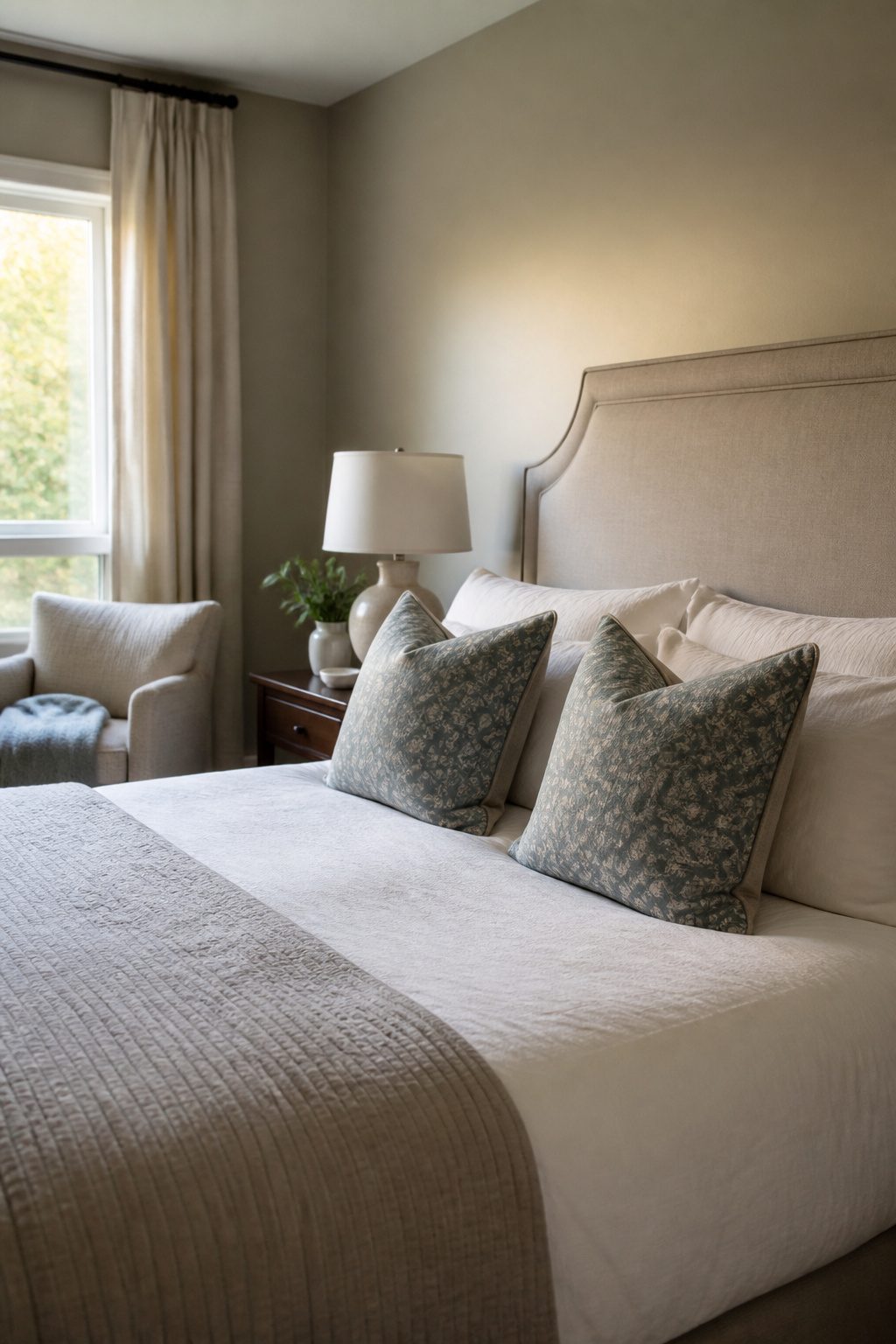
Two standard sleeping pillows leaned against the headboard, then two 18" x 18" accent pillows pulled forward in front. That square size sits low enough that it does not block whatever fabric or finish is happening behind it, and the gap between pillow rows keeps the whole thing from looking like a solid wall of stuffing.
This is the setup I actually sleep with. The small squares give just enough lift for reading without the neck-craning height of a full stack, and at the end of the night they get tossed to a chair without ceremony. For a photograph I would probably add a third layer, maybe lean a lumbar piece off-center for that studied asymmetry the camera likes. Off-camera, the two-row version wins because it still looks intentional when half the pillows are missing and the bed is unmade. A contrasting color or pattern on those front squares does the heavy lifting; the eye reads it as styled even when nothing else in the room cooperates.
19. Pattern Play
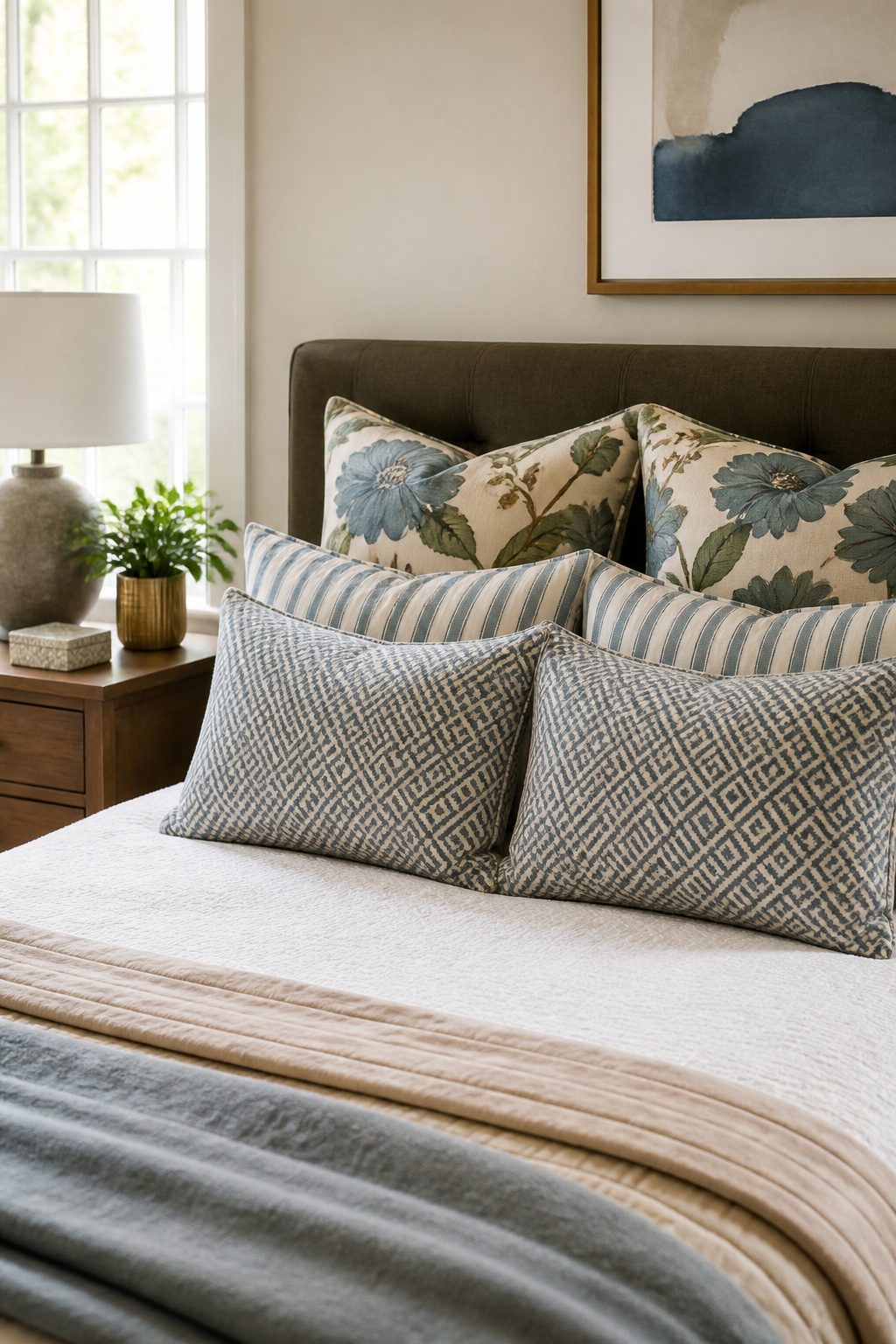
Pattern mixing on pillows works best when the scale climbs from small to large as you move back. Start with a tight geometric on your standard pillows, add a medium stripe to the first set of Euro shams, and finish with a big, loose floral on the second pair. The eye reads it like stepping back into a landscape: detail up close, atmosphere in the distance.
I tried reversing this once, putting the bold floral forward and the tiny pattern in back. The bed looked flat and busy at the same time. The large print swallowed the others, and there was nowhere for the eye to rest. Small patterns recede; large ones advance. Getting that backwards collapses the depth you’re trying to build.
The stripe in the middle acts as a bridge. It has enough structure to relate to the geometric and enough openness to talk to the floral. Without it, the jump from tight pattern to loose one feels like two beds arguing.
20. Perfectly Imperfect
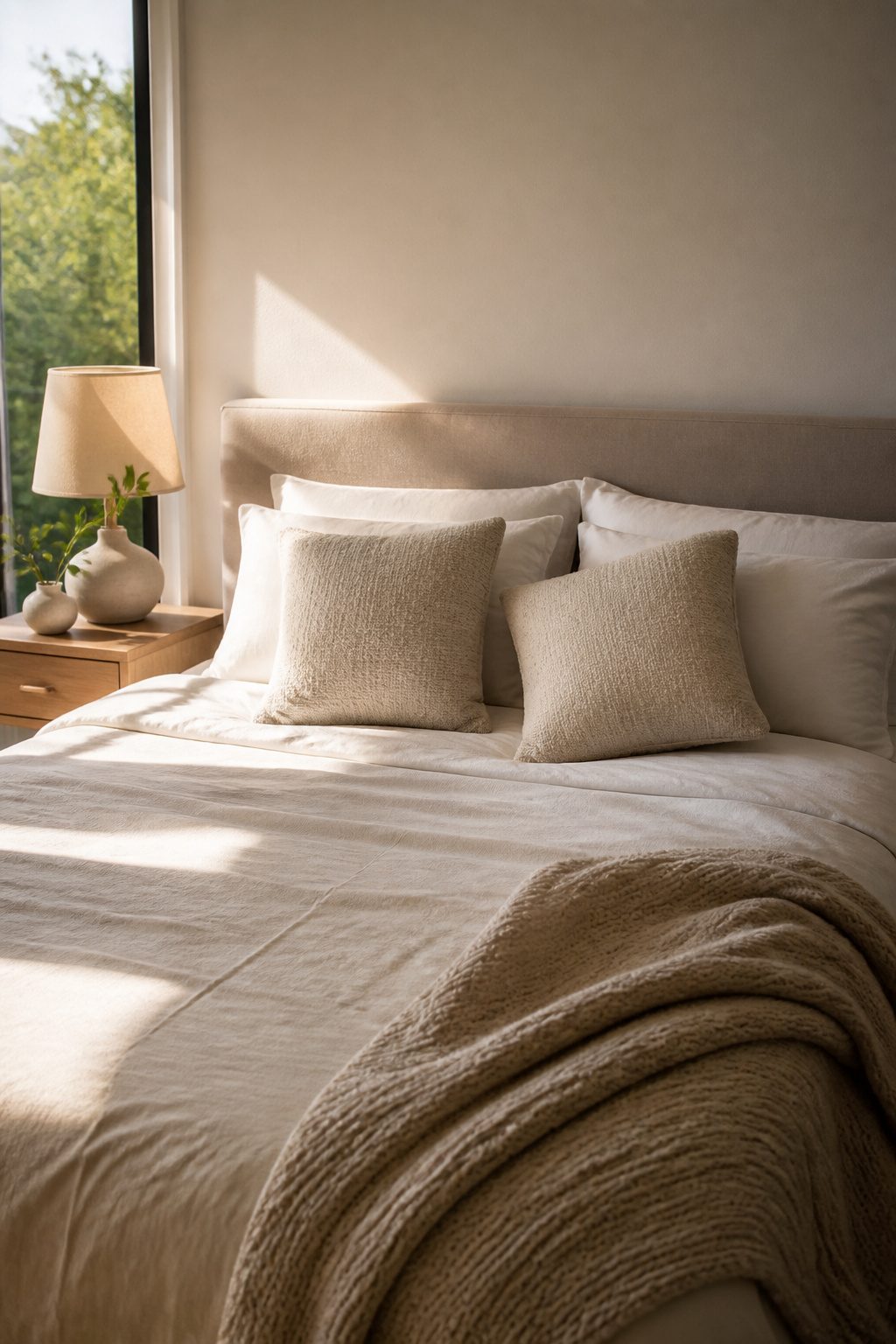
The perfectly imperfect look lives in a single, almost invisible detail. Two standard pillows stay flat against the headboard, nothing fancy there. The two matching throw pillows in front are where the work happens: one sits square to the edge, the other tilted just about five degrees off true.
That five degrees took me six tries the first time I attempted it. Straight-on looked staged. Ten degrees looked like a mistake. The sweet spot reads as someone flopped it down without thinking, which is exactly the point. Your eye keeps moving instead of locking into a grid.
I use this on a bed with solid linens and no other pattern, since the asymmetry itself becomes the visual interest. A busy duvet fights it. The pillows should share fabric and size so the mismatch reads as casual, not accidental in a sloppy way. Two 20-inch squares in a linen blend, one vertical, one leaning left, and the bed looks finished in under a minute.
Frequently Asked Questions
How many pillows should you have on a bed?
A king bed holds four to six pillows before it starts looking fussy, while a queen or smaller bed tops out around three to five. The difference is real estate: a 76-inch king mattress swallows standard sleeping pillows whole, so you either go large with king-size shams and Euro squares or pad the width with numbers. For daily use, many people settle on four sleeping pillows plus one accent piece.
What size throw pillows look best on a bed?
Twenty- and 22-inch square pillows are the workhorse size for most beds, with a long lumbar, typically 14 inches by 36 inches, to anchor the front edge. On a king or California king, 24- or 26-inch squares hold the scale better and save you from buying extras to fill the gap. The lumbar’s length matters more than its height; it keeps smaller pillows from looking scattered.
Should the throw pillows match the bedding?
Throw pillows that match your bedding exactly read like a department store display, not a room someone lives in. Stay inside one color family while shifting the finish or texture so the arrangement feels gathered over time rather than bought in a single afternoon. Contrast in texture matters more than contrast in color: a nubby bouclé against smooth cotton does the heavy lifting even when both sit in the same neutral.
How do you arrange pillows on a king bed?
Start with two king sleeping pillows flat against the headboard, then two or three Euro shams propped in front, followed by two square accent pillows and a long lumbar to finish. Three Euro shams across the back fills the width without leaving awkward gaps at the edges; two leaves roughly ten inches of bare headboard on either side. Size up inserts by one inch so the corners stay full rather than floppy.
Do you have to take all those pillows off at night?
Only the decorative pillows need to be removed; sleeping pillows stay on the bed. The practical arrangement, four bed pillows plus two or three decorative pieces, stays put through flu season and laundry weeks because everything behind the front accent layer is actually sleepable. Some setups, like the solitary standout with a single lumbar, lift off in one move.