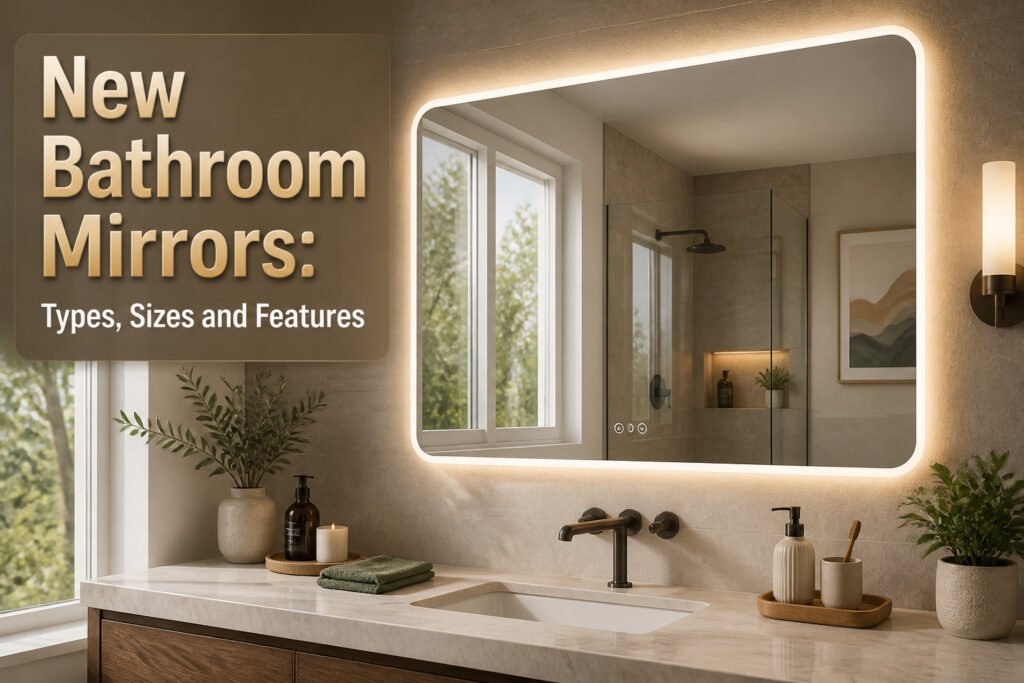
New bathroom mirrors in 2026 range from basic vanity glass to LED-integrated, sculptural, and smart surfaces, but the right choice depends on what your bathroom already gives you. A window opposite the sink delivers the even, shadowless light that front-lit mirrors try to recreate, making an unlighted mirror and simple sconces the smarter spend. Where lighted mirrors earn their keep is the interior powder room or basement bath, places with no natural light and ceiling cans that leave hollows under your eyes. Look for 2700K to 3000K for warmth, 4000K to 5000K for neutral clarity, and a CRI of 90 or above if accurate skin tone matters.
Vanity Mirrors

The vanity mirror is the starting point most people shop from, and for good reason. It sits directly above the sink and handles the daily work of shaving, skincare, and checking whether you actually got the toothpaste off your chin. For a single vanity, a single mirror centered above the basin keeps the wall clean and balanced. Double vanities give you two ways to play it: one mirror per sink for symmetry and separate zones, or one oversized mirror spanning the full width to unify the wall and make the room feel larger. The oversized route works especially well when the bathroom itself is tight, since an uninterrupted reflection bounces more light around and reads as extra square footage. Either way, this is the mirror you’ll spend the most time actually using, so the size and placement here sets the tone for everything else you hang.
Lighted Mirrors

LED-integrated mirrors come in three configurations, and the differences matter more than the marketing suggests. Backlit models mount the diodes behind the glass, throwing a soft halo against the wall that reads as ambient light rather than working light. Edge-lit versions embed the source into the perimeter of the glass itself for a cleaner, more even glow. Front-lit mirrors put the light on or near the mirror face, and that direct placement makes them the only choice if you actually need to see what you’re doing for shaving or makeup.
Two specifications separate the usable ones from the decorative ones. Color temperature between 3000K and 4000K hits the range where skin tones look like skin tones, not jaundiced or cadaverous. CRI, the Color Rendering Index, tells you how accurately the light reveals color at all; 90 or above is where you want to be for a bathroom, anything lower and you’ll walk out thinking your blush matches when it doesn’t.
The front-lit option wins for function, backlit for atmosphere, and edge-lit for the compromise. My own leaning, reading through enough of these specs to blur together, is that renters should skip the backlit halo unless the wiring is already there. It looks beautiful in photographs and leaves you squinting at your own reflection.
Medicine Cabinets

Medicine cabinets solve two problems at once when wall space is tight and your sink has no drawer beneath it. The mirror hides storage behind it, so your countertop stays clear without sacrificing a second wall for a shelf or cabinet.
Lighted medicine cabinets go further by building LED strips into the door itself. You get task lighting for shaving or makeup without mounting a separate fixture above the mirror, and the wiring runs to the same junction box the old mirror used. Recessed models sit flush with the wall, which reads cleaner in a small bath because the face doesn’t project into the room. Surface-mounted versions are easier to install and give you a little more interior depth, though the box sits proud of the drywall.
I would only recess if the wall cavity is open anyway, or if the cabinet width matches the space between two studs. Cutting into finished tile and finding a vent stack behind it turns a Saturday project into a three-weekend ordeal.
Magnifying Mirrors

Close-up task mirrors are the piece most full setups skip, then miss the morning after. A wall-mounted magnifying mirror on an articulating arm tucks flat when you do not need it and pulls within six inches of your face when you do. That reach matters more than the magnification itself, which should land between 5x and 10x for daily grooming. Any stronger and your eyelash becomes a blur of individual cells; any weaker and the tweezers still guess.
Freestanding models let you move the magnification where the outlet is, or where the light falls that hour. The trade is counter space and a cord to manage.
Neither replaces the main mirror. The main mirror shows your whole face in context; the magnifier shows whether the eyeliner wings match. One imagines a bathroom with only a 10x circle above the sink, backing up to check an outfit and seeing nothing but pore. The two together handle the full range of distance, which is why the task mirror mounts beside or extends over the vanity rather than centering it.
Full-Length Mirrors
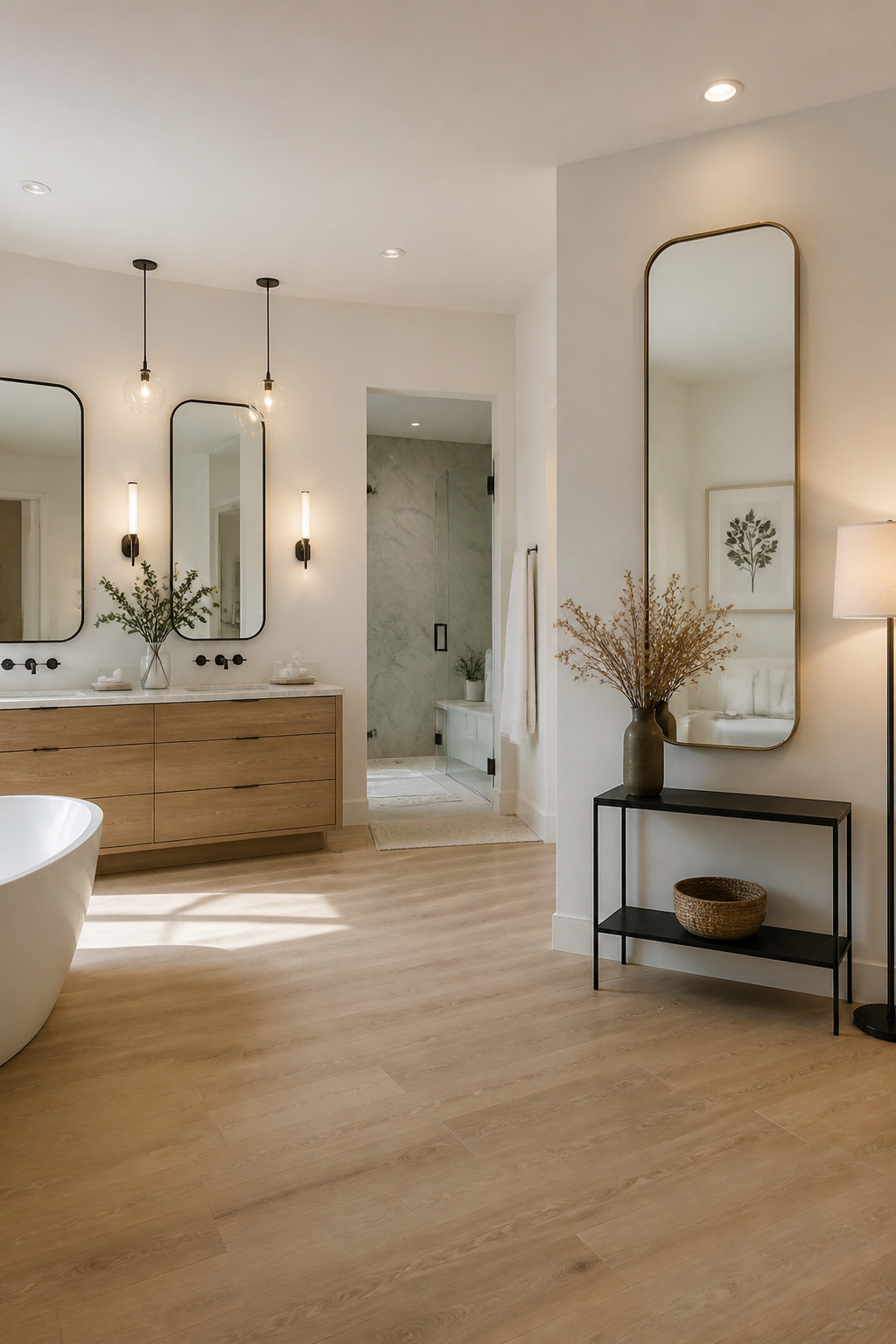
A full-length mirror in a bathroom only works when the wall space is already there. In a spacious primary bath, especially one next to a walk-in closet or dressing area, mounting one on a secondary wall away from the vanity gives you a head-to-toe reflection the vanity mirror never could. That placement also keeps the two functions separate: one station for grooming close-up, another for checking an outfit before you leave.
The mirror’s real contribution is the sense of openness it adds to the room. A wall that would otherwise hold a towel bar or nothing becomes a surface that visually doubles the space. The tradeoff is floor area; you need roughly 18 inches of clear depth in front of it to step back and see your whole frame, which rules out tight water-closet corners or shower-adjacent walls where the door swing already fights for room.
Mount it at a height where your eyes sit one-third down from the top edge, not dead center, and the proportions read right without you having to crane. In my own search for new bathroom mirrors, the full-length option kept feeling like a luxury until I measured the blank wall beside my linen closet and realized it was already the right size; I just had not been using it for anything.
Round Mirrors

A round mirror on a bathroom wall does something no rectangle can. The curve breaks up all those straight lines: tile edges, vanity corners, the door frame you stare at while brushing your teeth. In a small bathroom, that softness matters even more. A rectangular mirror can feel like another flat plane closing in on you, but a circle reads as open space, a window that happens to reflect back.
The single-sink vanity is where this shape earns its keep. Above one basin, a round mirror becomes the natural focal point without fighting the faucet or the sconces for attention. It centers the whole wall.
Size is the part that trips people up. Too small and the circle looks like a porthole you stuck on by mistake; too large and the softness tips into something that dominates the room. The sweet spot for most standard vanities sits between 24 and 36 inches in diameter, with the mirror width roughly matching the sink below it or running slightly narrower. Mount it so the center hits about eye level for whoever uses it most, typically 57 to 65 inches from the floor.
Frameless keeps the look light in tight quarters. A thin metal rim in black or brass adds definition without the visual weight of a thick wooden border. Either way, the round shape does the real work.
Oval Mirrors

An oval mirror gives you more glass to work with than a round one without the hard corners of a rectangle. The elongated shape catches your face and shoulders together, and the curved edges keep the room from feeling boxy.
The softened lines read best in transitional and traditional bathrooms, where you want something between the strict geometry of a rectangle and the full roundness of a circle. In my own searching, that middle ground is what makes an oval feel settled rather than trendy; it bridges those two looks without committing fully to either.
Mount one vertically over a standard vanity and the proportions usually fall into place. Turn it horizontal above a double sink and the stretch of glass ties the two basins together. Either way, the shape does the work of a larger mirror while keeping the visual weight lighter than a rectangle of the same width.
Arch Mirrors
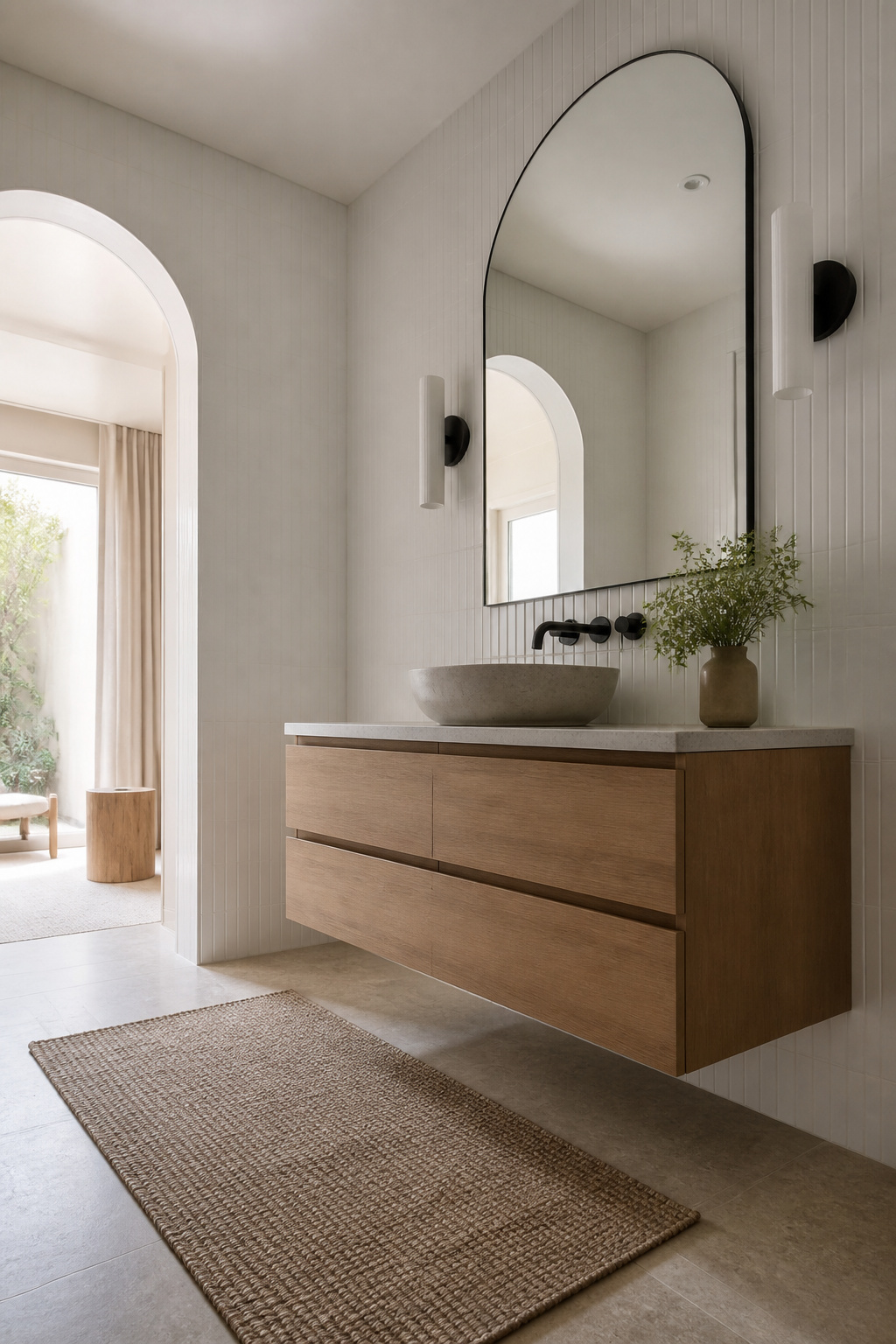
The curved top of an arch mirror draws the eye the same way a doorway or tall window does, which makes it a natural fit above a vanity where the flat base sits level with the countertop. That architectural reference works best when the surrounding space is fairly simple; in a bathroom already heavy with decorative tile or ornate fixtures, the silhouette starts to compete rather than complement. I have seen the shape look forced in rooms with low ceilings, where the vertical emphasis of the arch fights the compressed proportions and the mirror ends up reading like a stage prop. The flat base also matters practically: it gives you a stable visual anchor at counter height, unlike a fully rounded top that can feel unmoored. For a weekend project on a few hundred dollars, this is one of the easier statement pieces to swap in, since most arch mirrors hang on standard hardware and need no special framing. The design statement comes from the shape alone, so additional ornamentation usually tips it from character into clutter.
Abstract Mirrors
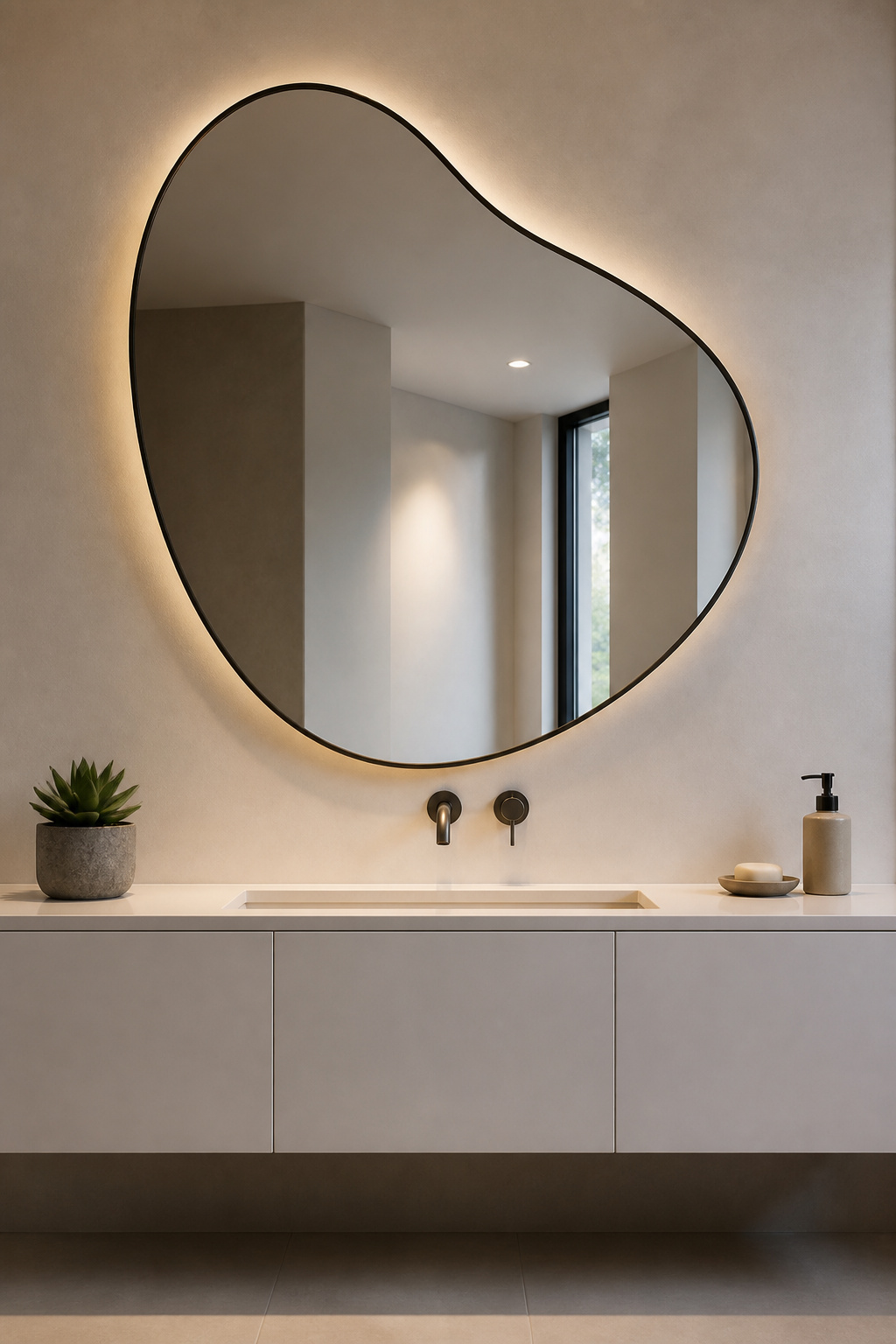
Abstract mirrors with organic, asymmetric, or sculptural forms read as artwork before they read as mirrors. The shape itself becomes the design gesture, which only works when the rest of the room steps back to let it. A busy vanity, patterned tile, or competing statement fixtures turn the effect from intentional to cluttered fast.
The winning setup pairs these mirrors with minimal vanities and restrained material palettes. Think flat-panel cabinetry, a single quiet stone or solid surface, and hardware that nearly disappears. The mirror then holds the spotlight without shouting for it.
Where this goes wrong is scale and placement. A sculptural form that crowds the vanity or forces awkward light placement fights the space instead of defining it. Leave breathing room above and beside the piece, or the asymmetry starts to feel like a mistake rather than a choice.
For renters, these mirrors can travel, but the wall prep usually cannot. The weight and mounting hardware for heavier sculptural pieces often require blocking or specialized anchors that landlords notice. A lighter, framed abstract shape mounted on a French cleat offers some of that gallery energy without the permanent commitment.
Sizing a Bathroom Mirror

A mirror hung too wide or too narrow throws off the whole wall. The rule I keep in mind is spanning 60 to 80 percent of the vanity width, or keeping the mirror about 2 to 4 inches narrower on each side than the cabinet below. For a 36-inch vanity, that lands you at 22 to 28 inches wide. I like the lower end of that range in a tight guest bath, where every inch of wall matters for sconce clearance, and the upper end in a main bathroom where two people share the sink and both want to see their reflection straight on.
Height matters just as much as width. The center of the mirror should sit 57 to 65 inches from the floor, which puts the reflective surface at comfortable eye level for most adults. In my own last rental, the previous owner had mounted the mirror at 72 inches on center, probably because he was six-foot-four. I lived with it for two years and never once saw my full face without standing on my toes.
Frame Materials and Finishes

Brass frames have swung back hard from their 1980s reputation, and the difference now is the finish. Unlacquered brass darkens unevenly where fingers touch it, which reads as patina to some people and grime to others. Lacquered brass holds steady but chips at corners where the towel bar catches. Either way, brass warms a white bathroom fast; against cream tile it can go muddy, so pair brass with cool whites or true grays, not beige.
Matte black absorbs light instead of throwing it back, so the frame itself drops back and the mirror shape reads louder. That makes it forgiving across styles: modern in a spare bath, grounding where cabinets run traditional. The catch is dust and water spots show flat against the surface, so black demands more wiping than it looks like it should.
Chrome still dominates rental hardware, and matching it keeps a bath from feeling pieced together. Chrome reads cold, though, and in a north-facing room it can feel clinical without wood or a warm wall color to balance it.
Wood frames bring in the only material that softens the space acoustically and visually, but steam swells cheap MDF in a year or two. Solid wood needs sealing, and even then dark stains show soap splatter the way black frames show dust.
Frameless is the renter’s friend when existing hardware is mixed chrome and nickel and you cannot replace it all. The beveled edge catches light and adds structure without introducing a third metal. What frameless does not do is hide wall flaws; every bump in drywall shows at the mirror’s perimeter, so the surface behind it needs to be flat.
Lighted or Unlighted

Backlit mirrors cast a soft halo against the wall, edge-lit ones run a cleaner glow around the perimeter, and front-lit designs put the light right on the glass for the sharpest task lighting when shaving or applying makeup. The real question is whether your bathroom needs any of this built in, or if the money is better spent elsewhere.
A bathroom with a window opposite the vanity already has what front-lit mirrors try to recreate: even, shadowless light on your face. In that setup, an unlighted mirror and a pair of simple sconces will do the grooming work for less, and the natural light carries the room through the day. The mirror becomes a surface, not a fixture.
Where I see lighted mirrors earn their keep is the interior powder room or the basement bath, places where no window exists and where ceiling cans leave hollows under your eyes. Even then, the specification matters more than the feature itself. Look for 2700K to 3000K if you want warmth, 4000K to 5000K for neutral clarity, and a CRI of 90 or above if accurate skin tone matters to you. Anything below that, and the light is decoration, not function.
Placement relative to your existing fixtures finishes the decision. A backlit mirror hung where a wall sconce already lives creates two competing ambient sources and washes everything flat. Front-lit models play nicer with overhead lighting because they handle the face directly while cans or pendants manage the room. If your wiring is already set for sconces beside the mirror, switching to a lighted unit usually means a centered junction box and a patch job, which pushes the project past a weekend.
Frequently Asked Questions
What size mirror should I use for a 36-inch vanity?
A mirror between 22 and 28 inches wide sits proportionally above a 36-inch vanity. That leaves enough wall visible on each side for sconce clearance and keeps the glass anchored to the cabinet below rather than floating past it. If you are adding side lights, size the mirror so the fixtures hit roughly at the midpoint height for even illumination across your face.
What is the best color temperature for a bathroom mirror?
For most bathrooms, a color temperature between 3000K and 4000K gives skin tones a natural look without going too warm or too clinical. Lower temperatures around 2700K to 3000K read cozy and spa-like, while 4000K to 5000K delivers neutral clarity. Pair that with a CRI of 90 or above so colors actually match what you will see outside.
Lighted vs. unlighted mirrors: which is better?
Neither is automatically better; it depends on what your bathroom already gives you. A vanity with a window opposite it already has even, shadowless light, so an unlighted mirror and simple sconces handle grooming for less money. Lighted mirrors earn their place in windowless powder rooms or basement baths where ceiling cans leave hollows under your eyes, but only when the color temperature and CRI are specified right.